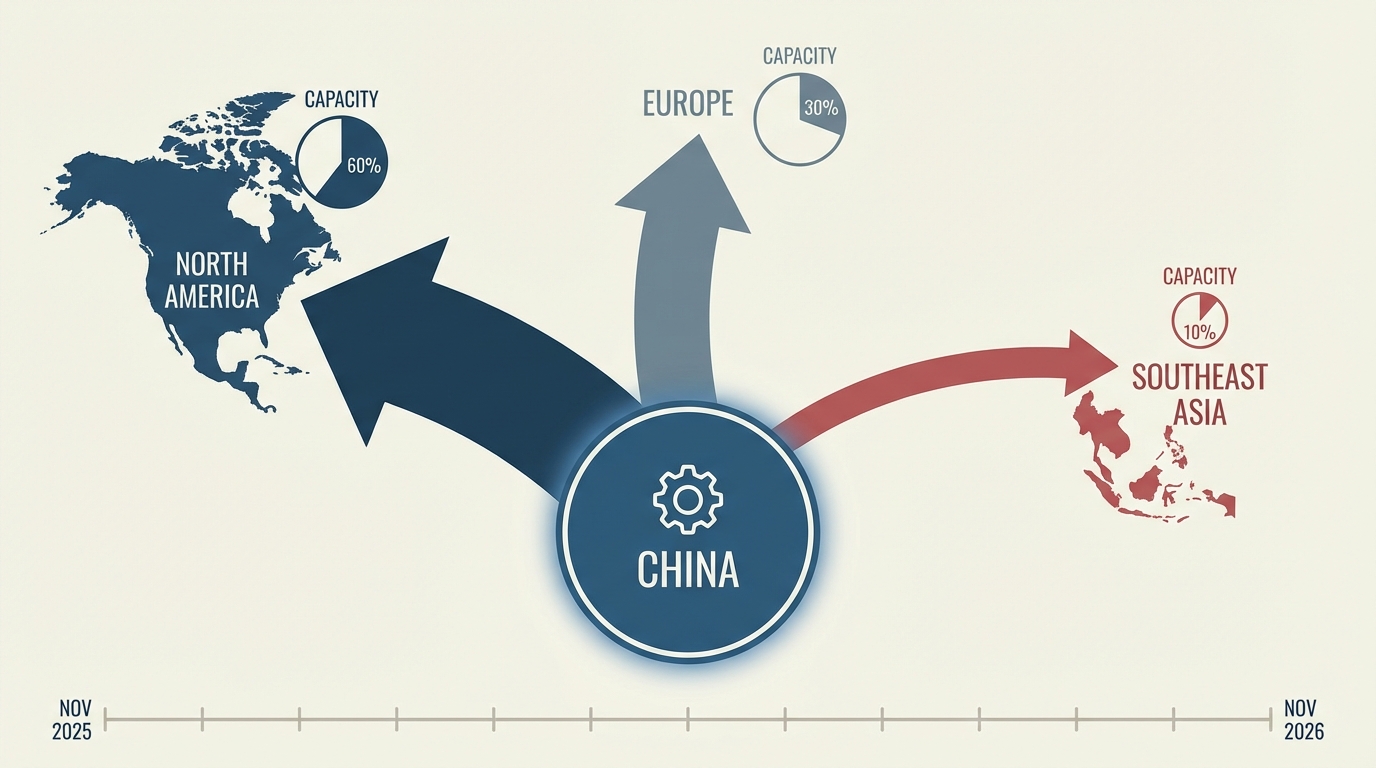
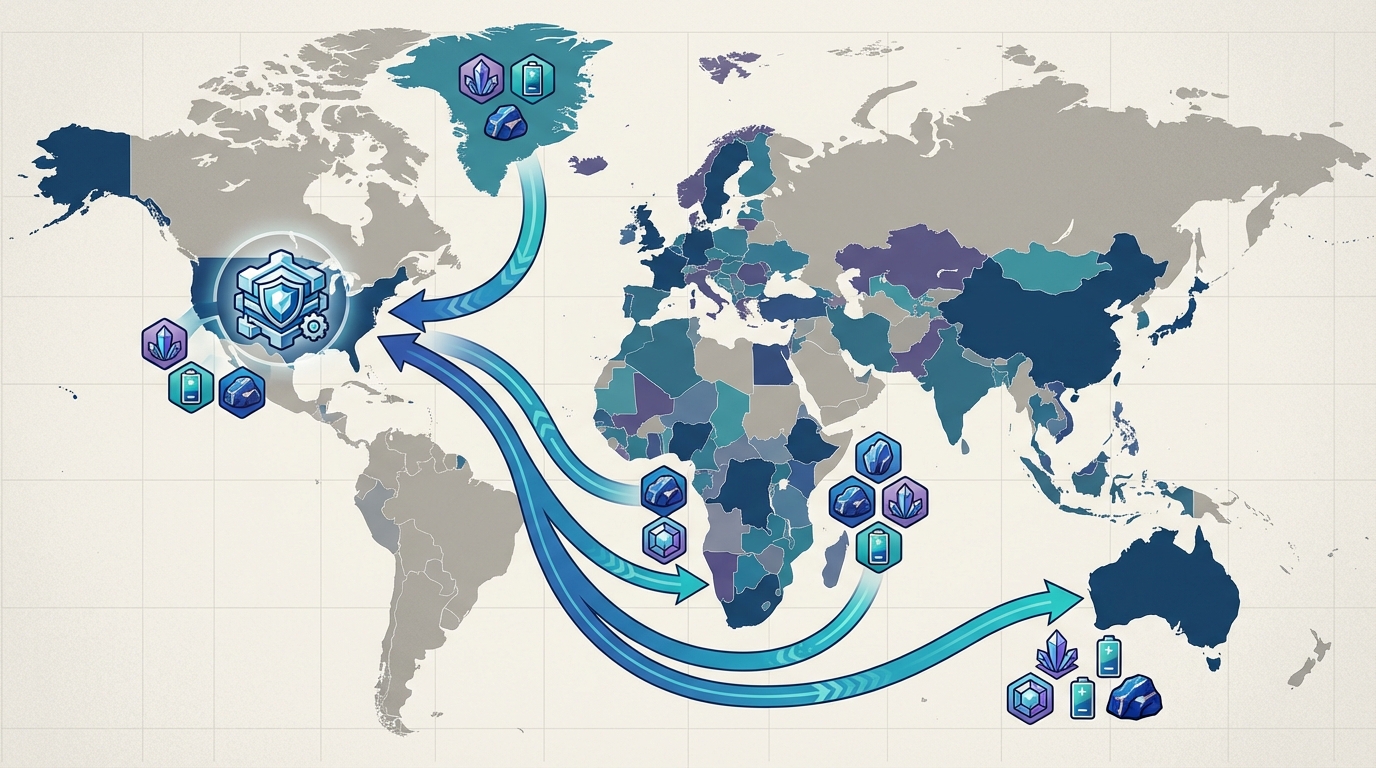
China accounts for ~98% of global low-purity gallium, creating a structural supply choke point.
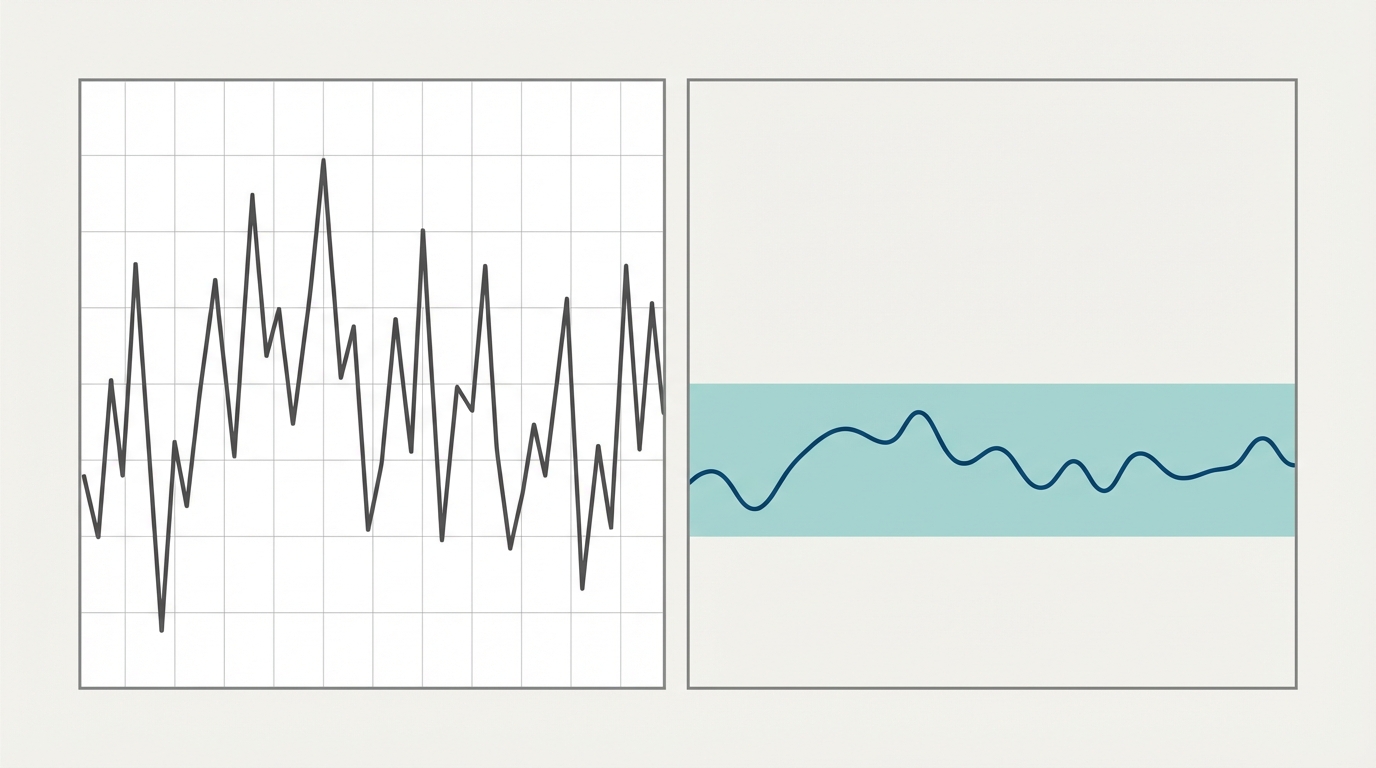
Export licensing (from Aug 2023) and a U.S.-targeted ban (announced Dec 3, 2024; suspended Nov 2025–Nov 2026) drove spot prices from about $240/kg to roughly $575/kg.
Ongoing licensing discipline and technology controls are likely to keep supply risk elevated through at least 2027.
Producers and downstream operators should map exposure, lock multi-year offtakes from non-Chinese sources, and build strategic stockpiles where feasible.
The Gallium Shock: Market Dynamics and Strategic Imperatives
Executive Summary
Materials Dispatch assesses how China’s near-monopoly on gallium—a byproduct metal vital for gallium-arsenide (GaAs) and gallium-nitride (GaN) semiconductors—has been leveraged through export licensing and a targeted restriction on U.S. shipments. Licensing controls since August 2023 and a Dec. 3, 2024 ban (suspended Nov. 2025–Nov. 2026) helped push spot prices from about $240/kg in mid-2023 to roughly $575/kg by December 2024. Crucially, the measures did not only constrain trade flows; they also tightened access to extraction technologies (notably ion-exchange/resin pathways). That combination supports structurally high supply risk through at least 2027, forcing semiconductor, defense, and power-electronics supply chains to move from scenario discussion to operational resilience planning.
Market Context and Supply Concentration
Gallium is recovered as a minor stream from aluminum and zinc refining, yet it underpins key technologies: RF front-ends, power electronics, radar, optical sensors, and high-efficiency LEDs. China controls approximately 98% of global low-purity output, creating a single-point failure dynamic for anything that depends on refined gallium supply. The strategic implication is straightforward: even when end-market demand is stable, licensing and technology controls can abruptly alter availability of material that downstream firms cannot easily substitute in the short run.
Before restrictions, U.S. exposure was especially sensitive because the supply chain was narrowly sourced and inventory depth was thin relative to the scale of semiconductor and defense demand. In practice, that means “spot” availability is not only a function of production capacity—it reflects whether qualified sellers can ship and whether customs clearance and end-use declarations remain acceptable under the licensing regime.
Policy Timeline and Price Impact
Licensing Shock (Aug 2023): Exports of gallium and germanium required MOFCOM licenses and end-use declarations (export licensing is a permit system where authorities review the exporter, end-user, and intended use). Chinese customs data indicated near-zero wrought gallium exports during the first months after controls tightened. Exports then reappeared at much lower volumes in October 2023—reflecting the compliance friction and discretionary nature of licensing. Spot markets responded quickly: prices moved higher by the October 2023 period, setting the tone for a prolonged repricing rather than a brief spike.
Global semiconductor supply chains rely heavily on Chinese gallium exports.
U.S. Ban & Technology Controls (Dec 3, 2024): MOFCOM escalated measures with a country-specific export ban on gallium, germanium, antimony, and superhard materials to the United States. At the same time, the export control catalogue was expanded to restrict gallium extraction technologies—specifically “technologies and processes to extract metallic gallium from alumina mother liquor using ion-exchange or resin methods.” That matters commercially because it targets the recovery pathway that supports conversion from feedstock streams into metal. Prices peaked at about $575/kg in December 2024 as buyers priced in both reduced trade access and reduced medium-term recovery optionality.
Partial Suspension (Nov 2025–Nov 2026): A temporary lift of the U.S. ban reduced political signalling risk but did not remove the underlying licensing and technology controls. As a result, downstream buyers should not interpret the suspension as a full return to “pre-shock” market normalcy; it primarily changes the risk of outright shipment prohibition to the U.S., while compliance requirements and technology restrictions continue to constrain the broader supply system.
Economic and Strategic Impacts
Gallium’s supply leverage becomes visible in how quickly disruptions propagate into manufacturing lead times. A gallium shortage is not like a commodity inventory issue that can be resolved through routine brokerage; it can interrupt component qualification cycles for GaAs/GaN RF and power devices, slow radar and sensor procurement timelines, and complicate substitution decisions across device architectures.
Regulatory attention also follows the supply logic. In Europe, gallium’s status as a strategic resource has been used to reinforce the policy focus on critical raw materials—an approach designed to support diversification, transparency, and stockholding where supply risk is concentrated. Taken together, these developments underline a market reality: the “real” constraint is not only mining or refining volumes, but the ability to legally and technically recover gallium into usable forms.
Gallium and gallium-based semiconductors are critical for power electronics and advanced communications.
Supply-Side Response
Global high-purity production and recycling are meaningful balancing factors, but the shock exposed how asymmetric the geography of upstream capability remains. Non-Chinese recovery projects have been announced across multiple jurisdictions, yet most are still at feasibility, engineering, or early implementation stages relative to the immediacy of downstream demand. That lag is economically important: even credible projects do not neutralize risk for lead times that can span quarters of device fabrication and qualification.
Recycling capacity outside China remains limited compared with the scale implied by global tightness. For industrial planners, that means the “supply response” is likely to be incremental rather than immediate—pushing the market toward a longer period of negotiated offtakes, careful quality management, and higher dependence on storage and contracted procurement.
Scenarios & Probabilities
Managed Constriction (Base Case, ~60%): Licensing remains discretionary and technology controls remain in place. Price premiums persist as buyers continue to source via contracted channels rather than pure spot purchasing, while non-Chinese capacity additions gradually improve medium-term availability toward the late 2020s.
Escalation & Crackdown (High Stress, ~25%): Renewed geopolitical tensions increase the likelihood of targeted enforcement, re-export scrutiny, and sharper shipment restrictions. The outcome is less about total global output and more about sudden loss of route access—driving acute shortages and episodic spikes.
Diversification Relief (Optimistic, ~15%): Alliances deepen and recovery pathways diversify. Alternative resin and processing compliance pathways, plus more robust upstream contracting, reduce reliance on Chinese-origin supply and gradually ease pricing pressure toward earlier baselines.
Actionable Intelligence
Materials Dispatch recommends a three-horizon response:
Immediate (Next 4 Weeks): Map gallium exposure to Tier-3 suppliers (not just cell or device assemblers). Stress-test inventories against a six-month cutoff scenario, and review force-majeure plus re-export clauses to ensure contractual compliance aligns with export licensing requirements and end-use documentation expectations.
Short-Term (Next Quarter): Secure multi-year offtake agreements with non-Chinese recovery/refining counterparties where quality and compliance can be validated. Align corporate stockpile targets with national or consortium initiatives (including programs referenced in U.S. and EU contexts, such as Project Vault and EU critical-material policy efforts), focusing on the material forms actually required by downstream processes.
Long-Term (Through 2027+): Co-invest in upstream recovery and recycling pathways, and integrate gallium risk into fab siting and product qualification planning. Codify critical-material playbooks for single-supplier and route-access scenarios to prevent procurement decisions from being driven solely by spot price movements.
Signals to Monitor
Price Levels: Track European and global spot markers closely, but treat large price prints as a sign of route-risk and licensing friction—not just supply scarcity.
Policy Updates: Monitor MOFCOM notices for changes in licensing mechanics, expansions or clarifications of extraction-technology controls, and any further updates to U.S. ban suspension timing after Nov 2026.
Re-export Flows: Watch for discrepancies between Chinese export reporting and U.S./EU import data, particularly when routing intermediates appear to increase.
Project Milestones: Prioritize announcements tied to FID and commissioning timelines for non-Chinese recovery capacity, since earlier-stage plans do not address near-term procurement constraints.
Stockpile Actions: Follow public procurement developments and strategic-reserve frameworks that attempt to translate policy intent into physical availability.
Conclusion
China’s export licensing and the U.S.-targeted ban have crystallized gallium’s role as a strategic lever in semiconductor and defense supply chains. With technology controls aimed at extraction pathways, tightness risk is likely to remain elevated through at least 2027 even when the U.S. shipment restriction is temporarily suspended. Operators should accelerate exposure mapping, diversify sourcing through credible non-Chinese projects, and institutionalise strategic stockpiling and contractual compliance to reduce vulnerability to future route disruptions.
China commands roughly 98–99% of primary low-purity gallium production, creating a “by-product trap” for global supply response.
Since July 2023, Beijing has sequenced licensing, embargoes, technology controls and tactical suspensions to toggle gallium exports on short notice.
Allied initiatives to develop alternative recovery capacity face economic and technological hurdles absent long-term offtake assurances.
Procurement, supply-chain and compliance teams must map indirect gallium exposure and plan for rapid policy reversals.
Executive Summary
China’s calibrated export and technology controls on gallium since mid-2023 reveal a deliberate playbook for exerting leverage over Western semiconductor, defense and clean-tech supply chains. Gallium is not scarce geologically—it is a minor by-product of bauxite and zinc refining—but China’s 98–99% share of primary low-purity gallium production and its proprietary extraction technologies empower Beijing to impose sudden restrictions. Even after the November 2025 suspension of the U.S. civilian export ban (extended through late 2026), the regulatory and technology choke points remain in place, posing persistent disruption risks for procurement and strategy teams.
Defining the “By-Product Trap”
The term “by-product trap” captures a structural constraint: non-Chinese producers cannot scale gallium output quickly because gallium is produced incidentally during large-scale aluminum and zinc operations. Re-establishing recovery circuits typically requires multi-year investments, qualified permitting, and process validation—meaning volumes cannot be toggled at the speed that policy can be toggled. In practice, this creates a reflexive market dynamic: when restrictions tighten, buyers face not only availability risk, but also the prospect that higher prices may be temporary if Chinese supply temporarily re-accelerates later, suppressing incentives to build outside capacity.
Export Control Timeline
July 2023: MOFCOM introduces licensing requirements for gallium and germanium exports, quickly reshaping pricing and export flows as end-use scrutiny tightens.
December 2024: Announcement No. 46 enacts a de facto embargo on U.S. gallium imports, halting civilian shipments and tightening the effective boundary for military end-use.
January–May 2025: Technology controls on extraction processes—specifically purification approaches that rely on ion-exchange and resin methodologies—alongside coordinated anti-smuggling enforcement deepen China’s chokehold on both volumes and know-how.
November 2025: Announcement No. 72 suspends the civilian embargo until late 2026 but preserves licensing authority, military restrictions and technology controls for rapid re-implementation.
Market and Price Dynamics
Gallium prices have behaved like a policy indicator rather than a pure supply-demand equilibrium. When licensing and enforcement tighten, buyers experience both immediate transactional friction (longer lead times, narrower sourcing channels, compliance overhead) and forward-looking uncertainty about whether volumes will be available in subsequent quarters. That uncertainty tends to flow through contracts, inventory strategies and safety-stock policies—raising effective demand even when end-user consumption has not changed.
USGS-based scenario analysis estimates that a sustained gallium and germanium cut-off could cost the U.S. economy $3.4 billion in GDP, with semiconductors bearing about half the impact. The key procurement implication is not merely “what happens if supply disappears,” but how quickly downstream plans can absorb upstream volatility when specifications, qualification testing and replacement approvals introduce friction.
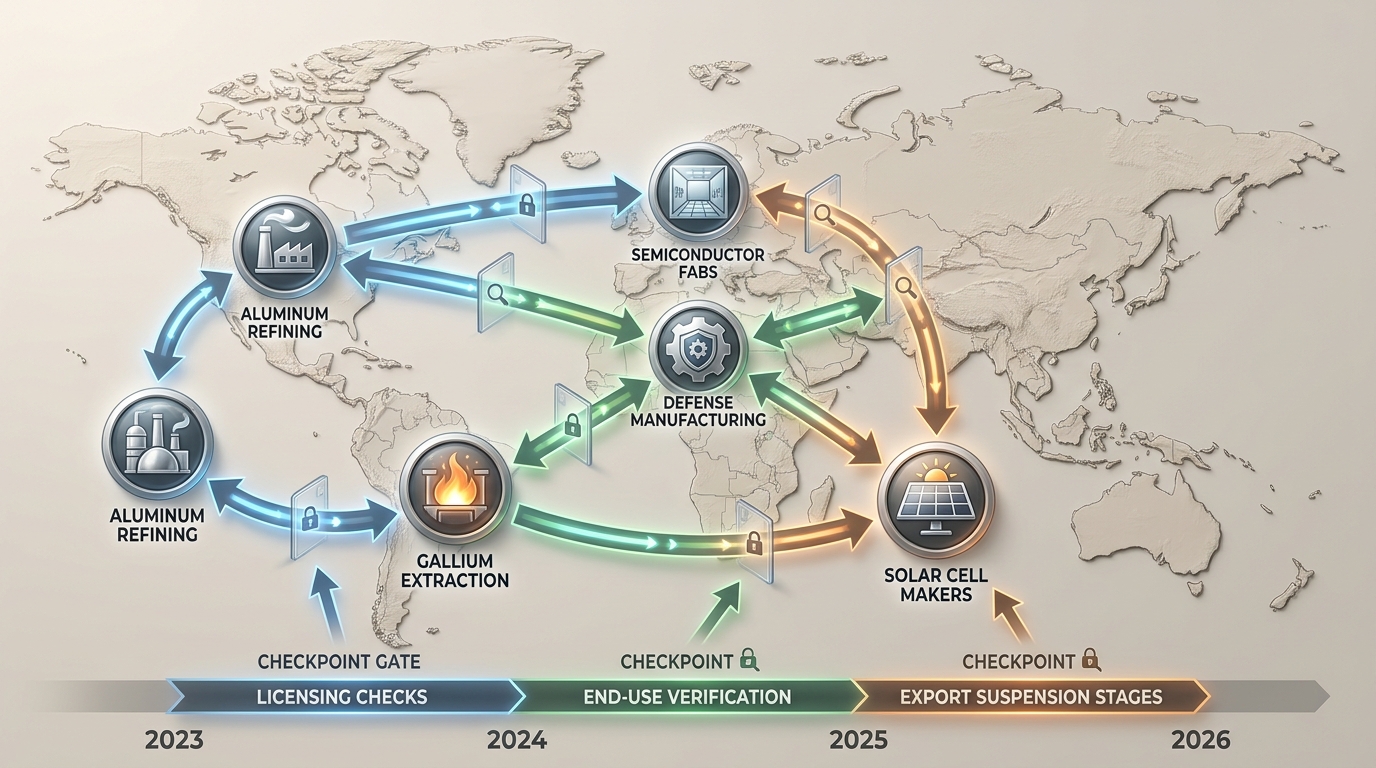
Visual timeline of licensing → embargo → suspension and downstream impacts.
For market participants, the most important nuance is that gallium’s by-product origin means that alternative supply is not elastic. Even where material exists in scrap or industrial streams, converting it into usable gallium requires recovery pathways and quality certification—so short-term price signals do not automatically translate into rapid, fungible supply.
Fragmented Coverage and Strategic Blind Spots
Specialist commodity analysts and policy think tanks meticulously track gallium export measures, production quotas and price effects. Mainstream tech and gaming-oriented outlets, however, often focus on downstream semiconductor shortages—GPUs, AI chips and lithography capacity—without naming gallium as an upstream bottleneck. This siloed coverage risks underestimating how quickly a “hardware story” can become a “critical minerals story” when Beijing activates its regulatory switch.
Process diagram showing why extraction technology is a control point.
For institutional stakeholders, the practical problem is measurement: if gallium exposure is not mapped by end-application, then policy moves can be misread as isolated input disruptions rather than as repeatable sovereign-risk events. In turn, that misreading delays mitigation—such as qualification of alternative feedstocks, redesign of procurement specifications, and compliance controls that prevent sourcing from becoming a legal and operational liability.
Allied Responses and Alternative Supply Efforts
Governments and firms in the U.S., EU, Japan, South Korea and Australia have launched feasibility work aimed at recovering gallium from bauxite, zinc and industrial scrap. European refiners and industrial groups have explored recovery pathways, while Japanese and Korean players emphasize closed-loop recycling strategies to reduce reliance on fresh primary feedstock. Australia’s bauxite-linked pathways have also been examined, though many efforts remain constrained by pilot-stage scale-up and commercialization risk.
Illustrate semiconductor supply vulnerability under export restrictions.
Across these initiatives, two challenges recur. First, by-product recovery is capital intensive: it requires additional processing steps, quality control and integration into existing refinery or waste-treatment workflows. Second, absent credible protection against future Chinese market surges, investment returns can remain uncertain—especially if policy can be tightened or relaxed faster than alternative capacity can qualify and deliver on consistent specifications.
Implications for Industry Stakeholders
Procurement and Category Management
Map direct and indirect gallium exposure. Treat gallium as a cross-cutting input across RF and power electronics, LEDs/optics, and PV-linked bills of materials—then document where qualification and substitution are realistic versus where they are not.
Scrutinize provenance, not just geography. Move beyond “country of last transformation” labels. For by-product metals, feedstock integrity and process history materially affect compliance posture and technical acceptance.
Negotiate inventory buffers and contractual resilience. Build flexible delivery terms, and add contingency clauses that explicitly address export control events and compliance-driven shipment holds.
Plan for recycled gallium as a structured supply lever. Integrate recycling streams from scrap and end-of-life devices where possible, and treat recovery yield variability as a managed risk rather than an assumption of steady-state output.
Supply-Chain Strategy and Operations
Scenario-plan for rapid policy toggles. Treat licensing changes, enforcement campaigns and temporary suspensions as repeatable scenarios. Then assess the downstream ripple effects on production schedules and inventory consumption rates.
Engage early with recovery projects, but anchor risk allocation. Use consortia or anchor offtake discussions to clarify who bears commercialization, yield and compliance certification risk.
Coordinate with R&D on material substitutes where technically viable. Substitute materials—such as silicon carbide in power electronics contexts—should be evaluated as qualification programs, not as instantaneous substitutes.
Embed regulatory monitoring into S&OP cycles. Incorporate signal monitoring across MOFCOM-linked developments and Western critical minerals/export control frameworks so forecasting assumptions are updated before procurement commitments become irreversible.
Trading Desks and Risk Management
Anticipate policy-driven volatility. Calibrate hedging logic to scenario distributions shaped by regulatory timing, not only by observed spot price behavior.
Monitor basis risk across venues. Track differences between Chinese domestic pricing signals, Rotterdam-linked market references, and end-user procurement pricing to avoid assuming uniform pass-through.
Avoid overestimating “normalization” from downstream announcements. Materials constraints—especially for by-product metals—can remain binding even when consumer-facing production schedules appear stable.
Compliance and Legal Considerations
Operate under dual-jurisdiction risk. Track both Chinese export control lists and Western critical minerals frameworks to prevent misalignment between sourcing decisions and compliance obligations.
Strengthen due diligence on intermediaries. Enhanced screening is essential for intermediaries and re-export hubs, given the elevated risk of illicit diversion pathways during policy tightening.
Prepare for evolving “trusted source” expectations. Expect procurement systems to increasingly favor documentation-intensive sourcing, especially where end-use verification and process provenance become gating factors.
Conclusion
China’s gallium playbook demonstrates how targeted export and technology controls on a by-product metal can deliver outsized leverage over critical supply chains. The November 2025 civilian suspension does not remove the underlying choke points; it only changes the timing and the conditions under which restrictions may be activated. Decision-makers should treat gallium as an enduring vulnerability—using this window to diversify sourcing, reinforce recycling, and institutionalize policy-risk scenarios into strategic planning.
Dissecting Top 12 China-Independent Critical Mineral Narratives: Supply Risk vs Reality
Key Takeaways
China retains integrated control over 60–90% of rare earth mining and refining, including heavy rare earth elements (HREEs).
Non-Chinese projects face permitting delays, higher costs, and ESG constraints that extend timelines by 5–7 years.
Resource diversification alone does not equal processing independence; offtake contracts and mid-stream choke points matter.
Projects like Mountain Pass and Lynas Texas advance resilience but cover only fractional shares of global demand.
Robust mapping of financing, processing routes, and regulatory friction points is essential for genuine supply security.
Across defense, EV, wind, and advanced electronics supply chains, strategic planners hear promises of rapid transition to “China-independent” critical mineral supply. Rare earths encompass light rare earth elements (LREEs) such as neodymium (Nd) and praseodymium (Pr), and heavy rare earth elements (HREEs) including dysprosium (Dy) and terbium (Tb). Total rare earth oxides (TREO) denote the combined oxides of all 17 lanthanides plus yttrium. Materials Dispatch’s review of 2024-2025 project data, trade flows, and ownership structures reveals a harsher reality: China still controls roughly 60–90% of rare earth mining and refining capacity and dominates HREE supply.
This briefing ranks the top 12 “China-independent” narratives by their strategic distance from reality. We contrast public storylines with operational details—contract terms, logistics, processing routes, and observed failure modes. The goal is to calibrate expectations and highlight the real levers that move supply risk.
1. US Mountain Pass Mine as a Fully Domestic “Mine-to-Magnet” Solution
The Asset / Risk. Mountain Pass in California is often introduced in official speeches as the linchpin of a sovereign US rare earth supply chain: mine, refine, and manufacture NdFeB magnets on US soil. The mine produces 40,000–60,000 MT/year of TREO concentrate, heavily weighted to LREEs such as Nd and Pr.
Strategic Context. For US defense platforms and EV drive motors, Mountain Pass anchors domestic mining know-how and signals U.S. progress toward China’s magnet ecosystem. The plan to add domestic separation and magnet production is framed as the final step to full independence.
The Bottleneck. On the ground, nearly 100% of concentrate still ships to China for separation. HREE separation (Dy, Tb) remains a critical gap. Scaling solvent-extraction circuits under US environmental and labor constraints is slower and costlier than in China. Even at a planned 1,000 MT/year NdFeB capacity—<1% of China’s 138,000 MT in 2018—the facility depends on power, skilled labor, and steady capex. Permitting delays have stretched timelines beyond initial guidance, and any regulatory hiccup in waste or water management triggers fresh reviews.
The Verdict. Mountain Pass enhances upstream resilience for LREEs and provides a partial hedge against raw-material shocks. It does not deliver a closed-loop, China-independent chain in the 2025–2030 window. Risk assessments should track domestic separation commissioning, long-term power contracts, and residual reliance on Chinese reagents or offtake partners.
2. Australia’s Nolans Project as an Allied HREE Independence Engine
The Asset / Risk. The Nolans project in Australia’s Northern Territory is positioned as an “ally-only” source of RE oxides, with integrated mining and processing to bypass China. Public messaging often blurs its primary LREE focus (NdPr) with the scarcer HREEs needed for defense and offshore wind magnet temperature performance.
Strategic Context. For OEMs in Japan, Europe, and North America, a stable NdPr source in Australia supports diversification. Government support and offtake agreements with non-Chinese customers reinforce the impression of a clean break from China’s dominance.
The Bottleneck. By mid-2020s, Nolans remained in advanced development, with construction and commissioning repeatedly delayed by environmental approvals, workforce constraints, and cost inflation. HREE volumes are modest relative to global deficits. Remote logistics, port capacity limits, and minority-stake approaches from Chinese-linked entities underscore challenges in fully divorcing from China’s processing ecosystem.
The Verdict. Nolans adds medium-term value for LREE diversification but is not a turnkey HREE solution. Planners should monitor final financing, offtaker identities, and any toll-separation routing through Asian hubs.
3. Brazil’s Serra Verde as a Non-Asian Light + Heavy REE Powerhouse
The Asset / Risk. Serra Verde in Goiás, Brazil, is promoted as the first major ionic-clay REE mine outside Asia, offering both LREE and meaningful HREE output. Ionic clays can be leached at relatively low cost, with lower-carbon profiles versus Chinese or Myanmar clays.
Strategic Context. Multinational OEMs value jurisdictional diversification and mixed LREE/HREE output for EV motors, offshore wind, and industrial catalysts.
The Bottleneck. Early offtake deals defaulted to Chinese processors due to scale and installed capacity. Brazilian environmental regulations and tailings management add compliance costs and delays. Labor disputes and port congestion create unpredictable export flows.
The Verdict. Serra Verde diversifies the resource base but not processing control. Procurement teams should scrutinize offtake contracts, potential redirection to non-Chinese processors, and Brazilian regulatory shifts.
4. Aclara’s Latin American Projects as ESG-Perfect, Fully Western Chains
The Asset / Risk. Aclara’s ionic-clay projects in Chile and Latin America are marketed on strong ESG credentials—closed-loop water use and ion-exchange technology feeding a planned US separation hub.
Strategic Context. A low-impact Latin American resource plus US processing facility would showcase allied industrial cooperation for defense and EV magnet supply chains under ESG pressure.
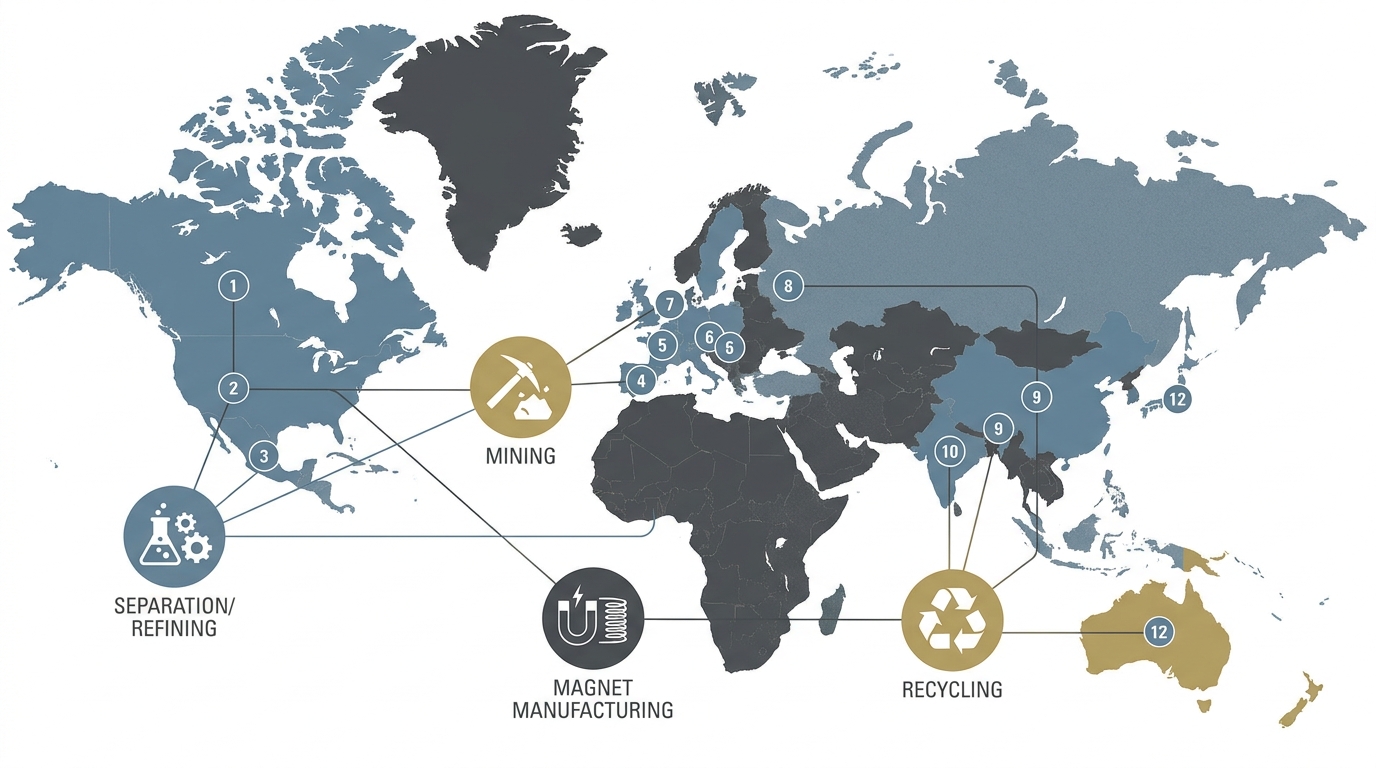
Global overview diagram contrasting mining, refining, and recycling nodes across the 12 ‘China-independent’ narratives.
The Bottleneck. Scaling ion-exchange from pilot to commercial scale poses throughput, resin-degradation, and water-quality challenges. US separation permitting under NEPA and local zoning can extend to five–ten years. Financing must tolerate schedule creep and evolving regulatory requirements around PFAS and waste.
The Verdict. Aclara offers a credible late-decade HREE pathway but remains aspirational for the 2020s. Its value hinges on firm offtake contracts, social license in Latin America, and US regulatory progress.
5. US Recycling (Vulcan, ReElement and Peers) as a Leapfrog over Mining
The Asset / Risk. US recycling ventures backed by defense funding promise to recover several thousand tonnes per year of RE oxides from e-waste and industrial scrap, framed as a way to “skip” upstream mining.
Strategic Context. Onshore recycling aligns with security-of-supply mandates and ESG goals, offering potential to flatten HREE price volatility if mine development lags.
The Bottleneck. Limited and fragmented REE-bearing scrap streams, purity and consistency challenges, and pilot-scale facilities with 12–24 month ramp-ups restrict near-term impact. Recovered purity (high-80s to low-90s%) often falls short of virgin-like specs, necessitating additional purification.
The Verdict. Recycling can offset 10–20% of rare earth needs in niche segments, especially defense. It is not a structural replacement for mining this decade. Track scrap-supply agreements, military qualification of recycled materials, and hazardous-waste regulations.
6. Greenland’s Kvanefjeld and Tanbreez as an Arctic HREE Safety Valve
The Asset / Risk. Greenland’s Kvanefjeld and Tanbreez deposits are invoked as potential sources of 20–25% of global HREE needs under Danish oversight.
Strategic Context. NATO planners cite geopolitical alignment and Arctic shipping proximity as advantages for HREE supply.
The Bottleneck. Projects are stalled by uranium restrictions, permafrost engineering challenges, seasonal shipping windows, and local opposition. Arctic conditions triple logistics costs versus temperate ports.
The Verdict. Greenland remains a strategic option, not an active mid-decade contributor. Model it as upside contingent on regulatory shifts, waste-management innovation, and Arctic infrastructure progress.
7. Canada’s Nechalacho as an Ethical HREE Cornerstone for North America
The Asset / Risk. Nechalacho in Canada’s Northwest Territories is promoted for “ethical” REEs from a high-standards jurisdiction, with small open-pit production and nearby processing.
Strategic Context. Fits USMCA rules-of-origin and ESG reporting; validates modular mining and initial processing in remote environments.
The Bottleneck. Scale remains modest (hundreds of tonnes/year), with full separation via toll processing in Europe. Sub-arctic conditions limit operating days and raise logistics costs. Major expansion requires lengthy permitting and community consultation.
The Verdict. Nechalacho is a high-integrity, low-volume node in the North American REE network. Watch moves toward onshore separation, remote power solutions, and Indigenous royalty frameworks.
8. Tanzania’s Ngualla (Peak Rare Earths) as a “Western-Controlled” African Supply
The Asset / Risk. Ngualla was cited as a Western-developed African resource with high TREO grades, poised to supply magnet materials free of Chinese influence.
Strategic Context. African sourcing appeals to OEMs seeking diversification, with Tanzania courting foreign investment and value-addition.
The Bottleneck. Ownership shifted to a Chinese-linked company, undermining the “Western-controlled” narrative. Tanzanian local-content rules and export levies add fiscal complexity. Grid instability and infrastructure gaps drive up capex and schedule risk.
The Verdict. Ngualla remains geologically attractive but no longer advances Western supply security. Treat it as a contributor to global tonnage, not a diversification win. Monitor Tanzanian policy, offtake structures, and parallel non-Chinese processing lines.
9. Lynas’ Texas Facility as the End of US Processing Dependence
The Asset / Risk. The DoD-supported Lynas plant in Texas is presented as closing the US loop for NdPr and select HREE processing under US law.
Strategic Context. “Kalgoorlie → Texas” is marketed as a clean, ally-controlled chain for defense-critical components.
The Bottleneck. Stricter US emissions and wastewater rules, community engagement, and technical scale-up challenges have stretched schedules and costs. Initial capacity covers only a fraction of US demand; HREE capability phases in slowly.
The Verdict. The Texas facility is a concrete step toward non-Chinese mid-stream capability, but it addresses only a slice of US needs. Track recovery rates, residue handling, permitting challenges, and energy-water agreements.
10. South African PGMs as a Platinum/Palladium Buffer against China
The Asset / Risk. South African platinum group metals (PGMs) underpin catalysis, hydrogen technologies, and high-temperature industrial processes. Mines in the Bushveld Complex supply dominant shares of global Pt, Pd, and Rhodium.
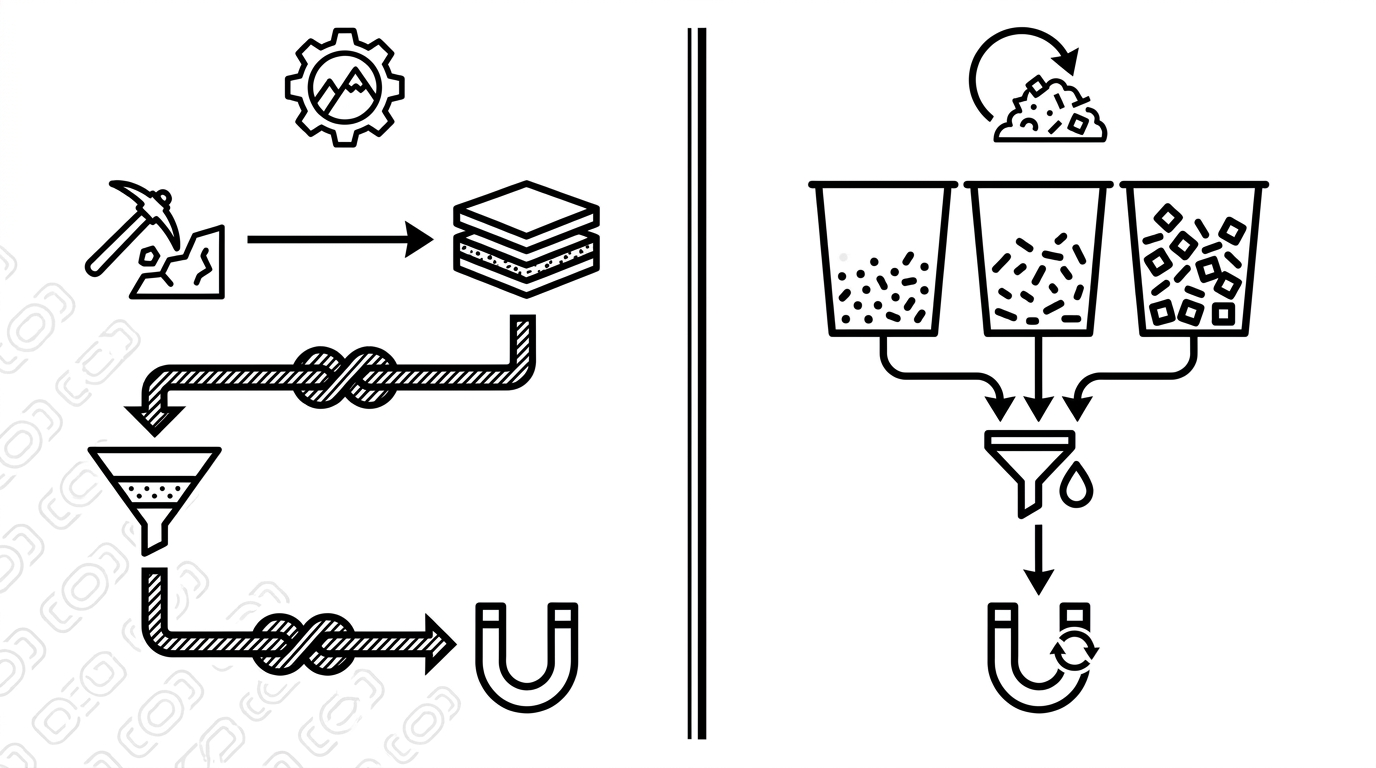
Mechanism view contrasting bottlenecks in mining/separation versus recycling pathways.
Strategic Context. Anchoring PGM sourcing in South Africa reduces Russian risk and appears to limit Chinese influence.
The Bottleneck. Chronic power shortages and load-shedding at Eskom, labor stoppages, and outsourced smelting/fabrication often involve Chinese intermediaries. Downstream dependencies on Chinese fabricators persist.
The Verdict. South African PGMs mitigate Russian exposure but not fully Chinese pricing power. Key levers: captive power investments, non-Chinese offtake contracts, and alternative fabrication hubs.
11. Myanmar’s Ionic Clays as a Non-Chinese Heavy REE Source
The Asset / Risk. Myanmar’s southern ionic-clay deposits mirror geological profiles of southern Chinese clays and are cited as an HREE diversification lever.
Strategic Context. Proximity to ports and existing mining experience suggest a second major clay district outside China.
The Bottleneck. Chinese firms finance and operate most mines; nearly all material flows into China for leaching and separation. Political instability, conflict, and sanctions risk hinder direct Western engagement.
The Verdict. Myanmar does not function as an independent HREE source. Treat its output as vulnerable to Chinese export policy and local instability. Monitor border closures, sanctions shifts, and any credible non-Chinese processing initiatives.
12. Sweden’s Norra Kärr as the EU’s Route to Rare Earth Autonomy
The Asset / Risk. Norra Kärr in Sweden is promoted by the European Commission as a cornerstone of EU strategic autonomy in REEs, with proximity to industrial hubs and strong legal frameworks.
Strategic Context. A domestic ore body supports EU EV, wind, and defense industries within stringent environmental and social standards.
The Bottleneck. Early-stage permitting faces local opposition over water impacts, biodiversity, and reindeer herding. Europe lacks commercial-scale separation capacity, requiring new plants subject to lengthy approvals or reliance on Asian processors.
The Verdict. Norra Kärr is a strategic option, not assured supply by 2030. Progress depends on permitting outcomes, committed financing, and parallel EU mid-stream infrastructure development.
Conclusion: Strategic Implications for Critical Mineral Security
Materials Dispatch’s analysis underscores that non-Chinese ore production, while necessary, does not alone secure supply chains. Genuine diversification demands parallel development of separation, alloying, and recycling capacity, aligned with realistic permitting and financing timelines. Industrial and defense stakeholders must track financing structures, mid-stream dependencies, and regulatory milestones to translate these options into actionable resilience. Only through disciplined governance and transparent industrial strategy can true China-independence be approached.
Due Diligence Review: ESG and Community‑Risk Red Flags in Strategic Mineral Projects
We reviewed a cross‑section of 15 strategic mineral projects—covering rare earths, lithium, nickel, cobalt and platinum‑group metals (PGMs)—to assess how environmental, social and governance (ESG) issues and community disputes are affecting operational continuity and upstream supply availability. Our work draws on site and virtual audits, regulatory filings, local media monitoring and direct qualification discussions with operators and downstream offtakers.
Key Takeaways
ESG and community disputes consistently convert into hard operational events: delayed expansions, frozen tailings projects, and halted water licences, which in turn shorten effective supply.
Water and tailings management are the dominant technical flashpoints across jurisdictions; projects with independently verified systems show materially less disruption.
Indigenous and local equity participation tends to channel conflict into negotiation rather than obstruction; absence of meaningful sharing correlates with escalations.
Governance fragility and sanctions amplify local incidents into national policy responses that can materially reduce available tonnage to ESG‑sensitive offtakers.
Analytical Lens: How ESG and Community Risk Becomes an Operational Event
The principal lesson from the dataset is straightforward: ESG disagreements rarely remain within public affairs teams. They become path‑critical operational events—delayed shaft sinking, frozen concentrator upgrades, revoked water or tailings permits—that sit on the same schedule drivers as geotechnical failures or metallurgical setbacks.
Across the portfolio four structural channels dominate:
Water and tailings exposure – Community concern about groundwater drawdown and tailings storage repeatedly triggers regulatory pauses. Projects adhering to international standards such as the Global Industry Standard on Tailings Management (GISTM) and with transparent monitoring experience shorter interruptions.
Indigenous and community consent – First Nations and Indigenous groups are asserting leverage through court actions, blockades and renegotiation of impact‑benefit agreements; this operates as an ongoing critical path risk rather than a single permitting hurdle.
Climate and natural‑hazard sensitivity – More frequent heatwaves, cyclones and permafrost thaw interact with legacy infrastructure and tailings designs to create recurring outage patterns.
Governance and sanction fragility – In jurisdictions with sanction or export‑control exposure, ESG findings are rapidly entangled with national policy, export quotas (government limits on the volume or value of goods allowed to leave a country) and external audits, increasing the probability of supply disruptions.
Power and infrastructure reliability – Opposition to new transmission lines or access roads compounds logistical fragility, producing bottlenecks that amplify delivery variance.
From a supply‑chain perspective, this collapses into a few operational questions: Will a water license or tailings permit hold through expansion? Is social licence resilient to a geotechnical setback? Are sanction and reputational risks acceptable for downstream OEMs with internal ESG screens?
Case Focus: Rare Earth and Lithium Supply in the United States
Two US projects in the dataset—Mountain Pass (California) and Thacker Pass (Nevada)—illustrate how ESG dynamics can shape strategic mineral reliability even in jurisdictions perceived as stable. Together they underpin a sizeable share of planned non‑Chinese NdPr (neodymium‑praseodymium) magnet feedstock and lithium carbonate for batteries. Note: we use TREO to refer to total rare earth oxides and LCE to refer to lithium carbonate equivalent, terms which appear below when discussing volumes and sourcing.
Geopolitical and ESG-risk overview map (illustrative).
Mountain Pass: Legacy Environmental Liabilities Meet New Supply Imperatives
Mountain Pass remains a cornerstone of non‑Chinese rare earth oxide (TREO) production. Our dataset characterises current production near 40,000 tonnes per year of rare earth oxides, with medium‑term plans toward ~60,000 tpa. The project sits at an uncomfortable intersection of legacy liability and strategic indispensability.
Critical findings with direct continuity implications:
Water stress in a sensitive basin – Legal action by local tribes over groundwater extraction has previously interrupted expansion permitting for more than a year, placing debottlenecking plans in limbo.
Tailings seepage and regulatory fines – Historic seepage concerns have attracted significant penalties and made hydrological audits de facto gatekeepers for license renewal and expansion approvals.
Incomplete water recycling implementation – Management proposals for closed‑loop water circuits have not yet achieved full capture; tightening extraction limits could quickly constrain throughput.
Climate exposure – Heatwaves that curtail open‑pit operations create short‑term production swings that ripple through just‑in‑time magnet supply chains.
For market planners, Mountain Pass demonstrates that a single ESG incident can trigger policy debates at state and federal levels, elevating supply risk beyond the local operating horizon. When substitutes at comparable scale are scarce, even a modest output shortfall materially tightens upstream availability for magnet manufacturers and defense users.
Thacker Pass: Social Licence on the Critical Path for US Lithium Supply
Thacker Pass, envisaged to produce around 40,000 tpa LCE, has become a test case of how community opposition can extend timelines in OECD settings. Internal tracking showed slippage in first‑production guidance—driven mainly by permitting pauses rather than technical redesigns.
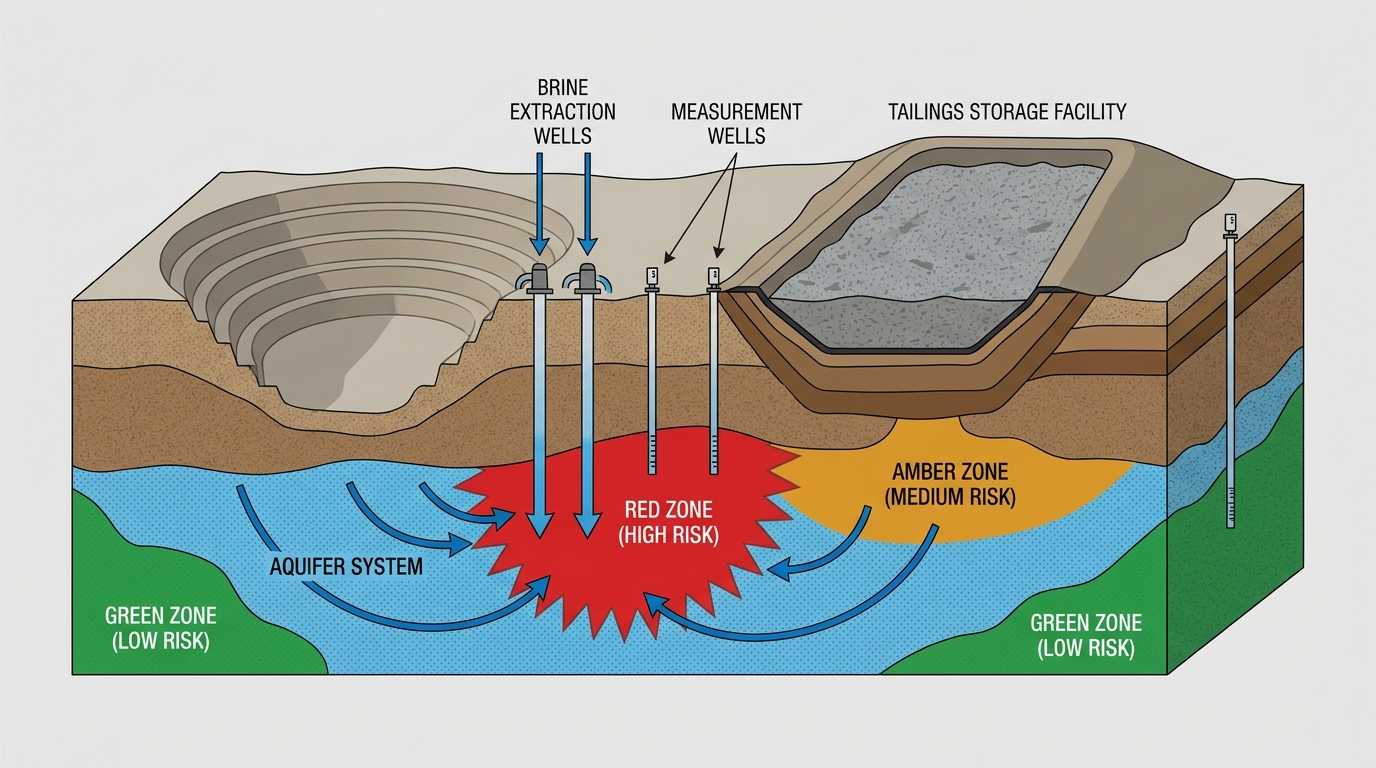
Water-and-tailings risk cross-section for battery metals projects.
Core risk elements:
Indigenous rights and sacred sites – Litigation by Paiute‑Shoshone groups over cultural heritage paused key Bureau of Land Management processes and disrupted construction sequencing.
Water use in an arid catchment – Hydrogeological assumptions about aquifer recharge have been challenged by local stakeholders, framing water competition as central to the dispute.
Ore and process complexity – Clay‑hosted lithium raises ongoing questions about grade consistency and impurity management; perceptions of under‑reported waste volumes have reinforced community scepticism.
National policy overlay – The project’s prominence in industrial policy and incentive frameworks has elevated local disputes to national‑level debate, slowing negotiated compromise.
Operationally, Thacker Pass underscores a risk inflection point common to long‑life projects in contested landscapes: social licence operates continuously. Downstream cathode and cell manufacturers have moved from a single “on‑time” sourcing case to a suite of scenarios—on‑time, slow‑ramp, stalled—each with different implications for blending strategies and compliance with domestic content rules.
High‑Risk Jurisdictions: Cobalt, Nickel and the ESG–Governance Nexus
Projects in the Democratic Republic of Congo (DRC), Papua New Guinea (PNG), Russia and Cuba illustrate a different dynamic: community incidents intersect with governance fragility and geopolitical stress to produce layered continuity risk.
Examples from the portfolio:
DRC copper–cobalt complexes – Interfaces with artisanal mining, resettlement disputes and river contamination led to logistical frictions—blocked roads, temporary export holds and curfews—that compressed effective deliveries even when nameplate figures looked intact.
PNG Ramu nickel–cobalt – Deep‑sea tailings placement and reported pipeline ruptures mobilised community blockades and government reassessments, turning single incidents into multi‑month access constraints exacerbated by cyclone exposure.
Russian Arctic operations – Chronic emissions and spills have prompted Indigenous protests and international scrutiny; when coupled with sanctions, these incidents restrict access to Western technology and financing, affecting maintenance and upgrade schedules.
Cuban nickel projects – Hurricanes and embargo‑related equipment constraints have combined to raise the operational and reputational cost of continued output in that jurisdiction.
Across these contexts, disruptions rarely manifest as permanent shutdowns. More commonly they increase delivery variance and raise compliance risk for ESG‑aware offtakers, who often reduce reliance on assets that migrate onto internal watch lists.
Community engagement flashpoint near a mining site.
Patterns and Monitoring Signals Across the Portfolio
Five recurring patterns matter for supply‑chain planning:
Water and tailings as primary flashpoints – Transparent, GISTM‑aligned designs and third‑party audits reduce disruption severity.
Indigenous/local equity participation – Shared‑value models convert conflict into negotiation more often than obstruction.
Climate impacts folded into community narratives – More frequent extremes increase scrutiny of “design storm” assumptions.
Governance risk amplifies incidents – Weak institutions can translate local disputes into license suspensions or royalty overhauls.
Downstream ESG screening as a demand‑side shock – Once a project is flagged for human‑rights or tailings failures, offtakers may diversify even while the mine remains operational.
Useful monitoring signals include: the tone and frequency of regulator communications; the presence of revenue‑sharing or equity structures with host communities; timing of tailings expansion or dam redesigns; renewal windows for water and emissions licences; and whether incidents become national political issues or remain local and resolvable.
Risk Inflection Points
Particular inflection points warrant close attention because they often trigger upstream re‑evaluations:
Transition phases for tailings capacity or tailings‑design changes.
Renewal or amendment periods for key water and emissions licences.
Revisions to Indigenous impact‑benefit agreements.
High‑profile environmental incidents that attract national media.
National elections or regulatory overhauls that reframe resource sovereignty debates.
Conclusion
Our review concludes that ESG and community factors are now core supply‑chain variables for strategic minerals. Projects that pair credible, independently verified tailings and water management with transparent benefit‑sharing and contingency planning demonstrate materially greater resilience. For market participants, durable access to critical feedstocks increasingly requires understanding both the geology and the governance surrounding production.
Materials Dispatch cares about this topic for a simple operational reason: in every missile-defense sourcing cycle examined over the last decade, the technical bill of materials led back to the same bottleneck – Chinese rare earth processing and magnet capacity. Export-control scares, supplier failures, and the scramble to qualify even small non-Chinese magnet volumes have turned that bottleneck from an abstract geopolitical trope into a daily procurement constraint. The current Israel-Iran missile dynamic exposes that constraint brutally: the same country underpins the magnets inside the Arrow interceptor defending Tel Aviv and the navigation architecture inside the Fattah-series missiles flying toward it, while also positioning itself as a diplomatic broker. That is not a paradox; it is supply chain design.
The underlying change is not a single law but the convergence of China’s roughly 90% control of rare earth processing, documented interceptor depletion in Israel, and slow-moving Western diversification efforts.
Covered scope includes neodymium and samarium-cobalt magnet dependence in Arrow, THAAD, Patriot and David’s Sling; BeiDou-3 use in Iranian missiles; and Chinese leverage via oil trade and rare earth chokepoints.
Operations are constrained by long magnet lead times, qualification cycles, and the reality that the US remains 100% net import dependent on finished rare earth magnets while EU and Japan only begin to scale alternatives.
Interpretation remains bounded by public data; quantified 2026 shortage and price scenarios derive from published modeling, not from Materials Dispatch forecasts.
The central asymmetry: China can influence both Israeli interceptor resupply and Iranian missile performance through materials and navigation supply chains in a way no other actor currently can.
FACTS: The Supply Chain Architecture Behind Sword, Shield, and Diplomacy
China’s Dominance in Rare Earth Processing and Finished Magnets
Open-source assessments converge on a central fact: China processes around 90% of the world’s rare earth oxides into usable materials and components. This includes the conversion of mined concentrates into separated oxides, metals, and high-performance magnets. The Australian Strategic Policy Institute (ASPI), in its work on strategic dependencies, has described US missile defense in particular as critically exposed to Chinese-controlled rare earth and magnet supply chains.
Rare earth permanent magnets – primarily neodymium–iron–boron (NdFeB) and samarium–cobalt (SmCo) – are mission-critical in modern missile defense systems. They appear in:
Actuators for aerodynamic control surfaces and thrust-vectoring in interceptors such as Arrow and Patriot.
Gimbal motors and guidance assemblies in seekers and radar systems used by THAAD and David’s Sling.
Electric drive systems inside radar arrays and fire-control systems supporting these batteries.
The United States is assessed by government and academic sources as being 100% net import dependent on finished rare earth magnets. The bulk of those finished magnets, even when sourced via intermediaries, originate from Chinese processing and manufacturing capacity.
ASPI’s analysis of US missile defense identifies Chinese-controlled rare earth supply and magnet manufacturing as chokepoints for critical systems, including Patriot and THAAD, where magnet substitution or redesign is either technically constrained or would take years to validate for combat use.
Interceptor Depletion: RUSI Data on Arrow and David’s Sling
The Royal United Services Institute (RUSI) has documented the pace at which Israel’s missile-defense interceptors have been consumed under sustained attack. One assessment reports approximately 122 of 150 Arrow-2/3 interceptors used, and 135 of 250 David’s Sling interceptors expended, in recent barrages. That translates into a significant drawdown of stockpiles for systems that depend heavily on rare earth magnet content throughout their guidance and actuation subsystems.
RUSI’s depletion figures do not themselves quantify magnet consumption. that said, given that each interceptor embodies multiple NdFeB and, in some high-temperature locations, SmCo components, these depletion rates map directly into magnet replacement requirements. Replacement is constrained not only by financial appropriations and assembly capacity, but by the availability of qualified magnet supply – overwhelmingly tied back to Chinese processing.
Iranian Missiles and BeiDou-3 Military-Grade Navigation
On the offensive side of the current regional dynamic, Iranian ballistic and cruise missiles – including advanced designs such as the Fattah family – have reportedly integrated China’s BeiDou-3 satellite navigation system. Open-source technical analyses describe the use of BeiDou-3 military-encrypted signals, which enhance accuracy and resilience relative to unencrypted civilian navigation feeds.
These missiles also rely on components and materials that run through Chinese supply lines more broadly, including electronics, machine tools, and precursors relevant to propellant and structural materials. While not all of these rely on rare earths, the navigation and guidance stack is directly tied into Chinese space-based infrastructure and related component ecosystems.
China is also reported to purchase roughly 80% of Iran’s oil exports, largely through channels that circumvent formal Western sanctions frameworks. That oil revenue underpins Tehran’s fiscal capacity for missile development and procurement. The same bilateral trade relationship that moves oil also provides a foundation for technology, component, and materials flows relevant to Iran’s missile programs.
Western Vulnerability: ASPI and West Point Modern War Institute Assessments
ASPI’s report on strategic rare earth dependence in US missile defense highlights two linked facts:
Chinese entities dominate the separation and processing stages for the specific rare earth elements required in high-coercivity NdFeB and SmCo magnets used in missile guidance and actuation.
US missile defense programs rely on these magnets with limited substitute materials or designs qualified to the same performance and reliability standards.
The Modern War Institute at West Point has framed China’s rare earth monopoly as a national security risk, warning that a disruption in Chinese rare earth or magnet exports could significantly degrade the US defense industrial base’s ability to sustain missile-defense sortie rates. The institute’s assessment emphasizes the time required – measured in years, not months – to stand up non-Chinese alternatives at every stage from oxide separation to finished magnet production and system-level qualification.
Regulatory and Strategic Responses: EU CRMA, Japan’s Stockpile, and 2026 Horizon Scenarios
Several jurisdictions have begun codifying responses to this structural dependence, with direct implications for defense supply chains:
European Union – Critical Raw Materials Act (CRMA): By the second quarter of 2025, the CRMA’s Phase 2 benchmarks include a target for 10% of certain critical raw materials, including rare earths, to be processed domestically within the EU. For defense contractors, non-compliance can trigger fines reportedly in excess of €10 million, creating a formal regulatory incentive to diversify away from Chinese processing.
Japan – Rare Earth Strategic Stockpile: By the fourth quarter of 2025, Japan’s rare earth strategy envisages doubling its strategic stockpile of NdFeB magnets to around 5,000 metric tonnes. This is particularly relevant given Japanese partnerships in missile-defense programs and co-production, where Japanese magnet capacity can act as a partial hedge against Chinese disruption.
2026 Horizon – Chinese Quota Scenarios: Bloomberg Intelligence has modeled potential Chinese quota tightening that could displace on the order of 13,000 metric tonnes of rare earth supply from global markets by 2026. In that scenario, Western buyers face modeled aggregate premiums of USD 2–3 billion, with dysprosium prices reaching around USD 1,200 per kilogram. These are scenario analyses, not certainties, but they illustrate the magnitude of financial and supply stress modeled under tighter export quotas.
These moves coexist with national-level programs in the US and elsewhere to seed domestic mining, separation, and magnet manufacturing, often through defense-focused industrial policy. However, the provided data do not specify exact volume or timing beyond the broad 2025–2026 horizons and the Japanese stockpile target.
China as Diplomatic Host and Supply Chain Gatekeeper
Parallel to its role as a materials and navigation supplier to both Israeli-aligned and Iranian-aligned systems, Beijing has positioned itself as a host for diplomatic initiatives and potential peace talks related to the conflict. This juxtaposition – Chinese-origin magnets inside interceptors defending Tel Aviv, Chinese navigation and trade flows enabling missiles targeting Israeli cities, and Chinese diplomats convening discussions – is grounded in the same structural fact: control over a set of industrial chokepoints that neither side can rapidly replace.
INTERPRETATION: How Structural Dependencies Translate into Leverage
From Monopoly to Leverage: The Asymmetry Embedded in Rare Earth Processing
To the extent that China maintains roughly 90% of rare earth processing and dominates finished magnet production, it holds a structural lever over both the pace and sustainability of missile-defense resupply in Israel, the US, and allied states. ASPI and West Point’s Modern War Institute are aligned on one core point: Western missile-defense architectures were built under an implicit assumption that cheap, reliable Chinese magnet supply would persist indefinitely. That assumption has already been challenged by Chinese export controls on other strategic materials such as gallium and germanium; magnets and rare earths sit one policy step away from similar treatment.
If Beijing were to tighten export licensing on specific magnet grades, prioritize domestic civil-industrial demand, or simply allow longer administrative delays for exports, interceptor production lead times in allied states would stretch. RUSI’s depletion figures show that Arrow and David’s Sling stocks can be drawn down quickly under sustained attack. In a scenario where interceptors are expended faster than they can be replaced and critical magnet components face longer or uncertain delivery, system-level readiness could erode even if funding and assembly capacity exist on paper.
The asymmetry is clear: even modest changes in Chinese export posture can ripple through Western defense industrial bases far more quickly than Western diversification efforts can come online. The multi-year timelines associated with new rare earth separation plants, alloying lines, and magnet factories put Western systems on the back foot in any short-notice crisis.
The “Sword and Shield” Feedback Loop: Iranian Missiles vs. Israeli Interceptors
The same industrial ecosystem that supports Western interceptors also underpins key capabilities on the Iranian side, albeit in different ways. BeiDou-3 integration into Iranian missiles ties guidance performance directly into Chinese space infrastructure and chipset ecosystems. Chinese demand for Iranian oil, reportedly around 80% of Tehran’s exports, provides fiscal oxygen for missile development programs. And Chinese-origin components and manufacturing know-how appear repeatedly in open-source missile forensics and supply chain mappings.
That said, there is an important structural difference. Iranian systems can tolerate cruder performance in some cases: larger circular error probable, more reliance on volume of fire rather than exquisite precision, and more flexible use of mid-tier electronics. Israeli and US missile-defense systems, by contrast, are engineered around high-precision intercepts that demand top-end guidance and control hardware. This makes magnet performance less fungible on the defensive side than on the offensive side.
If Chinese rare earth and magnet exports to Western-aligned defense industries were curtailed, Israeli interceptor production could face near-term constraints that would not automatically translate into equivalent constraints on Iranian missile output. Oil revenues can be redeployed into alternative components; guidance performance can be traded for volume; and lower-tech solutions can be fielded. The shield is more technologically brittle than the sword, and that brittleness runs straight through the magnet supply chain.
Regulation vs. Reality: Can EU, US, and Japan Close the Gap in Time?
On paper, measures like the EU CRMA’s 10% processing benchmark and Japan’s 5,000-tonne NdFeB stockpile are rational responses. They recognize that defense readiness is inseparable from critical materials security. However, these targets also underscore how small current non-Chinese capacities remain relative to global demand and to the concentration of processing in China.
If Bloomberg Intelligence’s 2026 quota scenario materializes – displacing roughly 13,000 tonnes of rare earth supply and driving modeled Western premiums and dysprosium price spikes – magnet availability for defense programs could become an explicit allocation problem rather than a background procurement concern. At that point, even well-intentioned regulatory benchmarks would be chasing a moving target: as China tightens supply or raises its own downstream consumption, the baseline against which “10% domestic processing” is measured may itself shrink in export-available terms.
In practice, Western defense primes and ministries have already begun multi-sourcing and pre-qualification of non-Chinese magnet suppliers. Yet, based on program-level audits Materials Dispatch has observed, qualification cycles often run several years, especially for high-reliability missile components. Even under optimistic scenarios, these efforts are unlikely to fully offset a determined Chinese tightening by 2026. The risk is a transitional window where stocks of interceptors – already partially depleted, as RUSI’s data shows – need fast replenishment, while the magnet supply base is still only partially diversified.
Diplomatic Hosting as an Extension of Industrial Power
Beijing’s role as a host for talks touching on Israel–Iran tensions is often framed purely in traditional diplomatic terms. From a materials and industrial perspective, it also reflects the reality that China sits at the junction of both parties’ critical supply chains. That positioning alters the geometry of any negotiation, even if it is never stated explicitly.
If Chinese policymakers perceive value in de-escalation, they have structural options – ranging from quiet tightening of certain export channels to technical “maintenance windows” in satellite navigation services – that could, in principle, alter the material conditions of the conflict. Conversely, neutral or permissive export behavior can allow both missile offense and missile defense to continue drawing on Chinese-enabled capabilities. The key point is not speculation about intent but recognition of capacity: no other state currently has comparable leverage over both sides’ material warfighting architectures at once.
This leverage does not automatically translate into overt coercion. It does, however, give Beijing a background influence over timelines: how fast interceptors can be replaced, how quickly certain missile capabilities can be iterated, and how credible long-war planning looks to capitals that remain magnet-dependent. In Materials Dispatch’s view, that quiet, structural power is underappreciated in mainstream assessments of the conflict.
WHAT TO WATCH: Signals of Shifting Leverage
Chinese export licensing for rare earth magnets: Any move to add specific NdFeB or SmCo grades to tighter dual-use control lists, extend processing times, or introduce end-use certification requirements directly affecting defense contractors.
MOFCOM quota announcements and commentary: Changes in annual or quarterly rare earth export quotas, especially language prioritizing domestic clean-tech or industrial upgrading over exports, which would squeeze available volumes for defense end-uses.
Implementation details of EU CRMA enforcement: Actual enforcement actions or fines against defense suppliers over critical raw materials sourcing, which would signal how seriously Brussels intends to push non-Chinese processing for strategic programs.
Japan’s strategic stockpile drawdowns: Evidence that Tokyo is tapping NdFeB stockpiles for defense co-production, particularly in missile or radar programs, would indicate that stress in global magnet markets is filtering into operational planning.
US magnet manufacturing milestones: Commissioning of full-value-chain facilities (from separated oxides to finished magnets) and, crucially, their qualification into specific missile-defense programs, not just commercial EV or wind applications.
BeiDou-3 service posture and chip export patterns: Any change in availability, signal characteristics, or export rules for high-grade BeiDou navigation modules to Middle Eastern buyers, particularly those linked to Iranian missile programs.
China–Iran oil trade volumes and terms: Sustained or rising Chinese intake of Iranian oil, especially under sanctions pressure, which continues to underpin missile development budgets and trade-based access to dual-use goods.
RUSI and similar analyses on interceptor stockpiles: Updated figures on Arrow, David’s Sling, Patriot, and THAAD inventories and usage rates under attack scenarios, as a real-time proxy for magnet-demand stress.
Public or leaked references to magnet shortages in defense contracting: Contract delays, program re-baselining, or formal notices citing rare earth or magnet availability as a schedule driver.
Beijing’s public framing of its mediation role: Shifts in Chinese official rhetoric that link peace initiatives with “stability in global supply chains”, which would indicate an explicit awareness of leverage at the intersection of materials and security.
Conclusion
The current missile confrontation around Israel reveals more than tactical interplay between interceptors and incoming missiles; it exposes the degree to which both offense and defense are wired into the same Chinese-centered materials and navigation infrastructure. Rare earth magnets and BeiDou-3 chips are not abstract strategic assets – they are the quiet components that determine how many salvos can be fired, how accurately, and for how long.
Regulatory moves in the EU, stockpiling in Japan, and nascent US magnet initiatives acknowledge the risk but do not erase the near- to medium-term asymmetry. As long as the United States remains fully import dependent on finished rare earth magnets and China dominates processing, Beijing holds structural leverage over the tempo and sustainability of Western missile-defense operations. For Materials Dispatch, active monitoring of regulatory and industrial weak signals around these chokepoints remains central to understanding how the next phase of this conflict – and any negotiated outcome – will be materially constrained.
Note on Materials Dispatch methodology Materials Dispatch builds its briefings by cross-referencing primary texts from relevant authorities and administrations with open-source defense analyses and specialist research on rare earth supply chains. These regulatory and technical readings are then mapped against observed market behavior and end-use specifications in systems such as missile interceptors and satellite-navigation-guided munitions, to link legal frameworks and industrial capabilities with concrete operational constraints.
Materials Dispatch has seen too many “one-off” disruptions in critical materials turn into structural regime shifts: China’s rare earth export quotas in the early 2010s, COVID-era logistics breakdowns, and more recent titanium and gallium restrictions. Each time, buyers and compliance teams tended to dismiss the first signals, only to scramble once paperwork and cargo were already blocked. MOFCOM Announcement 61 fits that same pattern, but with a twist: it targets the global downstream, not just exports at China’s border.
Across automotive, aerospace, wind energy and defense supply chains that Materials Dispatch has reviewed, rare earths are still treated as invisible trace materials: a magnet, a phosphor, a polishing powder, buried deep in bills of materials and safety data sheets. MOFCOM Announcement 61 effectively drags those traces into the center of regulatory risk management. For any organization that cares about supply security, compliance exposure, and strategic autonomy, ignoring this rule looks less and less defensible.
Key Points
MOFCOM Announcement 61 (October 2025) introduces an export licensing requirement tied to 0.1% or more Chinese-origin rare earth content in products, including those manufactured outside China.
The rule is explicitly extraterritorial: non-Chinese manufacturers shipping products that cross the 0.1% threshold are brought into a Chinese licensing process if Chinese-origin rare earths are involved.
Enforcement is formally suspended until November 27, 2026, creating a finite window before full application; voluntary compliance reporting is encouraged during this period.
Legal analyses (GvW, Clark Hill) frame the measure as comparable in ambition to U.S. ITAR extraterritorial controls, but applied to a far broader, largely commercial set of downstream products.
If enforced as written, the rule would force compliance, purchasing and engineering teams to establish traceable rare earth provenance and content quantification down to the 0.1% level across complex global supply chains.
FACTS: What MOFCOM Announcement 61 Actually Says and How It Is Structured
Core scope and legal framing
MOFCOM Announcement 61, issued in October 2025, is formally presented by China’s Ministry of Commerce as an export control measure covering certain rare earth elements (REEs) and related items. The Announcement places rare earth oxides, metals, alloys, compounds and selected downstream products under a licensing regime when exported from China.
The text goes significantly further than traditional export controls that only regulate goods leaving the jurisdiction in which they were produced. Announcement 61 explicitly extends its reach to “products manufactured outside the territory of the People’s Republic of China” that contain specified rare earth content originating in China, provided that such products are exported and meet defined thresholds. This is the anchor of the rule’s extraterritorial character.
The 0.1% Chinese-origin rare earth content threshold
A central technical feature of Announcement 61 is the quantitative trigger: an export license is required where the cumulative content of Chinese-origin rare earth elements in a product exceeds 0.1% by weight in the finished good. This threshold is applied to all Chinese-sourced REEs present in the item, aggregated across oxides, metals, alloys, compounds and embedded materials such as permanent magnets.
The rule is designed to capture both relatively simple products (for example, individual rare earth magnets) and complex assemblies where rare earths are only one among many materials: electric vehicle traction motors, wind turbine generators, avionics, guidance systems, or high-performance alloys used in aerospace and defense applications.
Announcement 61 and accompanying technical guidance indicate that compliance assessments may rely on high-sensitivity analytical methods such as inductively coupled plasma mass spectrometry (ICP-MS) or equivalent laboratory techniques. The explicit reference to analytical chemistry methods makes clear that the 0.1% level is intended as an enforceable quantitative threshold, not merely a nominal figure.
Extraterritorial reach and obligations for entities outside China
The legal text covers “any products manufactured outside China” that incorporate Chinese-origin REEs above the 0.1% threshold and are destined for export, regardless of where the manufacturer is established. In practice, this means that a factory in Europe, North America or Southeast Asia would fall under the scope of Announcement 61 if it uses Chinese-origin rare earth materials and its finished products are exported in ways that intersect Chinese jurisdiction or logistics.
For covered transactions, the rule requires an export license to be obtained from MOFCOM before shipment. License applications are to be submitted via MOFCOM’s online portal and must include, at a minimum:
Identification of all rare earth elements present in the product and confirmation of which portion is of Chinese origin.
Details of the processing chain for the Chinese-origin REEs, including intermediaries and processing locations.
Information on the final product type and technical characteristics.
Declared end use and end-user information, in line with standard export control practice.
These requirements essentially create a documentation regime for rare earth provenance and end-use, anchored in Chinese administrative procedures, that attaches to non-Chinese manufacturing where Chinese-origin REEs are present above the threshold.
Suspension of enforcement and key dates
Announcement 61 was initially framed for enforcement beginning on January 1, 2026. that said, an addendum issued on December 1, 2025, suspended full enforcement until November 27, 2026. During this suspension period:
Global REE supply flows with laboratory testing inset.
The 0.1% rule and associated licensing provisions remain on the books but are not applied to block exports in the normal course.
MOFCOM encourages voluntary submission of information and trial use of the licensing portal, effectively treating the period as a live pilot phase.
The Announcement and addendum specify that after the suspension expires, shipments that fall under the rule and are not properly licensed may be subject to measures including denial of export licenses, seizure at Chinese ports, and administrative sanctions such as inclusion on Chinese blacklists.
Public reporting and legal commentaries describe this suspension as linked to ongoing trade and security negotiations, but the legal text itself is clear on one point: the rule is deferred, not withdrawn, and a specific enforcement date is set for late November 2026.
Exemptions and special provisions
Announcement 61 and related guidance outline limited exemptions. These include specific carve-outs for humanitarian aid and certain categories of academic or scientific research materials, subject to case-by-case approval. There are also provisions for pre-approved defense contracts where Chinese entities are formal partners and where end-use and end-user are already known to Chinese authorities.
Notably, there is no general exemption for Western or other foreign original equipment manufacturers (OEMs). Dual-use items that could serve both civilian and military purposes, such as rare earth-based alloys used in aerospace components, are explicitly flagged as sensitive and are expected to require detailed end-user certificates and more intensive scrutiny.
Legal and policy context: comparison to U.S. ITAR extraterritorial controls
Several law firms, including GvW in Europe and Clark Hill in the United States, have analyzed Announcement 61 against the backdrop of existing extraterritorial control regimes. The most consistent point of reference is the U.S. International Traffic in Arms Regulations (ITAR), which regulate defense articles, services and technical data and extend U.S. jurisdiction to foreign-made products that incorporate controlled U.S.-origin content.
The ITAR regime is long-standing and focuses primarily on defense and national security-related items. Any foreign product that incorporates ITAR-controlled components or technical data can be subject to U.S. licensing requirements, regardless of where the final product is manufactured or exported. That is the core extraterritorial precedent.
Announcement 61 does something conceptually analogous: it asserts Chinese regulatory authority over foreign-manufactured products based on the origin and presence of a particular material class (Chinese-sourced REEs), above a defined percentage. However, its scope is structurally different. Instead of targeting a narrow set of explicitly military articles, it potentially reaches a much broader and more commercially oriented universe of goods where rare earths play enabling roles: electric vehicles, grid and wind power equipment, consumer electronics, industrial automation, and many more.
INTERPRETATION: How This Rule Rewires Compliance, Sovereignty, and Industrial Planning
From “export control” to extraterritorial regulatory claim
On its face, Announcement 61 is an export control regulation. In substance, to the extent that it is enforced as written, it behaves more like a broad extraterritorial regulatory claim over a material class and its downstream embodiments worldwide. Labeling this merely as “China’s latest export control” understates the shift.
Exploded view of an EV motor and magnet with microscopic trace-level magnification.
The core move is simple but consequential: China ties its licensing power not only to the act of exporting goods from its territory, but also to the historical fact that material originated in Chinese mines and refineries, wherever that material is subsequently transformed. That logic is familiar from ITAR and other strategic trade controls, but applying it to rare earth content above 0.1% pulls an enormous swath of otherwise “normal” industrial and consumer products into a defense-style regulatory perimeter.
If that perimeter becomes operational, China effectively gains a compliance lever over foreign plants whose only connection to Chinese jurisdiction is the original sourcing of REEs in their components. From a sovereignty perspective, this is a direct challenge to the assumption that regulatory control over a factory’s outputs lies solely with the country in which that factory operates.
Compliance at the molecular level: data, labs, and supply chain transparency
The 0.1% threshold, combined with the requirement to identify Chinese-origin content, implies a level of traceability and materials characterization that most commercial supply chains have not yet internalized. Materials Dispatch has seen even sophisticated OEMs struggle to answer basic questions about rare earth content deeper than Tier 1 suppliers, let alone to distinguish Chinese-origin fractions from non-Chinese material in multi-source blends.
If enforcement proceeds on schedule after November 27, 2026, compliance teams would need reliable answers to three interlocking questions for any product that might intersect Announcement 61:
Is there rare earth content at all? Many companies currently do not have structured databases capturing REE usage across all components and subassemblies, particularly for legacy products.
What is the total rare earth mass fraction in the finished good? This requires bills of materials aligned with realistic density and composition data, or access to lab testing when documentation is incomplete.
What share of that content is Chinese-origin? This is the most challenging dimension, demanding provenance declarations from suppliers and, in many cases, from their own upstream providers.
Analytical techniques like ICP-MS can technically resolve rare earth content well below 0.1%, but lab capacity, sample preparation, and cost considerations limit the feasibility of routine testing for every product line. Without structured provenance data from suppliers, companies would be forced into probabilistic assumptions that may not satisfy regulators, whether in Beijing or in other capitals responding to the rule.
Sectors most exposed: automotive, aerospace, wind, and defense
Materials Dispatch’s review of bills of materials and supplier maps across key sectors suggests that some industries are structurally more exposed to Announcement 61 than others, purely due to their dependence on rare earth-intensive components.
Automotive and EVs. Electric vehicle traction motors, power steering systems, and a growing set of comfort and safety features rely on permanent magnets and sensors that often contain neodymium, praseodymium, dysprosium and related REEs. In many current designs, the rare earth content in a motor or actuator is comfortably above 0.1% by weight. If any fraction of that rare earth stream is Chinese-origin, the finished vehicle or subassembly could fall under Announcement 61 when exported in certain trade flows.
Aerospace. High-temperature alloys, actuators, radar systems, and other avionics frequently incorporate REEs for performance reasons. Dual-use status is common, blurring civilian and military categories. For aerospace OEMs that already juggle ITAR, EU dual-use regulations and other national regimes, the introduction of a Chinese-origin REE trigger adds another compliance dimension that cuts across existing classification schemes.
Wind energy and grid equipment. Direct-drive wind turbine generators and high-efficiency grid equipment use large volumes of rare earth magnets. Given their size and composition, the 0.1% threshold is easily exceeded. Projects exporting components or complete systems along routes that intersect Chinese jurisdiction or logistics channels may find themselves unexpectedly grappling with MOFCOM licensing requirements.
Conceptual ‘REE passport’ ledger for provenance tracking.
Defense and advanced security applications. Guidance systems, precision munitions, electronic warfare equipment and secure communications all have rare earth heavy components. In many defense-industrial cases, there is already a push to reduce dependence on Chinese-origin REEs due to strategic concerns. Announcement 61 adds a legal and administrative dimension to that strategic logic, especially for systems that combine U.S. ITAR-controlled technology with Chinese-origin materials.
ITAR as mirror and warning: what extraterritorial control looks like in practice
Compliance professionals familiar with U.S. ITAR and related regimes have a living example of how extraterritorial controls reshape industrial behavior over time. Under ITAR, non-U.S. companies building systems that incorporate controlled U.S. components or technical data have gradually restructured supply chains, documentation practices and even R&D programs to manage licensing risks.
If MOFCOM applies Announcement 61 with similar consistency and duration, a comparable pattern could emerge around rare earth sourcing and documentation, with a few critical differences:
ITAR is anchored in a narrow category of clearly defense-related items; Announcement 61 reaches into mainstream industrial products whose primary use is civilian.
ITAR is administered by the United States, a country that is a key but not dominant supplier of most materials; China currently plays a uniquely large role in rare earth mining and processing, which magnifies the leverage of any origin-based rule.
Companies have had decades to internalize ITAR compliance; Announcement 61 compresses its adaptation timeline into the period leading up to and following November 27, 2026.
Legal commentaries from GvW and Clark Hill converge on one uncomfortable point: even if foreign courts ultimately reject the extraterritorial claim in principle, companies whose goods transit Chinese ports or who depend on Chinese-origin rare earth inputs will experience the rule as practically binding. In that sense, the question becomes less “Is this jurisdictionally legitimate?” and more “How much supply chain flexibility exists to avoid or accommodate it?”
Why many OEMs are still slow to react
Despite the potential reach of Announcement 61, Materials Dispatch encounters a striking disconnect in discussions with automotive, industrial and energy equipment producers. In many cases, the regulation is known in headline form but parked in the “future risk” bucket, with the suspension to November 2026 interpreted as a signal that the rule may never bite.
Three structural reasons appear repeatedly:
Rare earths are still invisible in governance structures. Corporate materials risk frameworks often treat REEs as a subset of “other metals”, without specific key performance indicators or dedicated reporting to boards and regulators. What is not explicitly measured is rarely prioritized in compliance roadmaps.
Data gaps run deep beyond Tier 1. Even where companies have invested heavily in human rights and carbon-footprint traceability, those systems typically track mine of origin and processing for a handful of flagship materials (for example, cobalt, lithium, nickel). Rare earths, particularly in magnets and specialized alloys, are often entirely absent from those dashboards.
Suspension breeds complacency. The 2026 enforcement date feels distant in annual planning cycles dominated by nearer-term cost, product launch and regulatory deadlines. That tends to push rare earth provenance workstreams down the queue, especially when they involve complex engagement with Tier 2 and Tier 3 suppliers.
The risk is not that every clause of Announcement 61 will immediately and uniformly apply on November 28, 2026. The more realistic concern is that enforcement begins in targeted areas-particular sectors, routes, or end-use categories-and catches unprepared supply chains at precisely the weak points where alternative sourcing is hardest.
WHAT TO WATCH: Signals That Will Define How Far the 0.1% Rule Reaches
Implementing rules and FAQs from MOFCOM. Detailed guidance on how Chinese origin will be determined, what documentation is deemed sufficient, and how mixed-origin material is treated will reveal how administratively aggressive the regime is intended to be.
Behavior during the suspension window. Even while formal enforcement is paused, patterns in voluntary filings, licensing trials and treatment of “test cases” at ports will indicate how strictly the 0.1% threshold may be applied in practice.
Alignment with other Chinese controls. Links between Announcement 61 and existing export restrictions on sensitive technologies (for example, AI chips, advanced materials) would signal an integrated strategy rather than a stand-alone measure.
Corporate disclosures and board-level attention. The appearance of Announcement 61 in public risk factor disclosures, ESG reports, or board committee agendas will show which sectors are beginning to internalize the rule as more than a theoretical concern.
Development of rare earth traceability tools. Growth in specialized software, certification schemes and lab capacity aimed at REE provenance would indicate that industry is operationalizing compliance, not merely discussing it.
Diplomatic and WTO-level reactions. Formal challenges or coordinated responses from other major economies-whether in trade fora or through their own countervailing measures—will shape how sustainable China’s extraterritorial stance is over the medium term.
Interaction with ITAR and allied controls. Cases where a single product is simultaneously captured by ITAR and Announcement 61 will be especially revealing, testing how companies and governments navigate overlapping, and potentially conflicting, extraterritorial claims.
Conclusion
MOFCOM Announcement 61’s 0.1% rule is not just another twist in the long story of rare earth export policy. It is an explicit attempt to anchor regulatory authority in material origin and carry that authority downstream, across borders and into factories that have never considered themselves under Chinese jurisdiction. For any organization that depends indirectly on Chinese-sourced rare earths, the legal text moves the conversation from abstract “overdependence” to concrete licensing risk.
Whether the rule ultimately operates as a narrow, selectively enforced tool or as a broad, normalized compliance regime will depend on choices made in Beijing, responses in Washington, Brussels and other capitals, and the degree to which industrial players build real visibility into their rare earth footprints. Materials Dispatch will continue active monitoring of regulatory and industrial weak signals that will determine which of these paths becomes reality.
Note on Materials Dispatch methodology Materials Dispatch bases this briefing on direct readings of official regulatory texts and implementing documents, continuous monitoring of communications from trade and export control authorities, and cross-checks with legal analyses such as those from GvW and Clark Hill. This is combined with bottom-up mapping of critical material usage in end-use sectors and technical specifications, in order to connect abstract rules to the actual behavior of automotive, aerospace, energy and defense supply chains.
Materials Dispatch cares about the November 2026 cliff because it compresses several recurring failure modes observed across critical materials into a single hard deadline: complacent diversification rhetoric, slow-moving alternative projects, and an underestimation of how aggressively Beijing is prepared to weaponise “ordinary” industrial inputs. In recent sourcing cycles monitored by the team-covering defense electronics, power semiconductors, and specialty machining-gallium, germanium, antimony, and superhard materials have repeatedly shown up as quiet single points of failure in otherwise sophisticated procurement plans.
The suspension embedded in China’s MOFCOM Announcements 70 and 72 created a time-limited buffer. The military end-use ban was never lifted. The export control architecture remains intact. The question now is brutally simple: were the last 20 months used to build credible non-Chinese supply for gallium, germanium, antimony, and superhard materials, or were they mostly consumed by process, politics, and slide decks?
The suspension of China’s export ban on gallium, germanium, antimony, and superhard materials expires on 27 November 2026; the underlying control regime and military end-use ban remain in force.
MOFCOM Announcements 70 and 72 created a dual regime: a narrow, conditional reprieve for civilian flows and a de facto blackout for defense and many dual-use applications.
Analyses from FDD, Clark Hill, and Global Trade Alert converge on one point: non-Chinese gallium and germanium capacity has expanded far more slowly than policy rhetoric implied.
Most Western alternative projects for gallium and germanium remain in permitting, pilot, or construction phases, with timelines extending well beyond the November 2026 expiration.
Operational exposure now concentrates in defense electronics, infrared optics, precision machining, and advanced tooling, where substitution and recycling options are limited or late.
FACTS: The Control Architecture and the November 27, 2026 Cliff
MOFCOM Announcements 70 and 72: Scope and Structure
On 15 November 2025, China’s Ministry of Commerce (MOFCOM) issued Announcement No. 70, introducing export controls on gallium, germanium, antimony, and a basket of “superhard materials,” including synthetic diamond and cubic boron nitride. The measure cited national security grounds and brought these materials under a licensing regime for all destinations. Exporters were required to apply for licenses and provide detailed documentation on product specifications, end-users, and end-use sectors.
On 27 November 2025, MOFCOM followed with Announcement No. 72, which did not dismantle this structure but overlaid a time-limited suspension of the ban for civilian trade. According to Chinese government notices and subsequent regulatory analyses, including work by Clark Hill and Global Trade Alert, key elements included:
A suspension period running until 27 November 2026, during which certain exports for non-military applications could proceed under license.
Quota-style volume management, with annual ceilings for gallium, germanium, antimony, and superhard materials reportedly set below pre-control export levels.
Stricter documentation requirements on end-use and end-user, including declarations that the materials would not be directed to military applications or re-exported for such purposes.
Administrative timelines for license review that extended up to several months in complex cases, effectively constraining just-in-time supply.
Crucially, the military end-use ban embedded in Announcement 70 was not undone by Announcement 72. Multiple legal and policy readings, including detailed work from FDD, underline that the suspension applied to civilian and narrowly defined commercial flows only. Materials destined for military end-use or for facilities clearly linked to defense programs remained either subject to a much higher bar for licensing or effectively barred.
The Military End-Use Ban That Never Went Away
From the outset, the control language around “military end-use” and “military end-user” was left deliberately broad. The Chinese framework tracks concepts familiar from other export control regimes but interprets them expansively. FDD’s analysis of licensing patterns under the suspension period reports that a large majority of applications from entities with any defense or dual-use exposure faced rejections or were never formally approved.
In practice, this meant that throughout the suspension period:
Programs involving gallium arsenide (GaAs) and gallium nitride (GaN) semiconductors for radar, electronic warfare, and secure communications equipment encountered sustained difficulty sourcing Chinese-origin gallium under license.
Defense and high-end industrial users relying on germanium optics for infrared imaging and missile guidance were frequently classified as too close to military end-use to qualify under the suspended regime.
Orders of antimony and superhard materials related to aerospace machining, turbine manufacture, and other defense-adjacent uses came under higher scrutiny or were denied.
As a result, while some commercial flows resumed under license after late 2025, defense and dual-use channels were structurally constrained even during the “reprieve” period. The suspension never represented a return to the pre-control status quo for these segments.
Timeline and Escalation Logic
Global Trade Alert and law firm chronologies trace the escalation as part of a broader sequencing of Chinese critical materials policy:
Early and mid-2025: tightening of rare earths-related controls and signalling that Beijing was prepared to apply export licensing to strategic inputs used in high-tech and defense supply chains.
15 November 2025: MOFCOM Announcement 70 introduced formal controls on gallium, germanium, antimony, and superhard materials, with immediate licensing requirements.
27 November 2025: MOFCOM Announcement 72 announced a suspension of aspects of the ban for one year, effectively running until 27 November 2026, while preserving the underlying control architecture and the military end-use exclusion.
Through 2026 (to date): no public indication from Beijing of an automatic extension, phase-out, or transition mechanism beyond the 27 November 2026 date.
Trade monitoring databases highlight that, even under the suspension, export volumes for these materials from China did not revert fully to pre-2025 patterns. Various datasets referenced by Clark Hill and other analysts show material declines in reported export volumes and a concentration of remaining flows in specific customer geographies and sectors.
Global supply-flow diagram for gallium, germanium, antimony and superhard materials, highlighting China’s dominant share and the 2025–2026 suspension window.
Reported Market and Supply Chain Responses
Industrial reporting and trade data across late 2025 and early 2026 describe a recognisable pattern:
Stockpiling by major semiconductor, optics, and specialty alloy producers as soon as it became clear the suspension was time-limited and contingent.
Lengthening lead times and increased use of intermediaries and traders to navigate licensing uncertainty and documentation requirements.
Significant reported price volatility for gallium, germanium, and antimony in early 2026, captured in trade press and commodities bulletins, commonly linked to perceived pre-cliff hoarding.
Growth in apparent imports of gallium and related products into third countries in Southeast Asia and elsewhere, which FDD and customs data analyses flag as potential trans-shipment vectors.
From a factual standpoint, two elements are clear by early April 2026: the suspension has always been partial and conditional, and its formal expiration date of 27 November 2026 has not been paired with any binding commitment from Beijing to normalise trade thereafter.
Status of Western Alternative Gallium and Germanium Projects
Against this regulatory backdrop, multiple government programs and private projects in North America, Europe, and allied jurisdictions have sought to develop non-Chinese gallium and germanium capacity. Public company disclosures, government critical minerals reports, and think tank tracking (including FDD and Clark Hill) converge on several factual observations as of early 2026:
Non-Chinese gallium production, while growing, remains a small share of global refined supply. FDD characterises it as still “under 10% of global needs,” with most incremental capacity coming from expansions at existing byproduct-processing facilities rather than new standalone projects.
Key Western gallium initiatives-including greenfield refining in the United States and expansion of European processing plants—are generally still in construction, advanced planning, or early ramp-up. Public timelines frequently point to start-up dates after 2026.
Germanium projects in Canada, the United States, and parts of Europe are predominantly embedded as byproduct streams in zinc, copper, or coal operations. Several of these initiatives remain at pilot or feasibility stage, with permitting and community challenges explicitly cited in company communications.
Some non-Chinese refining operations in Asia have increased throughput but continue to rely heavily on Chinese-origin intermediate feedstock, limiting their ability to insulate downstream users from Chinese export controls.
Across the project set, the picture that emerges from company filings and government progress reports is one of incremental, but not transformative, capacity growth within the 20‑month suspension window.
INTERPRETATION: A Narrow Reprieve, Largely Squandered
The Suspension as Tactical Pause, Not Policy Reversal
Materials Dispatch reads MOFCOM 70/72 not as a misstep temporarily corrected by Beijing, but as a deliberately calibrated pressure mechanism. The design is asymmetric: structurally constrain defense and dual-use channels via a military end-use ban that never relaxes, while allowing enough civilian trade under license to dampen the political backlash and keep industrial dependence intact.
If that reading is accurate, then the 27 November 2026 date was never an invitation to assume that “normal” trade would resume. It was a fuse. From this standpoint, Western governments and industrial champions had a finite period—roughly 20 months—to convert high-level diversification ambitions into concrete, operationally meaningful non-Chinese supply.
Close-up of gallium, germanium, antimony and superhard material samples alongside a semiconductor wafer.
The weight of evidence from FDD’s assessments, Clark Hill’s trade reviews, and recorded project timelines suggests that this period has been used only partially and unevenly. Rhetoric moved faster than engineering, permitting, and procurement reform.
Defense Exposure: De Facto Blackouts, Even During the Reprieve
For defense procurement and high-end dual-use manufacturing, the most uncomfortable reality is that the “reprieve” never truly applied. Licensing hurdles under MOFCOM’s military end-use provisions meant that Chinese-origin gallium for GaAs/GaN radar chips, germanium for infrared optics, and ultra-hard abrasives for precision machining remained severely constrained from late 2025 onward.
In sourcing and auditing work followed by Materials Dispatch across radar, missile, and secure communications programs, several recurring patterns stand out:
Tier‑1 defense primes frequently reported that key foundries and component suppliers either could not certify the absence of Chinese gallium/germanium inputs or could only do so by drawing down finite stockpiles.
Efforts to dual-qualify non-Chinese material for demanding defense specifications encountered long validation cycles and, in some cases, lower initial yields, affecting program schedules.
Scrambles to secure recycled gallium and germanium from scrap streams revealed that recycling infrastructures, while technically viable, remained undersized and under-incentivised relative to the risk.
These dynamics indicate that, for core defense applications, the cliff was not deferred to November 2026—it began in late 2025. The upcoming date simply threatens to extend that constrained regime more deeply into civilian and dual-use sectors if Beijing chooses not to prolong the suspension or to narrow it further.
Alternative Supply: Ambitious Announcements, Slow Translation into Tonnage
The divergence between public ambition and physical tonnage is stark. Since late 2025, Western governments have announced critical minerals funds, strategic stockpile top‑ups, and “friendshoring” frameworks. Yet project-level evidence indicates that gallium and germanium have often sat behind more politically visible commodities such as lithium and rare earths.
From the vantage point of Materials Dispatch’s project tracking:
Several headline gallium refinery projects in North America and Europe remain in mid-construction with commissioning dates beyond 2026, limiting their ability to mitigate a November 2026 disruption.
Multiple germanium initiatives in North America have encountered environmental review delays, local opposition, or capital reallocation, pushing out expected start dates.
Refiners in allied Asian jurisdictions have increased gallium and germanium output but remain heavily dependent on Chinese concentrates and intermediates, providing more processing flexibility than true supply independence.
Where funding has been allocated through defense or energy security programs, internal competition between different critical materials has often diluted the focus on these specific elements.
If the FDD characterisation that non-Chinese gallium production remains below 10% of global requirements is accepted, then the structural dependency remains overwhelming. Under that assumption, the November 2026 deadline risks exposing how little has changed behind the policy announcements.
Operational Risk Profile Heading into November 2026
Assuming that Beijing allows the suspension to expire on 27 November 2026 without broadening civilian exemptions, the near-term risk distribution looks skewed in several directions:
Conceptual image representing the ‘November cliff’ risk to critical-material supplies.
Defense and aerospace systems: Already strained supply chains for GaN/GaAs semiconductors, infrared optics, and precision machining could see further tightening, forcing schedule adjustments, re‑prioritisation of programs, or additional performance tradeoffs where substitution is technically possible.
Semiconductor and photonics manufacturing: Foundries and component makers that have relied on licensed Chinese gallium and germanium during the suspension face renewed uncertainty over continuity of supply, particularly where alternative qualification has lagged.
Industrial tooling and superhard materials: Tooling for turbine, aerospace, and high-performance automotive parts—where cubic boron nitride and synthetic diamond are embedded—may confront longer lead times and more fragmented sourcing, with implications for maintenance and expansion projects.
Stockpiles and inventory strategies: Public reporting already points to stockpiling in 2025-2026; the extent to which those inventories are centrally audited, quality-controlled, and allocated toward defense versus civilian uses will shape how the cliff is experienced in practice.
All of this unfolds under the shadow of an export control regime that has already demonstrated administrative discretion. Even if some civilian licenses continue post‑November, the ability of Chinese authorities to tighten or loosen the tap by redefining “sensitive” applications remains a structural feature.
Why the Window Was So Hard to Use
From an operational perspective, it is tempting to describe the Western response as simply “too slow.” That underestimates the structural frictions at work, which recur across multiple supply chains tracked by Materials Dispatch:
Permitting and social licence: Gallium and germanium are often byproducts of base metal operations. Accelerating their recovery implies expansions or process changes at mines and smelters that already face legal challenges and local opposition, particularly in North America and Europe.
Capital allocation priorities: Corporate and governmental capital has gravitated toward marquee battery and rare earth projects. Gallium and germanium, though strategically critical, lack the same political visibility and consumer-facing narrative.
Technical lock-in: Defense and telecom specifications are written around established materials and supply chains. Re‑qualifying components based on alternative sources or substitute chemistries is neither quick nor risk‑free, especially when reliability and long-term performance are paramount.
Fragmented responsibility: Within many organisations, gallium, germanium, antimony, and superhard materials fall between categories—neither pure raw materials nor standard electronic components—leading to diffuse accountability for securing them.
If these patterns persist, the November 2026 cliff becomes less an abrupt shock and more the visible culmination of choices and delays that have already locked in several years of heightened vulnerability.
WHAT TO WATCH: Signals into the November 27, 2026 Deadline
Several observable indicators over the coming months will clarify whether the cliff turns into a controlled descent or a sharper dislocation:
MOFCOM communications: Any draft regulations, Q&A documents, or informal guidance from MOFCOM and associated agencies on the post‑November status of Announcements 70 and 72, particularly language around “continuation,” “adjustment,” or “normalisation.”
License and export data: Quarterly statistics from Chinese authorities on approved versus rejected licenses for gallium, germanium, antimony, and superhard materials, and any notable changes in rejection rates for dual-use categories.
Global Trade Alert and law firm timelines: Updates to trade measure databases and legal briefings that capture new restrictive or permissive elements from both China and Western jurisdictions.
Project milestones at key alternative suppliers: Groundbreaking, commissioning, or first-production announcements at North American and European gallium and germanium facilities, along with any reported supply agreements into defense, semiconductor, or optics value chains.
Defense and industrial procurement signals: Changes in sourcing guidelines, material specifications, or supplier qualification frameworks from defense ministries, major primes, and leading semiconductor and optics manufacturers.
Recycling and substitution initiatives: Concrete scaling steps at recycling plants recovering gallium and germanium, and deployment of design changes that reduce or substitute these materials in non-critical applications.
Stockpile policy evolution: Official communications on strategic reserves for these materials, including revisions to stockpile targets or drawdown protocols.
Conclusion
The November 27, 2026 expiration of China’s suspension is not a technicality; it is the point at which an already asymmetric regime can tighten further with minimal administrative effort from Beijing. The military end-use ban never went away, and the architectural logic of MOFCOM 70/72 has been to preserve leverage, not to de-escalate.
Across the projects and policies tracked by Materials Dispatch, Western systems have made progress on documentation, awareness, and some capacity additions, but far less progress on hard, diversified tonnage than the 20‑month window warranted. Unless alternative sources accelerate sharply, the cliff will expose just how limited the diversification achievements have been behind the announcements.
For supply chain strategists, compliance teams, and defense procurement officials, the next eight months are less about discovering the problem and more about quantifying the exposure realistically. Materials Dispatch will continue active monitoring of regulatory and industrial weak signals that will determine how this cliff plays out in practice.
Note on Materials Dispatch methodology Materials Dispatch analysis triangulates official texts and implementing rules from trade and export control authorities with ongoing monitoring of specialist legal, policy, and market commentary. This is cross‑checked against observable project milestones, company disclosures, and end-use technical specifications in sectors such as defense electronics, optics, and advanced machining. The objective is not to forecast prices, but to map structural dependencies and operational constraints as they evolve.
Project Vault: How a $10 Billion Stockpile Quietly Rewired Critical Minerals Policy
Materials Dispatch cares about Project Vault for a blunt reason: this is the first time since the Cold War that the United States and a broad coalition of partners have decided that rare earths, cobalt, gallium, and other strategic inputs are too important to leave to a mostly uncoordinated spot market. Clients allocate multi‑year budgets to secure these materials; suppliers and traders structure portfolios around them. Every time Chinese export controls choke gallium flows, or rare earth shipments stall in a port strike, procurement teams have to rewrite playbooks in real time. Project Vault turns those ad‑hoc stress tests into a permanent policy environment.
For Materials Dispatch, the inflection point was the sequence of shocks between 2020 and 2025: COVID‑era logistics breakdowns, the 2023 Chinese export license regime on gallium and germanium, and rolling rumors of rare earth quota tightening. Each episode forced defense primes, EV supply chains, and magnet makers to overpay for last‑minute tonnage or accept production delays. Against that backdrop, a $10 billion U.S. strategic stockpile, tied to a 55‑nation preferential trade framework with price support mechanisms, is not a marginal policy tweak; it is a structural rewrite.
Key points
Project Vault commits $10 billion to U.S.-led critical minerals stockpiling, procurement, and allied capacity building, announced at the February 2026 Critical Minerals Ministerial in Washington.
A 55‑nation “Minerals Security Alliance” framework layers preferential trade and price support mechanisms over Vault, effectively carving out a bloc market for non‑Chinese supply.
Compared with the legacy U.S. National Defense Stockpile and allied reserves, Vault is larger, more targeted to REEs and battery metals, and explicitly linked to pricing floors and tender schedules.
If implemented broadly as announced, Vault and the alliance framework could structurally reroute supply, narrow arbitrage for traders, and hard‑wire provenance and compliance expectations into contracts.
Execution risks are significant: intra‑bloc tensions, verification challenges, and potential Chinese countermeasures could limit how far the framework actually shifts market power.
FACTS: What Project Vault and the 55‑Nation Framework Actually Do
1. Core design of Project Vault
At the February 2026 Critical Minerals Ministerial in Washington, D.C., the United States announced Project Vault, a critical minerals stockpiling initiative with an initial $10 billion commitment. The program is structured around three pillars:
Acquisition and storage: A multi‑year acquisition program for strategic minerals, including rare earth oxides (with emphasis on neodymium, praseodymium, and dysprosium), cobalt, gallium, lithium, and nickel, paired with investments in storage and handling infrastructure.
Domestic processing incentives: Funding to expand U.S. processing and refining capacity for these materials, complementing the physical stockpile and aiming to reduce dependence on foreign refining, particularly from China.
Allied capacity building: Support for partner countries’ mining and processing projects, tied to the broader preferential trade framework agreed at the same ministerial.
According to U.S. government statements, Vault is designed as a standing buyer through structured tenders, not a one‑off procurement. Program documents describe recurring tenders for rare earth oxides and cobalt, targeting a strategic reserve equivalent to a significant share of combined defense and electric vehicle demand over a defined multi‑year horizon. The funding draw reportedly rests partly on Defense Production Act authorities and recent industrial policy legislation.
Compared to the pre‑Vault U.S. National Defense Stockpile (NDS), which held relatively modest tonnages of rare earths and focused heavily on legacy metals such as beryllium, chromium, and titanium, Vault explicitly prioritizes materials that underpin permanent magnets, advanced electronics, and battery chemistries. NDS operations historically lacked explicit price support mechanisms; Vault’s architecture directly contemplates interacting with market price signals.
2. The 55‑nation “Minerals Security Alliance” framework
Alongside Vault, the ministerial produced a 55‑nation preferential trade and coordination framework widely referred to as a Minerals Security Alliance (MSA). Participating states reportedly include:
The Five Eyes countries (United States, Canada, United Kingdom, Australia, New Zealand).
Most EU member states, plus Japan and South Korea.
Several major resource holders in Latin America and Africa, including Brazil, South Africa, and the Democratic Republic of the Congo.
Key Indo‑Pacific partners such as India.
The framework is described as offering preferential tariff treatment for intra‑bloc trade in specified critical minerals, while establishing coordination mechanisms on export volumes, environmental and labor standards, and traceability requirements. A shared price support fund, backed in part by U.S. commitments, is intended to operate alongside Project Vault by stabilizing prices for certain minerals extracted and processed within the bloc.
Program descriptions cite the use of digital provenance tools, including blockchain‑based tracking and third‑party audits, to verify origin and compliance for shipments claiming MSA preferences. Implementation dates in the communiqués place the first wave of these requirements in the second half of 2026, with further tightening thereafter.
Map of the Minerals Security Alliance and international mineral flows.
3. Price support mechanisms and observable market signals
Vault and the MSA framework incorporate price support mechanisms in two distinct ways:
Direct stockpile purchasing: Vault tenders act as a buyer of last resort for allied production, creating an effective floor for certain materials when spot prices weaken.
Dedicated support fund: Within the 55‑nation framework, a pooled fund is allocated to stabilizing prices via mechanisms such as guaranteed minimums, loan guarantees, or deficiency payments on qualifying output.
Public and industry data points give some sense of the reference levels in play. Fastmarkets assessments cited in ministerial briefings put neodymium‑praseodymium (NdPr) prices at around $212.60/kg for praseodymium at the time of the meeting, reportedly up about 47% year‑to‑date. Internal modeling referenced by officials implied that Vault’s procurement and support mechanisms could be consistent with sustained levels closer to $250/kg in tight‑supply scenarios, particularly if Chinese export quotas were tightened further.
In cobalt, basis trades between London Metal Exchange contracts and Shanghai physical premiums were reported to have widened by around 15% around the time of the announcement, reflecting shifting expectations around floor prices and bloc‑aligned demand. For dysprosium, internal government planning materials referenced Vault’s role in covering a projected 2026 U.S. deficit, where anticipated demand of roughly 1,000 metric tons was expected to exceed assured supply by around 600 metric tons in the absence of dedicated stockpiling.
4. Comparison with existing U.S. and allied stockpiling programs
Historically, the U.S. National Defense Stockpile and comparable allied programs were:
Focused on a broader set of industrial and military metals, with less emphasis on rare earths and battery materials.
Run largely as unilateral, nationally scoped programs, with only loose coordination through NATO or bilateral arrangements.
Administered with limited integration into trade policy or explicit price support regimes.
By contrast, Project Vault is characterized by:
A larger nominal budget than recent NDS authorizations, concentrated on a tighter list of critical inputs.
Formal linkage to a multinational preferential trade framework, rather than standalone national stockpiling.
A design that anticipates regular market interaction via tenders and support mechanisms intended to influence both availability and pricing, not just emergency readiness.
Allied initiatives, such as Australia’s critical minerals reserve programs and the European Union’s strategic raw materials initiatives, exist alongside Vault but do not, on their own, combine the same scale of U.S. funding, explicit price interaction, and bloc‑wide trade preferences. Ministerial documentation emphasizes coordination rather than replacement of these existing efforts.
INTERPRETATION: How Project Vault May Rewire Markets and Operations
5. A deliberate shift from market‑first to state‑directed security
Materials Dispatch’s reading is that Project Vault represents a conscious decision to treat key critical minerals as strategic assets analogous to munitions or energy reserves, not just as commodities managed via private contracts. To the extent that Vault tenders proceed on the announced scale, a non‑commercial buyer enters the market with objectives that are explicitly not profit‑maximizing: resilience, national security, and allied leverage sit ahead of short‑term price efficiency.
This shift did not emerge in a vacuum. The 2010 rare earth export dispute between China and Japan, the COVID‑era shipping breakdown, and the 2023 Chinese export controls on gallium and germanium all tested the assumption that global markets would always clear efficiently. In practice, procurement teams ended up scrambling to qualify new suppliers, paying up for marginal tons, or pausing production. Vault is a policy response to that operational reality.
If Vault consistently absorbs a defined slice of non‑Chinese rare earth and cobalt output on bloc‑friendly terms, the “world price” for these materials could bifurcate: a bloc‑linked corridor with implicit or explicit floors, and a residual market for non‑aligned buyers with more volatility and potentially higher embedded geopolitical risk. From a risk‑management perspective, that is a deliberate trade‑off: less exposure to sudden shocks for bloc‑aligned demand, more fragmentation and complexity for everyone else.
6. Operational implications across the chain
For upstream mining and processing projects in aligned jurisdictions, Vault and the MSA framework function as a de‑risking overlay. If tenders and support mechanisms are executed as described, long‑cycle projects in Australia, North America, and parts of Africa gain a clearer path to sustained demand for compliant tonnage. That tends to:
Shorten decision cycles around expansions or new projects that can meet MSA environmental, labor, and provenance standards.
Elevate the importance of independent ESG audits, blockchain‑style traceability, and export licensing disciplines in project evaluation.
Make offtake linked to MSA eligibility more valuable than physically similar material lacking verified provenance, purely because of policy overlay.
For traders and midstream processors, the move cuts both ways. On one hand, predictable government tenders and price support mechanisms reduce downside risk for qualified flows. On the other, classic arbitrage between regions may narrow if a majority of non‑Chinese supply is directed into the bloc via preference regimes. Basis trades, particularly in cobalt, already reflect this: widening spreads between LME benchmarks and Chinese physical markets around the Vault announcement signal diverging risk and policy regimes rather than pure logistics or quality differentials.
Downstream manufacturers-especially magnet producers, EV makers, and defense primes-stand at the sharp end of provenance and compliance requirements. If MSA certification effectively adds ninety days to contract cycles, as some ministerial briefings have suggested, that is a non‑trivial alteration of procurement workflows. Legacy playbooks that prioritized cheapest compliant tonnage from anywhere are being displaced by multi‑criteria sourcing: origin, auditability, and alignment with bloc policy now sit alongside technical specifications and cost.
The dysprosium example is emblematic. Internal planning assumptions that Vault stockpiles will cover a projected 2026 gap between U.S. demand and secure supply effectively anchor defense planners’ expectations. To the extent Vault actually acquires that material on schedule, missile guidance systems and high‑temperature magnets feel less exposed to quota shocks or port disruptions. If acquisitions lag, the same projected gap could reappear with added complexity, as potential spot supply outside the bloc faces stricter compliance filters.
7. Can the 55‑nation framework hold under real pressure?
The most ambitious part of the ministerial outcome is not the $10 billion headline, but the assumption that 55 countries with very different geological profiles and political economies can sustain a coherent Minerals Security Alliance.
Diagrammatic comparison of market volatility vs. price-supported floor.
There are clear strengths. Concentrating a large share of non‑Chinese rare earth and cobalt reserves inside an explicit framework, with U.S. financial backing and shared standards, materially increases collective bargaining power with downstream industry. For states such as Australia or Canada, the framework validates years of work pushing critical minerals from niche topic to strategic agenda. For processing‑constrained economies like the United States, the alliance creates a structured environment to import refined material without being wholly dependent on adversarial suppliers.
However, Materials Dispatch does not see the framework as a done deal. To the extent that environmental, labor, and traceability standards are enforced rigorously, some producer states will face real domestic trade‑offs. Brazil’s niobium producers or DRC cobalt operations may find that stricter audit regimes collide with domestic political priorities. India’s desire to expand its own processing industry could create friction if alliance export coordination is perceived as constraining its autonomy.
Verification and enforcement are another pressure point. Provenance fraud has already appeared in rare earth supply chains, including documented cases where throughput from high‑profile operations did not match declared exports. Blockchain tracking and ISO‑type certifications help, but they are not a panacea. If verification lags or bad actors can launder non‑compliant material into the MSA stream, the credibility of the framework’s “trusted supply” claim erodes quickly.
Finally, there is the question of Chinese counter‑strategy. If Beijing responds with targeted quota tightening, tax incentives for allied‑country plants that continue to use Chinese‑origin intermediates, or subsidized offtake for non‑aligned producers, the bloc could face a moving target. In that scenario, Vault’s tenders and price supports would be operating not against a static benchmark, but against a rival state‑directed system with its own levers.
WHAT TO WATCH: Signals That Will Define Project Vault’s Real Impact
Vault tender cadence and fill rates: Whether REE and cobalt tenders are fully subscribed, partially filled, or repeatedly delayed will show how quickly upstream projects are aligning to bloc requirements.
Fastmarkets NdPr and dysprosium behavior vs. implied floors: Persistent divergence between observed prices (e.g., the $212.60/kg praseodymium reference) and implied Vault floor levels near $250/kg would signal either over‑ or under‑delivery of stockpiling commitments.
Share of non‑Chinese supply tied to MSA contracts: Public disclosures from producers such as Australian REE miners or North American cobalt refiners will indicate how much tonnage is effectively removed from free‑floating global trade.
Enforcement cases and provenance disputes: Early audits, shipment rejections, or fraud investigations around MSA‑certified flows will reveal how serious member states are about standards versus volume.
Chinese policy responses: Any new export quota rounds, licensing regimes, or targeted subsidies for non‑aligned projects will define whether Vault is operating in a cooperative, competitive, or confrontational ecosystem.
Evolution of allied national stockpiles: Adjustments to the U.S. NDS, EU strategic reserves, or allied national programs in light of Vault will show whether governments view Vault as additive or partially substitutive.
Conclusion
Project Vault is not a technocratic footnote; it is a deliberate decision to move critical minerals away from a loosely coordinated global spot system toward a bloc‑anchored, state‑directed architecture. The $10 billion commitment, coupled with a 55‑nation preferential framework and explicit price support mechanisms, signals that the United States and its partners are prepared to absorb real economic and diplomatic friction to secure supply.
Whether this ultimately reduces strategic vulnerability or simply fragments markets depends on execution: the credibility of tenders and floors, the cohesion of alliance members, and the nature of Chinese countermeasures. For now, the operational reality is already shifting. Procurement, compliance, and supply chain governance are being re‑written around Vault and the MSA, regardless of whether all long‑term goals are met. Materials Dispatch will continue active monitoring of regulatory and industrial weak signals around Project Vault and the Minerals Security Alliance, as these will define how much of the announced architecture translates into durable structural change.
Note on Materials Dispatch methodology Materials Dispatch assessments integrate continuous monitoring of U.S., EU, Chinese, and allied regulatory texts, communiqués, and agency rulemakings with observable market behavior where price and volume data are available. For Project Vault and the Minerals Security Alliance, this briefing cross‑references official ministerial documentation with reported tender structures and end‑use technical specifications in sectors such as permanent magnets, battery materials, and defense systems, without projecting unverified numerical forecasts.
The Day the Assembly Line Stopped: What the Ford Explorer Halt Really Signals
For more than a decade, rare earths sat in the “strategic risk” slide deck but rarely in the actual production incident log. That changed when, in early 2025, Ford halted Explorer production because it could not secure critical rare earth permanent magnets. At the same time, dysprosium was reported trading at around $1,125/kg and terbium at $4,500/kg in Western spot markets, at massive premiums to Chinese domestic pricing. This was not a debate about export policy in a conference room; it was an empty assembly line.
Materials Dispatch has seen rare earth issues disrupt margins, delay model launches, and force quiet motor redesigns. A complete halt of a mainstream vehicle program marks a different phase: critical materials are now a direct determinant of civilian industrial output, not just a background geopolitical worry. This briefing separates what is known from what is inferred, and argues that the Explorer halt is a systemic indicator, not an isolated misstep.
The Ford Explorer halt in 2025 over rare earth magnet shortages marks a visible operational failure, not just a procurement headache.
Dysprosium at $1,125/kg and terbium at $4,500/kg in Western spot markets highlight a bifurcated price system versus Chinese domestic markets.
McKinsey projections of rare earth magnet demand rising from about 59,000 to 186,000 metric tons by 2035 point to a structural supply-demand squeeze.
NdFeB magnet constraints now sit at the critical path for EV drivetrains and industrial motors, especially where high-temperature performance is non-negotiable.
Operationally, magnet supply has moved from a Tier‑2 component issue to a board-level risk, with implications for design, sourcing, and regional industrial competitiveness.
FACTS: What Can Be Stated with Confidence
Ford’s 2025 Explorer Production Halt
In early 2025, Ford halted production of its Explorer line because it could not secure sufficient volumes of rare earth permanent magnets for key powertrain and systems components. Reporting around the episode linked the disruption specifically to shortages of neodymium-iron-boron (NdFeB) magnets containing heavy rare earth dopants for high-temperature performance.
The affected magnets are used in traction motors, power steering, and other critical systems where compact, high-torque, and high-efficiency performance is required. Substitute technologies exist (for example, induction or wound-rotor motors), but they require substantial redesign, validation, and retooling. As a result, the immediate lever available to the OEM was not rapid substitution, but line stoppage.
Dysprosium and Terbium Western Spot Prices in 2025
At the time of the Explorer halt, dysprosium was reported trading at around $1,125 per kilogram and terbium at approximately $4,500 per kilogram in Western spot markets. These levels represented substantial premiums to contemporary Chinese domestic prices for the same oxides and metals.
Dysprosium and terbium are heavy rare earth elements used in small quantities as dopants in NdFeB magnets to maintain coercivity and performance at elevated temperatures. High-temperature traction motors for EVs, hybrid systems, and industrial drives are typical applications. The price spike and premium over Chinese domestic levels are consistent with a situation in which:
Chinese producers and consumers operate in a protected or semi-insulated domestic price environment.
Export availability is constrained by a mix of policy, licensing, and internal demand prioritization.
Western and allied buyers compete in a residual, thinner, higher-priced pool of material and finished magnets.
McKinsey Rare Earth Magnet Demand Projections to 2035
McKinsey analysis referenced in industry discussions projects that demand for rare earths used in permanent magnets could rise from roughly 59,000 metric tons to about 186,000 metric tons by 2035. The central drivers identified are:
Rising global EV and hybrid vehicle production, particularly magnet-intensive permanent magnet synchronous motors.
Expansion of renewable generation, especially wind power using direct-drive or hybrid-drive generators with NdFeB magnets.
Growth in industrial automation, robotics, and high-efficiency motor use across manufacturing and logistics.
This projection implies roughly a threefold increase in demand for magnet-related rare earth oxides and metals over a decade-scale horizon. It assumes continued dominance of NdFeB-type systems in high-performance applications and only gradual penetration of alternative motor technologies.
NdFeB Magnets in EV and Industrial Motor Architectures
NdFeB (neodymium-iron-boron) permanent magnets are widely used in:
Electric and hybrid vehicle traction motors, where high power density and efficiency are essential.
Industrial motors and drives operating under continuous duty cycles and elevated temperatures.
Robotics, automation systems, compressors, pumps, and HVAC units targeting energy efficiency standards.
To meet temperature and coercivity requirements in drive motors, NdFeB magnets are often partially doped with dysprosium and, in more demanding cases, terbium. These heavy rare earths are much scarcer and more geographically concentrated than the light rare earths (such as neodymium and praseodymium). Processing and magnet fabrication capacity for high-Dy/Tb compositions has historically been heavily concentrated in China and, to a lesser extent, in Japan.
Across the past decade, several governments and corporate consortia have announced programs to expand non-Chinese mining, separation, and magnet-making capacity. However, as of the mid‑2020s, the bulk of high-performance NdFeB magnet production still traces back, directly or indirectly, to Chinese supply chains.
INTERPRETATION: How This Changes the Industrial Risk Map
The Ford Explorer halt is widely treated in technical and policy circles as a “wake-up call.” Materials Dispatch takes a harder view: it is not a wake-up call; it is the first widely visible casualty of a structural shift that was already underway. Several conditional readings follow from the facts above.
From Theoretical Risk to Binding Constraint
If a high-volume, mainstream vehicle platform can be halted for lack of rare earth magnets, then rare earth availability has crossed from “margin and sourcing issue” to “hard production cap” for Western automotive manufacturing. This event indicates that:
Contingency sourcing for NdFeB magnets did not keep pace with the concentration of supply and the escalation of policy risk.
Alternative motor architectures were not ready for rapid substitution at the required scale and certification level.
Internal risk models underestimated the probability and impact of simultaneous shortages in both raw heavy rare earths and finished magnets.
Materials Dispatch has observed similar patterns at a smaller scale: industrial OEMs forced into last-minute redesigns to de-spec heavy rare earth content or shift torque curves because magnet suppliers quietly reallocated constrained material to defense or domestic customers. The Explorer halt extends this from engineering compromise into outright production stoppage.
A Bifurcated Market: Two Price Systems, Two Realities
Dysprosium at $1,125/kg and terbium at $4,500/kg in Western spot markets, trading at “massive premiums” over Chinese domestic prices, point to a de facto dual system:
Inside China (and partially in closely integrated neighbors), prices reflect a large, captive ecosystem with policy-mediated stability and privileged allocation.
Outside that ecosystem, prices reflect scarcity, policy risk premia, and the cost of ramping smaller, less integrated supply chains.
If this divergence persists, Western OEMs are effectively competing not against Chinese companies at the same input price, but against Chinese companies with structurally cheaper and more secure access to the same performance-critical materials. That is not a commodity disadvantage; it is a technology platform disadvantage, because permanent magnets sit at the heart of EV drivetrains, high-efficiency motors, and a growing slice of industrial automation.
McKinsey’s 59k-186k MT Projection: Demand Growth That Outruns Plausible Supply
McKinsey’s projection of magnet rare earth demand climbing from about 59,000 to 186,000 metric tons by 2035 sketches a future in which demand growth is not incremental but exponential. If that scenario materializes, several implications follow:
Even aggressive, well-funded non-Chinese mining and separation ramp‑ups may only offset part of the increased pull, not replace existing Chinese dominance.
NdFeB magnet capacity, rather than ore availability, is likely to remain the primary bottleneck, especially for high-Dy/Tb compositions.
Product designers and platform planners face a moving constraint: what is technically optimal (high-Dy NdFeB) may be structurally unreliable in volume.
It is plausible that, under the high-demand end of this range, entire EV and industrial product segments will be defined more by magnet allocation than by consumer demand or assembly capacity. In that world, the Explorer halt looks less like an outlier and more like the first case study.
NdFeB Shortages: How They Cascade Through EV and Industrial Motors
NdFeB magnet shortages do not simply reduce output linearly. They force triage. Materials Dispatch has observed procurement and engineering teams forced into difficult allocations when magnet supply tightens:
Prioritizing magnets for flagship EV and hybrid models while delaying lower-margin variants or ICE-electrification upgrades.
Redirecting high-Dy/Tb compositions to applications with the harshest duty cycles (towing, fleet, off‑highway, industrial drives), leaving others with downgraded or redesigned motor options.
Shifting some product lines to ferrite-based or induction motors, accepting trade-offs in efficiency, weight, or package size.
In industrial motors, similar patterns emerge: high-efficiency, premium motors continue to receive NdFeB magnets, while cost-sensitive segments risk a slide back toward less efficient technologies. This undercuts regulatory and corporate energy-efficiency objectives and complicates planning for utilities and grid operators expecting certain efficiency baselines in new industrial loads.
Governance Failures: When “Components” Were Treated Like Commodities
One uncomfortable conclusion from the Explorer incident is that many OEM governance structures treated magnets as generic components, not strategic chokepoints. In multiple supplier audits, Materials Dispatch has seen:
Magnet supply chains mapped only to Tier 1 motor suppliers, with little visibility into upstream rare earth sourcing or processing.
Risk registers that captured rare earths at the level of “critical materials” but did not tie them explicitly to model-specific production constraints.
Capital allocation that favored visible end-assembly capacity over midstream partnerships in metals-to-magnets processing.
When dysprosium and terbium markets tightened, this lack of granularity translated into slow reaction times. The system was optimized to negotiate prices, not to secure physical availability under stress. By the time the magnet shortfall reached the Explorer line, the buffer of supplier inventories, alternative formulations, and short-term substitution options was already exhausted.
Policy Focus Misaligned: Mines vs. Magnets
Western policy responses in the early 2020s leaned heavily toward mine development and early-stage processing: supporting new rare earth projects, streamlining permitting, and funding separation plants. Those steps address part of the problem, but the Explorer halt argues that the system bottleneck now sits further downstream:
Finished magnet capacity, particularly for high-coercivity NdFeB variants, remains concentrated in a small number of jurisdictions.
Qualification cycles for new magnet plants into automotive and industrial platforms are long and complex, involving safety, reliability, and warranty considerations.
Without robust metals-to-magnets infrastructure, new mines simply reroute ore back into the same constrained processing ecosystems.
If policy and corporate capital continue to over-weight upstream projects while under-weighting magnet manufacturing, then similar production halts are likely to appear in other vehicle programs and in industrial sectors. The Explorer case is best read as a stress test that the current configuration failed.
Procurement and Design: Late Convergence of Two Worlds
In practice, the rare earth crisis is forcing an overdue convergence between procurement and engineering. Historically, many organizations treated motor architecture as a fixed technical choice and magnet sourcing as a commercial exercise. The Explorer halt demonstrates that, for NdFeB-based systems:
Design choices (magnet type, Dy/Tb loading, operating temperature margins) now embed long-term geopolitical and supply risk.
Procurement strategies (single vs multi-sourcing, regional diversification, depth of transparency into Tier 2 and Tier 3) feed directly into production resilience.
Board-level risk appetite around dependence on Chinese-centric supply chains is no longer an abstract ethical or political discussion; it connects to unit output and employment.
Materials Dispatch has already seen internal pressure rising from operations teams toward more integrated critical materials governance: cross-functional committees, deeper supplier audits, and formal scenario work on export controls and dual-pricing regimes. The Explorer halt is likely to accelerate that shift in other OEMs and industrial groups.
WHAT TO WATCH: Indicators of Whether This Was an Exception or the New Normal
Several observable signals will indicate whether the Explorer episode remains an outlier or becomes the template for Western industrial exposure to rare earths:
Magnet plant announcements outside China: Concrete progress on NdFeB magnet facilities in North America, Europe, and allied Asian countries, including actual commissioning and automotive qualification, not just groundbreaking ceremonies.
OEM disclosures on motor architectures: Shifts toward alternative motor technologies in new EV platforms, explicit mentions of reduced heavy rare earth dependence, or formal statements about magnet sourcing diversification.
Export policy and licensing changes: Any tightening or loosening in Chinese export regimes for heavy rare earths, metals, and magnet technologies, and corresponding responses from Japan, the EU, and the U.S.
Persistent price gaps: Ongoing or widening differentials between Chinese domestic and Western spot prices for dysprosium and terbium, signalling whether bifurcation is transitory or entrenched.
Defense procurement behaviors: Evidence that defense programs are locking in long-term magnet supply in ways that crowd out civilian demand, especially for high-spec NdFeB products.
Recurrent production disruptions: Any repeat of line halts or extended delays in other mainstream vehicle programs, heavy equipment lines, or industrial motor product families linked explicitly to magnet shortages.
Recycling and substitution progress: Demonstrated, scaled use of rare earth recycling from end-of-life magnets and uptake of designs that lower or eliminate Dy/Tb content while retaining performance.
Conclusion
The 2025 Ford Explorer halt converts rare earth risk from a slide in a geopolitical deck into a visible hole in Western industrial output. Dysprosium and terbium’s elevated Western spot prices, far above Chinese domestic levels, expose a bifurcated system in which one industrial bloc controls both material and manufacturing depth, while another operates on residual access and price spikes.
If McKinsey’s high-end demand projection is even directionally correct, the Explorer episode will not remain unique. NdFeB magnets, especially high-temperature, heavy rare earth variants, are now a principal bottleneck for EV and industrial motor deployment. The critical question is whether corporate governance and public policy realign quickly enough toward the midstream magnets chokepoint rather than remaining fixated purely upstream.
For Materials Dispatch, this incident marks a clear transition: critical materials are no longer a background risk to be noted; they are a primary determinant of which factories run and which stand idle. Active monitoring of regulatory and industrial weak signals around magnets, heavy rare earths, and motor technologies will define how this story evolves.
Note on Materials Dispatch methodology Materials Dispatch integrates continuous monitoring of regulatory texts and administrative decisions in key jurisdictions with close tracking of industrial project developments and technology roadmaps. This briefing cross-references those regulatory and market signals with detailed analysis of end-use technical specifications in automotive and industrial motors to assess where materials constraints translate into real-world production risk.
The Pentagon is pivoting from buyer to equity investor across rare earths and missile propulsion, deploying roughly $9.5B in direct stakes and structured financing and becoming a dominant capital provider in U.S. critical minerals supply chains.
The Pentagon Becomes a Shareholder: Equity as Industrial Policy in Critical Minerals and Missile Propulsion
Executive Summary
Over the past 18 months, the U.S. Department of Defense (DoD) has shifted from a traditional buyer-supplier model toward direct equity and equity-like stakes in critical minerals and weapons manufacturers, committing approximately $9.5 billion across at least six major transactions, alongside a $9 billion expansion of Defense Production Act (DPA) Title III authority for broader industrial base investment [1][8][25]. This marks a structural pivot in U.S. industrial policy at the intersection of defense, critical minerals, and capital markets.
Flagship moves include an estimated $400 million equity-led package into MP Materials to scale U.S. rare earth magnet capacity [1][5], a $1.6 billion Commerce/DoD-backed package for USA Rare Earth combining a $1.3 billion senior secured loan with equity and warrants [1], and a $1 billion convertible preferred investment in L3Harris’s Missile Solutions business that will convert into common equity at a planned H2 2026 IPO, making DoD the anchor investor [2][9]. Parallel deals with Vulcan Elements/ReElement, Trilogy Metals, and Korea Zinc extend this model into recycling, copper, and other critical materials [8][12][13][20].
These interventions seek to counter China’s ~95% control of heavy rare earth output and the U.S. dependence on China for ~90% of its heavy rare earth imports [6], but they also embed the Pentagon deeply in corporate governance, capital structure, and long-term project risk. For defense OEMs, miners, and investors, the core question is no longer whether the state will back domestic supply chains, but on what terms and with what strategic and governance consequences.
Immediate actions (next 30 days)
Map exposure: Identify portfolio, JV, and supply-chain links to DoD-backed assets (MP Materials, USA Rare Earth, Vulcan/ReElement, Trilogy, L3Harris Missile Solutions) and flag governance interfaces where DoD is or could become a material shareholder [1][2][5][12][13][20].
Stress-test procurement strategies: For defense primes, model scenarios where DoD equity ownership influences source approval, volume allocations, and pricing in magnets, heavy rare earths, and solid rocket motors [2][5][6][11].
Engage early with Office of Strategic Capital (OSC): Mining and processing developers should align project milestones and financing structure to OSC/DPA Section 303 criteria before DPA Title III solicitations close in the current budget cycle [1][8][25].
Risk / Impact / Timing
Risk level: High – structural shift in state-industry relations, concentrated in few critical assets [1][5][6][8].
Impact: Multi‑billion‑dollar distortions in capital allocation; potential single‑asset dependencies in magnets and propulsion >$5 billion program exposure per major platform cluster [2][5][6].
Crisis timing: 2026–2030 – coinciding with H2 2026 L3Harris Missile Solutions IPO, MP/USA Rare Earth hydromet and magnet commissioning, and potential further Chinese export control moves [1][2][5][9][11].
The Problem
At the core of the Pentagon’s equity turn lies a hard constraint: the U.S. warfighting ecosystem depends on critical minerals and components largely controlled by geostrategic competitors. As of 2024, the United States was 100% net-import reliant for 12 critical minerals and at least 50% reliant for 29 more [10][24]. For heavy rare earths such as dysprosium and terbium-indispensable for high‑performance permanent magnets in fighter aircraft, missiles, radar, and naval propulsion-China controls around 95% of global output, and roughly 90% of U.S. heavy rare earth imports come from China [6].
While the U.S. is the world’s second‑largest producer of unprocessed rare earth oxides, it has historically lacked domestic processing and magnet manufacturing, forcing U.S. producers to export oxides to foreign refiners-predominantly in China—and reimport finished materials [10]. This structural weakness was weaponized in 2025 when Beijing imposed export controls on 12 rare earth elements and related technologies with direct application to permanent magnets and defense systems [11]. Subsequent trade data indicated that, even after a limited one‑year “truce” announced in mid‑2025, China restored exports of finished magnets but kept upstream rare earth metals and compounds below pre‑control baselines, underscoring its enduring leverage [11].
Traditional defense procurement tools—multi‑year purchase contracts and marginal capacity payments—have proven insufficient to change this risk calculus. Capital‑intensive rare earth separation, hydrometallurgy, and magnet plants face long lead times, technology risk, and the threat of Chinese price suppression. Without visible state risk‑sharing, private capital remained reluctant to fund U.S. projects at the necessary scale and speed [1][5][8][12].
From the Pentagon’s perspective, the result was an industrial base that could not be reshored by “writing bigger purchase orders” alone. The response has been to deploy DPA Section 303 and Industrial Base Assessment and Sustainment (IBAS) authorities in new ways, using the Office of Strategic Capital to structure loans, convertible preferred securities, warrants, and long‑term offtake and price‑floor commitments [1][5][8][12][25]. This transforms the DoD from a purchaser into a shareholder and co‑financier, embedding it in the capital stack of mines, refineries, and weapon‑system OEMs.
For operators and investors, the problem is two‑sided. On one hand, equity participation may be the only credible path to build magnet, hydrometallurgy, and propulsion capacity outside China within this decade. On the other, it creates new governance and execution risks: concentration of state support in a handful of firms; potential misalignment between national‑security objectives and minority shareholders; politicization of capital allocation; and the possibility that over‑reliance on a small portfolio of DoD‑backed assets simply re‑creates a different version of single‑source dependence.
Current State
The shift toward equity has unfolded through a compressed series of policy moves and transaction announcements since early 2025. Below we outline the key milestones and their implications for critical minerals and defense production.
Policy and Authority Build‑out (2025)
March 2025 – Executive Order on Minerals. A presidential order on “Immediate Measures to Increase American Mineral Production” directed agencies to identify mineral projects for expedited permitting, coordinate loans and capital assistance, and explicitly instructed the DoD and Department of Energy to develop a plan for a Defense Finance Corporation to create a dedicated fund for domestic mineral investments under DPA authority [25]. This provided direct presidential cover for equity and quasi‑equity tools in mining and processing.
April 2025 – Acquisition Modernization Order. A follow‑on executive order on “Modernizing Defense Acquisitions and Spurring Innovation in the Defense Industrial Base” adopted a more flexible toolkit: expanded Other Transactions Authority, rapid capabilities mechanisms, and direct lending or investment pathways outside the traditional Federal Acquisition Regulation (FAR) model [26]. The order framed private‑capital crowd‑in as a priority, foreshadowing OSC’s later structures combining loans, equity, and demand guarantees [1][8].
April & October 2025 – Chinese Export Controls. In parallel, Beijing imposed and then escalated export controls on 12 rare earth elements and related processing technologies with direct defense applications, including dysprosium, terbium, and several others critical to permanent magnets [11]. Even after a limited mid‑2025 easing, exports of rare earth metals and compounds remained depressed, while finished magnet exports normalized, reinforcing China’s ability to set terms in upstream segments [11]. These moves hardened views in Washington that reshoring required more than offtake contracts—it required ownership and governance influence.
Late 2025 – Acquisition Transformation Strategy. In November 2025, the Department released an Acquisition Transformation Strategy that formally endorsed “public‑private partnerships” with “stable demand signals and the correct incentives” and explicit “risk sharing with industry” via enhanced Department participation in governance and returns structures [8]. The document called for collaboration with private equity and venture capital, and instituted “routine monitoring of performance against milestones” and commercialization progress for supported firms [8]. This institutionalized the equity playbook that had been developing ad hoc.
From Buyer to Investor: Transaction Wave (Late 2025 – Early 2026)
MP Materials – “Mine to Magnet” Backbone. In December 2025, MP Materials announced a “transformational public‑private partnership” with the DoD involving a multi‑billion‑dollar package of convertible preferred equity, warrants, loans, and price‑floor and offtake commitments running more than a decade [5]. MP’s Mountain Pass mine in California supplies over 10% of global rare earth oxides and is one of the only non‑Chinese rare earth ore producers in operation [19]. The deal positions DoD as MP’s largest shareholder and underwrites construction of a second U.S. magnet plant—dubbed the “10X Facility”—to bring total company magnet capacity to roughly 10,000 t per year by around 2028 [5]. Industry reporting places DoD’s equity component near $400 million, though exact figures are not publicly disclosed [1][5].
Vulcan Elements & ReElement – Scale‑up from Pilot to Mass Production. Around the same window, Vulcan Elements announced a $1.4 billion strategic partnership with the U.S. Government and ReElement Technologies [12][20]. The Department committed a $620 million direct loan for Vulcan’s magnet facility expansion, plus $80 million for ReElement’s recycling and processing capacity, while the Department of Commerce took $50 million in equity stakes; warrants to DoD added further upside [12][20]. Vulcan currently operates a ~10 t per year magnet facility in Durham, North Carolina and plans to scale to 10,000 t annually through the new plant [20]. The deal leverages an earlier offtake agreement between Vulcan and ReElement for light and heavy rare earth oxides [12].
USA Rare Earth – Hydrometallurgy and Heavy REEs. In January 2026, USA Rare Earth announced a non‑binding letter of intent from the Commerce Department’s CHIPS Program for a proposed $1.6 billion package: a $1.3 billion senior secured loan and $277 million in federal funding, in exchange for 16.1 million shares and roughly 17.6 million warrants [1]. The financing is keyed to operation of a hydromet demonstration plant in Colorado in early 2026, running five solvent‑extraction circuits for 2,000–4,000 hours targeting heavy rare earths such as dysprosium and terbium [1]. Successful demonstration is required to accelerate commercial production into late 2028, compressing timelines by roughly two years versus earlier plans [1].
Trilogy Metals – Direct Equity and Governance Rights. Also in late 2025, Trilogy Metals secured a $35.6 million DoD investment structured as direct equity: $17.8 million for 8,215,570 units (each one share plus three‑quarters of a 10‑year warrant), giving DoD approximately 10% ownership and the right to appoint a director for three years [13]. The warrants, priced at $0.01 per share, are exercisable only if the Ambler Road access project is completed, directly linking equity upside to project execution [13].
L3Harris Missile Solutions – Propulsion as a Financial Asset. In January 2026, the Pentagon announced a $1 billion convertible preferred investment in L3Harris Technologies’ Missile Solutions business [2][9]. Missile Solutions, built on L3Harris’s 2023 acquisition of Aerojet Rocketdyne, is a key supplier of solid rocket motors for systems such as PAC‑3, THAAD, Tomahawk, and Standard Missile [2][36]. The security automatically converts into common equity upon a planned H2 2026 IPO of Missile Solutions, making DoD the anchor investor and largest shareholder while L3Harris retains control [2][9]. Proceeds are earmarked for capacity expansion, facility modernization, and throughput increases on backlogged missile programs, and are paired with multi‑year procurement arrangements to provide demand certainty [2].
Portfolio Scope. Taken together, these and related transactions across MP Materials, USA Rare Earth, Vulcan/ReElement, Trilogy Metals, Korea Zinc, and L3Harris Missile Solutions amount to at least six equity or equity‑convertible deals totaling roughly $9.5 billion as of early 2026 [1][8]. A separate $9 billion expansion of DPA Title III authorities further enlarges the pool available for future equity‑like interventions [25]. The state is now a central capital provider, not just a customer.
Isometric flow diagram showing government capital directed to mining, processing, and manufacturing sites.
Governance and Contracting Overlay (2026)
In January 2026, a new executive order titled “Prioritizing the Warfighter in Defense Contracting” directed DoD to incorporate performance triggers into future contracts, including restrictions on stock buybacks, dividends, and CEO compensation above $5 million during periods of under‑performance, non‑compliance, or insufficient production [3]. This reinforced the message that for mission‑critical suppliers—many now with DoD on the cap table—corporate governance and capital allocation are under closer scrutiny.
By March 2026, all major defense primes had raised 2026 capital expenditure guidance, several significantly so, a move contemporaneous with the new order’s implementation [3]. While causality is complex, the pattern suggests investors expect both higher demand and more active Pentagon involvement in investment decisions, especially where OSC and DPA funding are present.
Key Data & Trends
The emerging Pentagon equity portfolio is concentrated, strategic, and designed to close specific bottlenecks. Below we highlight quantitative patterns relevant for capital allocation and supply‑chain planning.
1. Federal Capital Concentration in a Few Critical Nodes
Federal equity and loan commitments are clustering in a small set of firms at the heart of rare earth magnets and missile propulsion [1][2][5][12][13][20].
Illustrative distribution of major DoD/Commerce commitments by company:
This concentration underscores why counterparties need detailed visibility into which suppliers have implicit or explicit government backstops. It also highlights crowding‑risk: private capital may be pulled toward DoD‑favored platforms, leaving other prospective projects capital constrained even if they are technically viable.
2. China’s Dominance in Heavy Rare Earths
DoD’s equity push is fundamentally a response to the scale of Chinese dominance in heavy rare earths [6].
With China controlling ~95% of global heavy rare earth output and supplying ~90% of U.S. heavy rare earth imports [6], any export restriction reverberates immediately through U.S. defense programs. The scale of this asymmetry explains why Washington is prepared to accept higher costs, increased state ownership, and governance entanglements to establish even partial domestic capacity.
3. U.S. Magnet Capacity: From Near‑Zero to Tens of Thousands of Tonnes
Domestic permanent magnet capacity is set for an order‑of‑magnitude expansion this decade if announced projects deliver [5][20].
Vulcan aims to move from a 10 tonne pilot to 10,000 tonnes annually; MP Materials’ 10X plan brings its U.S. magnet output toward a similar scale [5][20]. Even combined, this remains only a portion of total U.S. demand, but from a strategic perspective it creates a domestic floor of supply that cannot be sanctioned away. For OEMs, the key question is how much of this capacity will be reserved for defense versus commercial uses, and under what pricing structures.
4. From Capacity Payments to Equity and Convertible Structures
Transaction structures show a consistent pattern: blending senior debt with equity or equity‑linked instruments and long‑term offtake / price‑floor commitments [1][2][5][12][13]. USA Rare Earth’s package anchors a secured loan with shares and warrants; MP’s deal layers convertible preferred, warrants, and floor‑price offtake; Trilogy’s structure hard‑wires warrant value to project completion [1][5][13].
For procurement and finance teams, the “so what” is clear: government‑backed suppliers may have lower cost of capital and different risk appetites than peers. This can affect bidding behavior, willingness to invest ahead of contracts, and resilience under price pressure, reshaping competitive dynamics across mining, refining, and components.
5. Rapid Scaling of DPA/OSC Financial Deployment
The cumulative effect of the past 18 months is a step‑change in how much capital DoD deploys through financial channels rather than pure contracting [1][8][25].
Conceptual image of the Pentagon as an investor, combining the building with abstract shareholder motifs.
Between at least $9.5 billion in specific equity or equity‑convertible deals and a $9 billion DPA Title III expansion, total potential deployable capital exceeds $18 billion [1][8][25]. While not all of this will be drawn, the signal matters: for critical minerals developers and OEMs, alignment with DoD strategic priorities can now unlock quasi‑sovereign financing far beyond traditional cost‑sharing grants.
Risks & Scenarios
The Pentagon’s equity turn introduces a new risk landscape for defense and critical minerals stakeholders. Below we outline three scenarios with indicative probabilities and implications.
Scenario 1 – Managed Expansion (Base Case, ~60%)
Outline. DoD and partner agencies continue to deploy OSC and DPA authorities along the current trajectory. MP’s 10X facility, Vulcan’s expansion, and USA Rare Earth’s hydromet line reach mechanical completion broadly on schedule (2028±1 year) [1][5][20]. The L3Harris Missile Solutions IPO goes ahead in H2 2026 with DoD as a large but non‑controlling shareholder [2][9]. China maintains but does not dramatically escalate export controls [11].
Risks. Execution risk remains high: hydrometallurgy scale‑up failures, permitting delays (e.g., Ambler Road for Trilogy [13]), and cost overruns could force additional state capital or painful restructurings. Governance tensions may surface as DoD appointees push for mission‑driven decisions (e.g., prioritizing defense offtake at lower margins) that conflict with minority shareholders’ expectations. Yet systemic disruption is limited; procurement managers can rely on a growing, albeit still thin, domestic supplier base.
Implications. In this world, being inside the DoD equity “tent” is a durable advantage. Non‑backed projects face tougher capital markets and may become acquisition targets or adjuncts to the main DoD‑favored platforms. Price formation in magnets and certain missile systems will partially internalize state risk‑sharing—leading to more predictable but potentially structurally higher cost curves.
Scenario 2 – Stress and Politicization (Escalation, ~25%)
Outline. One or more major projects in the Pentagon portfolio misses technical or schedule milestones: hydromet demonstration underperforms at USA Rare Earth [1], magnet throughput at Vulcan lags nameplate [20], or L3Harris’s Missile Solutions faces IPO market pushback, delaying conversion of DoD’s preferred stake [2][9]. In parallel, Beijing tightens export controls further or introduces informal administrative barriers that squeeze non‑Chinese refiners [11]. Domestic political scrutiny of “industrial policy by equity stake” intensifies.
Risks. DoD is forced into visible capital calls, restructurings, or even de‑facto nationalizations of critical assets to preserve capacity, blurring the line between shareholder and regulator. Congressional oversight could respond with restrictive riders, slowing or freezing further OSC deployments. Private investors, seeing heightened political risk and uncertain exit pathways, price in higher required returns or shift capital elsewhere. Supply‑chain planners may face renewed fragility if a few over‑concentrated projects stumble.
Implications. This scenario amplifies governance risk. Counterparties to DoD‑backed firms must plan for scenarios where government priorities override commercial logic, including forced allocation of output to specific programs or price interventions. For firms outside the portfolio, opportunities may open to position as “politically neutral” alternatives—but without matching access to cheap capital.
Scenario 3 – Diversification and Normalization (Relief, ~15%)
Outline. Technological and market developments diffuse risk: successful hydromet processes at USA Rare Earth [1] and Trilogy’s project [13] are replicated by additional developers; allied producers in Europe and Asia expand capacity; recycling (e.g., ReElement) scales more rapidly than expected [12][20]. China adopts a more pragmatic posture, keeping export controls in place but administering them less aggressively [11]. Politically, a cross‑party consensus emerges favoring time‑limited, performance‑linked state equity stakes that sunset as projects mature.
Risks. The main risk here is complacency: policymakers could misread an improved short‑term supply picture as structural security and prematurely unwind support before a diverse supplier base is fully established. Private investors may demand clearer signals on state exit timelines before recommitting capital to the sector.
Implications. Equity stakes begin to look more like catalytic bridge financing than permanent governance arrangements. For operators, this would mean greater emphasis on meeting performance milestones that trigger state exit and a gradual reversion to more conventional supplier–buyer relationships. However, given the time horizons of mining and processing, any such normalization is unlikely before the early 2030s.
Risk Matrix (Qualitative)
Supply security risk: High now; moderate in Scenario 1; spikes in Scenario 2; moderates in Scenario 3.
Governance/political risk: Structural and rising under all scenarios, highest in Scenario 2.
The Pentagon’s equity play changes how defense suppliers, miners, and investors should plan. Below are concrete actions by time horizon.
Do Now (Next 4–6 Weeks)
Map portfolio and supply‑chain touchpoints.
Owner: Strategy / Supply Chain leads.
Action: Build an internal registry of exposure to MP Materials, USA Rare Earth, Vulcan/ReElement, Trilogy Metals, Korea Zinc, and L3Harris Missile Solutions—both as suppliers and as JV/portfolio positions [1][2][5][12][13][20]. Flag where DoD equity or board representation is present.
Review contract and governance clauses.
Owner: Legal / Contracts.
Action: For entities dealing with DoD‑backed firms, review change‑of‑control, state‑aid, and information‑sharing clauses. Where DoD has board rights (e.g., Trilogy [13]) or is expected to become a major shareholder (MP, L3Harris Missile Solutions [2][5][9]), assess whether contractual protections need updating.
Integrate OSC/DPA criteria into project design.
Owner: Mining and processing project developers.
Action: Align feasibility studies and investment cases with DPA Section 303 and OSC’s stated criteria: contribution to national security, technology readiness, co‑investment from private capital, and clear commercialization milestones [1][8][25]. Position projects for upcoming DPA Title III solicitations.
Do in the Next 2–3 Quarters
Scenario‑plan DoD as shareholder across tiers.
Owner: CFO / Corporate Development.
Action: For primes and major subsystem suppliers, model how DoD ownership in key upstream nodes (magnets, motors) could influence pricing, volume allocation, and technology roadmaps. Consider both favorable (stable offtake) and adverse (priority allocation away from you) scenarios.
Explore co‑investment or partnership structures.
Owner: Strategy / Business Development.
Action: For investors and industrials, evaluate minority positions alongside DoD/OSC in magnet, hydromet, or recycling projects, treating the state as an anchor LP. Focus on structures where governance rights and exit pathways are clearly defined to avoid being subordinated to non‑commercial priorities.
Re‑assess sourcing diversification strategy.
Owner: Supply Chain / Procurement.
Action: Rebalance sourcing matrices to include both DoD‑backed and independent suppliers where technically feasible. For critical inputs like high‑coercivity magnets and heavy rare earth oxides, identify at least one non‑DoD‑backed alternative per component if available, to mitigate concentration risk.
Positioning for 2026–2030
Design capital structure for policy durability.
Owner: CEOs / Boards of mining and processing firms.
Action: Structure future financings so that state equity stakes are either clearly time‑bounded or paired with sunset / buy‑back mechanisms tied to performance milestones. This mitigates the risk of permanent politicization and may make projects more attractive to institutional investors.
Build technology options beyond current DoD bets.
Owner: CTO / R&D.
Action: Invest in alternative technologies that could de‑risk current dependencies: magnet chemistries with reduced dysprosium/terbium content, motor designs less reliant on rare earths, or improved recycling yields [1][6][12][20]. Position to benefit if policy shifts away from today’s chosen assets or if those assets underperform.
Institutionalize political‑risk and governance monitoring.
Owner: Risk / Government Affairs.
Action: Treat DoD equity involvement as an ongoing political‑risk exposure. Establish regular reviews of executive orders, DPA/OSC guidance, and congressional oversight trends [3][8][25][26]. Integrate these into capital allocation and M&A decisions, particularly for assets in the Pentagon’s orbit.
Signals to Watch
Monitoring a few concrete indicators can provide early warning of shifts in the Pentagon’s equity strategy and its impact on critical minerals and defense supply chains.
L3Harris Missile Solutions IPO timing and structure.
Signal: Confirmation, delay, or downsizing of the planned H2 2026 IPO and any changes in DoD’s conversion terms [2][9].
Why it matters: A bellwether for investor appetite for DoD‑backed equity stories and for the durability of the convertible‑preferred model.
USA Rare Earth hydromet demonstration performance.
Signal: Public reporting on runtime hours achieved, throughput, and separation efficiencies at the Colorado demonstration facility [1].
Why it matters: Underpins the feasibility of U.S. heavy rare earth separation; under‑performance would ripple through supply plans and financing.
Progress on key enabling infrastructure (e.g., Ambler Road).
Signal: Regulatory and legal milestones on projects linked to Trilogy Metals’ assets [13].
Why it matters: Trilogy’s warrant structure only pays off if Ambler Road is completed, making it a test case for how DoD handles contingent equity tied to politically contentious infrastructure.
Chinese export control adjustments.
Signal: New or modified controls on rare earth elements, processing technologies, or magnet exports from China [11].
Why it matters: Any tightening will validate the Pentagon’s reshoring strategy and could trigger accelerated or expanded equity interventions.
DPA Title III and OSC solicitation cadence.
Signal: Frequency, size, and sector focus of new solicitations or awards under DPA Section 303 and OSC programs [8][25].
Why it matters: Indicates whether the current equity push will broaden beyond today’s portfolio or consolidate around existing champions.
Sources
[1] Public disclosures and company statements regarding USA Rare Earth CHIPS Program letter of intent and associated federal financing package.
[2] Department of Defense and L3Harris announcements detailing the $1 billion convertible preferred investment in Missile Solutions and planned IPO structure.
Geographic distribution of Pentagon equity investments across mining, processing, and manufacturing sites.
[3] Executive order “Prioritizing the Warfighter in Defense Contracting” and subsequent reporting on defense prime capital expenditure guidance.
[5] MP Materials corporate communications on the “transformational” public‑private partnership with DoD, including financing structure and 10X magnet facility plans.
[6] Assistant Secretary of War testimony on Chinese control of heavy rare earth output and U.S. import dependence.
[8] Department of Defense Acquisition Transformation Strategy and related Office of Strategic Capital materials describing investment frameworks and monitoring protocols.
[9] Investor presentations and filings outlining the L3Harris Missile Solutions spinoff, DoD’s anchor investor role, and H2 2026 IPO timing.
[10] U.S. government assessments quantifying net‑import reliance for critical minerals.
[11] Chinese government notices and trade data analyses on 2025 export controls covering rare earth elements, processing technologies, and related products.
[12] Vulcan Elements and ReElement Technologies announcements on the strategic partnership with DoD and Department of Commerce, including loan and warrant terms.
[13] Trilogy Metals news releases and filings on the $35.6 million DoD equity investment, warrant terms, and board appointment rights.
[16] MP Materials location announcement for the 10X magnet facility in Northlake, Texas, including planned investment and employment figures.
[19] MP Materials disclosures on Mountain Pass mine production and share of global rare earth oxide supply.
[20] Vulcan Elements materials describing current and planned magnet production capacities at the Durham facility and expansion project.
[24] U.S. geological and critical minerals strategy documents on import dependence across key commodities.
[25] Executive order on “Immediate Measures to Increase American Mineral Production” and documentation of the $9 billion Defense Production Act Title III expansion.
[26] Executive order on “Modernizing Defense Acquisitions and Spurring Innovation in the Defense Industrial Base.”
[36] L3Harris corporate filings and press releases related to the 2023 acquisition of Aerojet Rocketdyne and integration into Missile Solutions.