Author: Anna K

  • Weekly dispatch #3: smuggling crackdowns, customs data, and transshipment routes

    Weekly dispatch #3: smuggling crackdowns, customs data, and transshipment routes

    Executive summary: Belgian enforcement and customs data from late‑2025 through early‑2026 indicate a material shift in how rare earths (REEs), antimony, cobalt and precious metals move into the EU. Coordinated EPPO operations, FATF findings and national legal changes have exposed transshipment routes through Antwerp and Liège that have been used to evade export controls and traceability rules.

    • New fact: Customs and enforcement data show a 27% surge in undeclared REE and antimony shipments routed through Antwerp and Liège in Q4 2025, and EPPO‑led seizures totaling 14.2 metric tons of smuggled material.
    • Why it matters: Belgium’s hubs were being used to relabel and reexport strategic metals, creating hidden flows into EU supply chains for batteries, defense magnets and catalysts-raising lead‑time and compliance friction for processors and OEMs.
    • Immediate risk: Expansion of Belgium’s Criminal Code (effective April 2026, six‑month transition) increases corporate liability for smuggling with amplified penalties and professional bans; EPPO oversight tightens settlement flexibility.
    • Signals to watch: EPPO case counts; Belgian customs HS‑code declarations (2601-2617); dwell‑time statistics at MPET terminal and Liège/Antwerp airports; FATF follow‑up on Belgium’s AML effectiveness.

    What changed

    Belgian authorities, coordinated with the European Public Prosecutor’s Office (EPPO) and highlighted by FATF commentary, stepped up enforcement in 2025-26 against transshipment schemes disguising REEs, antimony, cobalt and precious metals. Official customs reporting flagged a 34% increase in “metal ores and scrap” transshipment declarations in H2 2025, while targeted EPPO operations reported 79 active investigations in Belgium by December 2025, 47 of which involved cross‑border strategic metals.

    Parallel policy action enlarged corporate criminal liability from April 2026 with a six‑month transition; the change raises monetary penalties and professional restrictions tied to smuggling convictions, with EPPO asserting tighter oversight on settlements and asset recovery.

    How supply chains are affected

    Operationally, the crackdown has increased inspections and dwell times at Antwerp’s MPET terminal and Liège Airport, with customs data showing inspection‑driven dwell times doubling to roughly 72 hours at some terminals. Those frictions translate into added lead‑time (estimates in sourced reporting: 7-14 days on high‑risk cargoes) and higher due‑diligence costs for consignments routed via Belgium.

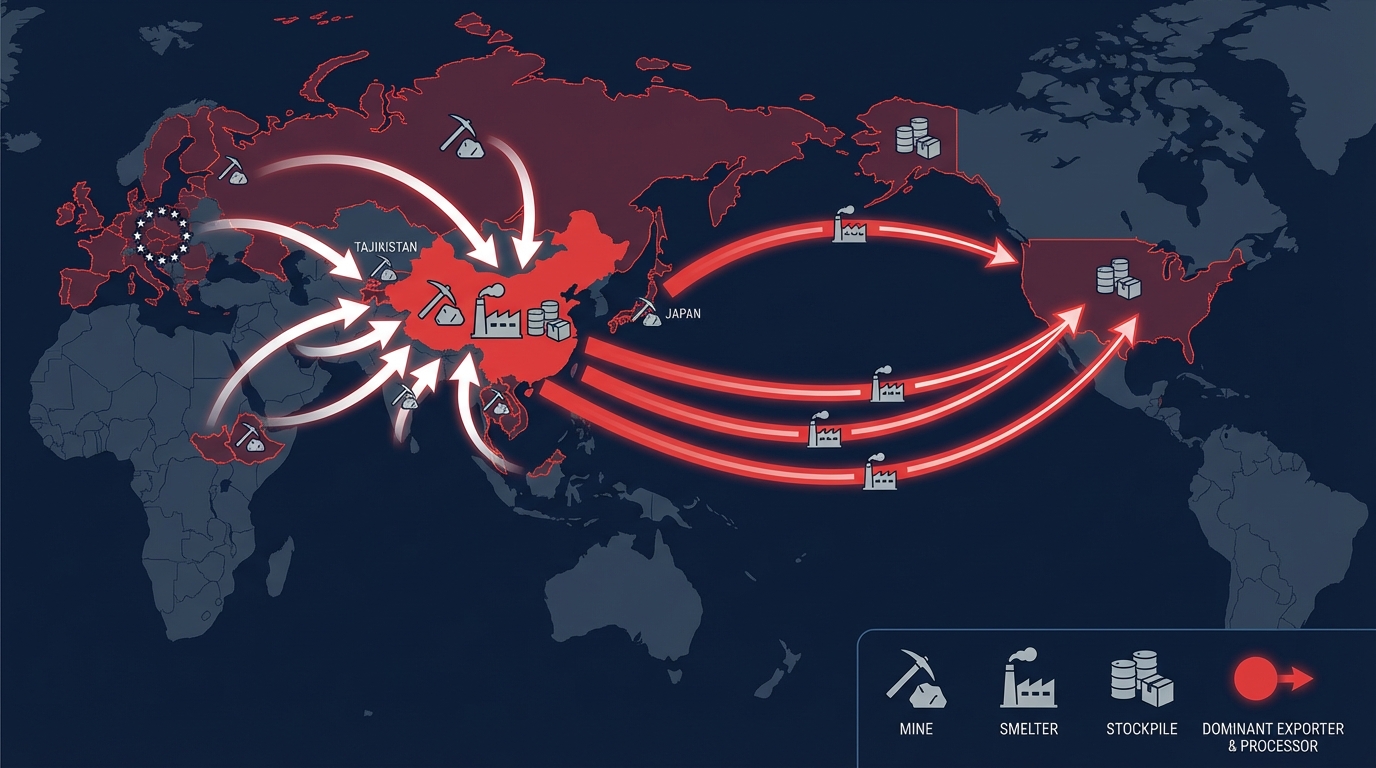
    Key Belgian transshipment hubs for strategic and precious metals.
    Key Belgian transshipment hubs for strategic and precious metals.

    Specific flows exposed include relabeling of Chinese antimony and REE magnet scrap through bonded warehouses in Antwerp, air‑cargo concealment via Liège and gold/silver bundles transiting alongside REEs and diamonds. Reported seizures include 4.7 MT in November 2025 misdeclared as lead, and Q1 2026 figures showing 1.2 MT of undeclared gold via Brussels Airport tied to sanctions‑evasion channels.

    Market and operational implications

    Processors and downstream users face a short‑term reduction in effective throughput of Belgium‑routed material: reported impacts include production interruptions at Hoboken recycling and refinery sites and flagged consignments at large storage facilities. For recyclers, contamination from smuggled magnet scrap prompted temporary shutdowns and certification backlogs. For battery chains, diverted or intercepted cobalt flows increased traceability exposures ahead of EU CBAM and other emissions/traceability regimes.

    Customs inspections reshaping strategic metal flows through Belgian ports.
    Customs inspections reshaping strategic metal flows through Belgian ports.

    Tradeoffs are visible: rerouting via Dutch or German ports reduces seizure risk but increases logistics costs and lead times; remaining through Belgian hubs now carries higher compliance scrutiny, potential criminal exposure under the 2026 code, and a greater likelihood of regulatory holds under EPPO investigations.

    Compliance, enforcement and geopolitical notes

    FATF evaluations highlighted Belgium’s resource constraints in AML enforcement that previously allowed commodity‑linked laundering networks to exploit diamond and metals channels. China’s export controls on antimony and rare earths intensified circumvention attempts, and official statements from China in late‑2025 noted concern about foreign circumvention. EPPO’s cross‑border remit increases the legal and reputational stakes for logistics providers and end‑users associated with Belgian transshipments.

    Data-driven view of enforcement actions, seizures, and supply chain delays.
    Data-driven view of enforcement actions, seizures, and supply chain delays.

    Signals to monitor

    • EPPO case filings and seizure reports tied to Antwerp/Liège.
    • Belgian customs HS‑code statistics for 2601–2617 and airport transshipment volumes.
    • Dwell‑time metrics at MPET terminal and Liège/Antwerp cargo facilities.
    • FATF follow‑up on Belgium’s AML effectiveness and resource allocations.
    • Implementation details and enforcement guidance under the April 2026 Criminal Code amendments and the six‑month transition period.

    Materials Dispatch Signal: The Belgium crackdown signals a structural tightening of EU transshipment controls for strategic metals. Short‑term frictions are translating into lead‑time and compliance premiums for Belgian routes; medium‑term effects will depend on enforcement resource allocation, EPPO case outcomes and whether alternative ports scale capacity to absorb rerouted flows. The pattern indicates elevated legal exposure for logistics firms and a higher bar for traceability certification across REE, antimony and cobalt supply chains.

    Sources referenced in this synthesis include EPPO operational notices, Belgian customs and port authority reports, FATF evaluations, and industry operational disclosures from key processors and traders active in Antwerp and Liège (public summaries and sector reporting from 2025–2026).

  • Tech deep dive: graphite vs silicon anodes – materials, supply chains, and risk

    Tech deep dive: graphite vs silicon anodes – materials, supply chains, and risk

    **Graphite remains the backbone anode material for lithium-ion batteries, but its China-centric refining footprint is now a structural vulnerability. Silicon promises an order-of-magnitude higher capacity and largely Western-centric supply chains, yet introduces new technical, scaling, and safety risks. The critical question for the second half of the decade is no longer “graphite or silicon” but how fast silicon blends can be industrialized while managing graphite exposure under tightening policy, ESG, and technology constraints.**

    Tech Deep Dive: Graphite vs Silicon Anodes – Materials, Supply Chains, and Risk

    Electric vehicle and stationary storage programs are no longer debating whether to use lithium-ion batteries; the debate has moved inside the cell. Anode chemistry, in particular the balance between graphite and silicon, has become a structural determinant of range, fast-charge capability, and-critically-supply chain risk. This is the terrain of the current “Tech Deep Dive: Graphite vs Silicon Anodes – Materials, Supply Chains, and Risk.”

    Graphite has delivered the reliability that made lithium-ion bankable at scale. Silicon, with roughly an order-of-magnitude higher theoretical capacity, is now the front-runner for the next energy-density step-change. Yet the trade-off is clear: graphite is technologically mature but geopolitically exposed; silicon is geographically diversified but technically immature at volume.

    Materials Dispatch views this not as a simple technology upgrade, but as a restructuring of risk: from a single dominant material with concentrated refining to a mixed anode landscape where chemistry choice, supplier footprint, and policy alignment interact in non-trivial ways.

    1. Material Fundamentals: What Graphite and Silicon Actually Do in the Cell

    1.1 Graphite: The Workhorse Intercalation Host

    Graphite anodes rely on lithium intercalation. Lithium ions insert between the graphene layers to form stages of LixC6, with a commonly cited theoretical capacity of around 372 mAh/g for fully lithiated graphite. In practice, commercial anodes operate somewhat below this limit to preserve cycle life and avoid lithium plating.

    The key operational strength of graphite is dimensional stability. During cycling, well-designed graphite anodes typically experience limited volume change, enabling thousands of cycles in mainstream EV duty cycles when paired with appropriate cathodes and operating windows. This stability simplifies mechanical design of cells and packs, reduces mechanical stress on separators, and limits continuous re-formation of the solid-electrolyte interphase (SEI).

    The downside is energy density and fast-charge headroom. Graphite’s specific capacity caps the anode-side contribution to cell-level energy density. Under aggressive fast-charging, the anode potential can reach levels where lithium plating becomes a dominant failure mode, degrading cycle life and raising safety concerns. Most current-generation fast-charge EV strategies so rely on sophisticated thermal management and charge protocols to protect graphite rather than fundamentally changing the anode material.

    1.2 Silicon: From Intercalation to Alloying

    Silicon operates through a different mechanism: lithium-silicon alloying rather than intercalation. Fully lithiated silicon (approaching Li15Si4) has a widely cited theoretical capacity on the order of 3,500-3,600 mAh/g, almost an order of magnitude higher than graphite. Even partial utilization of this capacity enables significant anode mass reduction and higher cell-level energy density.

    However, alloying drives extreme volume change-often cited on the order of several hundred percent between fully lithiated and delithiated states. This expansion-contraction cycle induces mechanical stress, cracking of silicon particles, loss of electrical contact, and continuous SEI growth as fresh surface is exposed. The result, in unmitigated form, is rapid capacity fade and gas evolution.

    Modern silicon-anode approaches rarely rely on bulk silicon particles. Instead, they use engineered structures—nanowires, nano- or micro-structured silicon, silicon-oxide (SiOx), or silicon embedded in carbon frameworks—combined with optimized binders and electrolyte additives. Commercial players such as Amprius, Group14, Sila Nanotechnologies, NanoGraf, and others each pursue distinct architectures, but they all converge on the same challenge: harnessing silicon’s capacity while controlling mechanical and interfacial damage.

    1.3 Comparing Performance Levers: Energy, Power, and Life

    At cell level, the graphite–silicon trade-off is not binary. Most near-term implementations use hybrid anodes with a fraction of silicon blended into graphite, typically in the single-digit to low double-digit percentage range by weight. This approach targets incremental energy-density improvements while retaining established manufacturing baselines and cycle life expectations.

    Various public demonstrations by silicon-anode developers have reported energy densities significantly above those of standard graphite-based cells, with some lab and early commercial cells claiming gravimetric energy densities around or beyond 400 Wh/kg in specialized formats. Traditional EV-grade graphite-based cells often cluster materially below that figure, depending on cathode chemistry and format. The exact numbers vary by chemistry, packaging, and operating window, but the direction of travel is consistent: silicon increases the ceiling.

    Fast charging is another axis. Silicon-containing anodes can, in principle, accept higher currents because the anode potential can be maintained at safer levels while storing more lithium. Several developers publicly highlight sub-15-minute charge profiles under specific conditions. Yet high-power protocols also accelerate mechanical and SEI-related stress in silicon, so fast-charge capability is coupled tightly to thermal management, cell design, and control strategies rather than anode material alone.

    1.4 Property Comparison in Operational Terms

    Parameter Graphite-Dominant Anode Silicon-Enhanced / Silicon-Dominant Anode Operational Consequence
    Theoretical specific capacity (mAh/g) ~372 (lithiated graphite) ~3,000–3,600 (lithiated silicon, depending on phase) Silicon enables substantially higher anode-side capacity in principle.
    Volume change during cycling Typically limited; often quoted at <10% range Very high; often cited in the several-hundred-percent range for pure Si Silicon requires advanced mechanical accommodation to avoid fracture.
    Cycle life (EV-grade duty) Established; multi-thousand cycles feasible with optimized cells Highly architecture-dependent; commercial targets focus on matching graphite-grade warranties Long-term stability of silicon solutions remains a core qualification question.
    Fast-charge tolerance Constrained by lithium plating risk at high C-rates Potentially higher acceptance if mechanical/SEI issues managed Silicon blends are being positioned as fast-charge enablers, but validation is ongoing.
    Manufacturing maturity Highly mature; global multi-GWh scale across regions Emerging; pilot to early GWh-scale lines focused in North America, Europe, and East Asia Graphite remains baseline; silicon capacity ramps from a lower base.

    The pattern is clear: silicon pushes the frontiers on energy density and potentially charge rate, while graphite anchors mechanical stability and proven lifetime. The technology race is not only about which material is “better,” but about which combinations deliver acceptable performance at industrial scale with manageable risk.

    2. Graphite Supply Chains: From Geology to Export Controls

    2.1 Upstream: Natural vs Synthetic Graphite

    Graphite for lithium-ion anodes comes from two broad sources: natural graphite mined from deposits, and synthetic graphite produced from petroleum coke or other carbonaceous precursors at high temperatures. Natural graphite offers lower energy intensity in mining but requires extensive processing and purification. Synthetic graphite offers highly controlled properties but is energy- and emission-intensive due to graphitization furnaces operating at very high temperatures.

    From an operational standpoint, natural graphite anode feedstock is typically produced by crushing and flotation to concentrate carbon, followed by micronization, spheronization, and purification to reach battery-grade specifications. This route relies on water-intensive beneficiation and often uses chemical or thermal purification steps to reduce impurities to low ppm ranges. Synthetic graphite, in contrast, begins from petroleum or coal-derived coke that is calcined, formed into shapes, and then graphitized. The process consumes significant electricity and can have a sizable CO2 footprint, depending on power sources.

    For EV-cell producers, both routes converge midstream: the critical step is spherical graphite production with controlled particle size distribution, tap density, surface area, and coating, rather than whether the carbon originated from rock or coke. However, the geographic and regulatory profile of these routes differs sharply, and that distinction is increasingly important.

    2.2 Midstream: Spherical Graphite and Chinese Dominance

    Most of the world’s anode-grade spherical graphite refining capacity is currently located in China. Public data from agencies such as USGS and industry trackers consistently indicate that China accounts for a majority of natural graphite mining and an even larger share of battery-grade graphite processing, often cited at well over four-fifths of global output. Even when ore is mined elsewhere—Mozambique, Canada, Madagascar, or other jurisdictions—a substantial fraction has historically been shipped to China for purification and spheronization.

    The refining process is where much of the value-add and environmental impact arises. Chemical purification routes frequently use hydrofluoric acid and other reagents to lower impurity levels, raising worker safety and effluent management challenges. Thermal purification requires high-temperature furnaces and significant electricity. Many Chinese facilities have spent years optimizing throughput, yields, and cost structures across these steps, building a high-barrier-to-entry competitive moat.

    This concentration creates a simple but uncomfortable reality for battery producers in North America, Europe, and allied jurisdictions: even with diversified mining, the system remains exposed to Chinese refining policy, permitting cycles, and local environmental enforcement. Export licensing regimes and critical minerals lists have turned what used to be a procurement detail into a board-level risk item.

    Conceptual comparison of graphite and silicon anode structures and performance characteristics.
    Conceptual comparison of graphite and silicon anode structures and performance characteristics.

    2.3 Downstream: Anode Production and Qualification Cycles

    Downstream of spherical graphite and related precursors, anode manufacturers mix active materials with binders, conductive additives, and solvents, coat copper foil, dry and calendar the electrodes, and then cut, stack, or wind them into cells. This is also where new non-Chinese capacity is scaling: several facilities in North America and Europe are seeking to process imported natural graphite or domestically produced synthetic graphite into finished anodes without intermediate Chinese steps.

    However, anode production is tightly integrated into cell manufacturers’ qualification regimes. Changing supplier, surface coating, or particle morphology can require extensive requalification, including formation cycle optimization and long-term durability tests. This slows diversification. Even when alternative graphite sources are available, ramping them into qualified EV cells is a multi-year operational exercise, not a simple sourcing switch.

    2.4 Regulatory and ESG Pressures on Graphite

    Environmental regulation is tightening around both natural and synthetic graphite. For natural graphite, water use, tailings management, and biodiversity impact at mine sites are focal points for permitting agencies and local communities. For refining, chemical usage and disposal are under increasing scrutiny. For synthetic graphite, greenhouse-gas intensity of production is a growing concern for automotive OEMs that have lifecycle emissions targets.

    Policy instruments such as the US Inflation Reduction Act’s “foreign entity of concern” provisions and the EU’s Critical Raw Materials Regulation are not merely labels; they influence where anode-grade graphite can be counted towards local-content thresholds and subsidies. In practice, this adds another layer of complexity: some graphite volumes are technically available on the market but effectively constrained for certain EV programs due to origin and processing history.

    In short, graphite is abundant as an element and technologically mature as an anode, yet its refined form is now entangled in policy, ESG, and industrial strategy debates. The risk is less about physical scarcity and more about concentration, compliance, and the pace at which new refining capacity outside China can reach competitive cost and quality.

    3. Silicon Anode Supply Chains: Abundant Element, Scarce Processing

    3.1 Raw Materials: From Quartz to Metallurgical Silicon

    Silicon, the second most abundant element in the Earth’s crust, is not constrained at the ore level. Quartz and other silica-rich materials are globally distributed, and metallurgical-grade silicon (MG-Si) is produced at large scale in multiple regions, including North America, Europe, and Asia. MG-Si is already used extensively in aluminum alloys, chemicals, and solar-grade silicon production.

    For anodes, however, the bottleneck is not MG-Si itself but the conversion of silicon into nano- or microstructured forms with tightly controlled properties. Battery-grade silicon materials require narrow particle sizes, engineered porosity, specific surface chemistries, and controlled impurity profiles. These are produced through processes such as gas-phase deposition (for nanowires), high-energy milling, plasma synthesis, or various proprietary methods.

    As a result, the upstream silicon resource base offers comfort from a physical availability perspective, but the midstream processing layer is nascent and capital intensive. The leverage point in the silicon anode supply chain is not the mine but the specialized processing plant.

    3.2 Midstream Technologies: Multiple Pathways, Common Constraints

    Silicon-anode midstream players are pursuing diverse technical paths:

    • Silicon nanowires: Grown via chemical vapor deposition on conductive scaffolds, this approach (seen in public descriptions from companies like Amprius) aims to accommodate volume expansion along the wire axis while maintaining electrical contact.
    • Silicon-carbon composites: Silicon particles embedded in porous or graphitic carbon matrices (e.g., architectures promoted by Group14 and others) distribute stresses and buffer expansion while leveraging carbon’s conductivity.
    • Silicon-oxide and silicon-rich oxides: SiOx-based materials offer lower effective expansion and more gradual lithiation profiles at the cost of reduced specific capacity vs pure silicon.
    • Graphite–silicon hybrids: Blending silicon into graphite with tailored binders and coatings yields incremental performance gains with lower disruption to existing anode lines.

    Each route imposes different capex and opex structures. Gas-phase processes using silane or other precursors raise stringent safety, gas-handling, and permitting requirements. Solid-state routes can be more modular but still demand advanced powder-handling, classification, and surface-treatment equipment. Across all approaches, tight process control is essential: small deviations in particle morphology or surface chemistry can translate into large swings in cycle life and gas generation.

    3.3 Geographic Footprint: A More Distributed Base

    Unlike graphite refining, silicon-anode midstream capacity is more geographically distributed from inception. Many of the leading developers are headquartered or building major facilities in the United States and Europe, often co-located with existing semiconductor, specialty-chemicals, or advanced-materials clusters. East Asia remains critical, particularly for integration with established cell manufacturing ecosystems in Korea, Japan, and China, but the vendor base is not as singularly concentrated as graphite refining.

    Moreover, government support programs in North America and Europe explicitly target silicon-anode capacity as part of broader battery-industrial strategies. Grants, loans, and tax incentives are being deployed to bridge initial capex gaps, recognizing that silicon processing plants resemble specialty chemical or semiconductor facilities in their complexity and safety requirements.

    This positioning creates an interesting asymmetry: silicon anodes are technically more challenging yet politically favored, while graphite is technically mature yet increasingly scrutinized. The net result is a supply landscape where growth in silicon capacity is likely to be policy-pulled and regionally diversified, even if starting from a much smaller base than graphite.

    3.4 Technology Maturity and Qualification Risk

    For OEMs and cell manufacturers, the main constraint on silicon is not raw material availability but technology maturity and qualification risk. Public announcements from silicon-anode companies often showcase high energy densities and promising cycle life in cell formats targeted at aerospace, premium EVs, or consumer electronics. Translating those results into multi-GWh automotive lines involves several non-trivial steps:

    Global supply chain concentration for graphite versus emerging silicon anode production.
    Global supply chain concentration for graphite versus emerging silicon anode production.
    • Scaling from pilot to production while preserving particle morphology and surface chemistry.
    • Ensuring binder and electrolyte systems remain stable under manufacturing variability.
    • Meeting stringent safety and abuse-test standards, including nail penetration, thermal runaway characterization, and crush tests.
    • Proving calendar life under real-world temperature and state-of-charge distributions, not just cycling at laboratory conditions.

    Early silicon deployments in EVs are appearing first in higher-end or specialty models, where the performance premium justifies higher material costs and where volumes are moderate enough to manage supply risk. Over time, silicon-graphite blends are expected to diffuse into more mainstream platforms if durability and cost trajectories align with OEM requirements.

    4. Comparative Risk Map: Material, Geopolitics, Technology, ESG

    4.1 Material Availability and Concentration Risk

    From a pure resource perspective, both carbon and silicon are abundantly available in the Earth’s crust. The relevant risk is not geological scarcity but the industrial structure of conversion to battery-grade materials.

    Graphite’s risk locus is refining concentration. A large share of the world’s spherical graphite capacity sits in a single country, which has already demonstrated willingness to apply export controls and industrial policy in other critical-materials sectors. Any disruption—whether from policy, environmental enforcement, or local energy constraints—can ripple through EV and storage programs globally.

    Silicon’s risk locus is processing maturity. The abundance of silica and global MG-Si production offers comfort on upstream availability, but the specialized plants turning silicon into advanced anode materials are few, young, and technology-specific. If a key vendor’s process underperforms in the field, or if scaling reveals unforeseen reliability issues, substitution options are more limited in the short term.

    4.2 Geopolitical and Trade Exposure

    Graphite’s heavy processing concentration in China exposes it directly to the evolving landscape of export controls, tariffs, and local-content rules. Measures that tighten export licensing or reclassify certain graphite products as sensitive can affect availability and qualification timelines far beyond what raw tonnage statistics might suggest.

    Silicon-anode supply chains, anchored more strongly in North America and Europe alongside East Asian partners, align more naturally with Western industrial-policy objectives. This does not eliminate geopolitical risk—technology export controls and cross-border investment review can also affect silicon technologies—but the risk is more distributed across jurisdictions rather than concentrated in one.

    One structural insight emerges here: the geopolitical risk of graphite is about single-node concentration; the geopolitical risk of silicon is about many small nodes whose reliability is not yet fully proven. In other words, graphite’s threat is macro and concentrated, silicon’s is micro and distributed.

    4.3 Technology and Scaling Risk

    Graphite technology is well understood. Known issues—such as lithium plating at high charge rates or gas evolution under certain conditions—are familiar and embedded in existing design rules. Scaling risk for new graphite capacity primarily relates to building and commissioning purification and shaping lines, not to fundamental uncertainty about anode behavior.

    Silicon technology, in contrast, still sits on a steeper learning curve. Each vendor’s architecture (nanowire vs composite vs SiOx, and others) has distinct failure modes and sensitivities. Binder chemistries, electrolyte formulations, and formation protocols are highly co-optimized with the silicon material. As a result, introducing a new silicon supplier is closer to integrating a new cell platform than swapping in an incremental graphite source.

    Furthermore, silicon processing often relies on hazardous precursors (such as silane in certain gas-phase processes) and advanced equipment. This raises commissioning and operational risk: delays in safety permitting, training, or equipment delivery can push back capacity ramps. For graphite, the equipment set—mills, reactors, furnaces—is demanding but more conventional in the materials-processing world.

    4.4 ESG, Lifecycle, and Compliance Risk

    ESG considerations are reshaping both graphite and silicon trajectories. Lifecycle assessments show that synthetic graphite’s energy-intensive production can have a substantial carbon footprint unless powered by low-carbon electricity. Natural graphite mining brings its own land use, biodiversity, and water-management challenges, which are increasingly scrutinized by regulators and financiers.

    Silicon-anode materials are produced in relatively smaller volumes today, but their pathways often intersect with high-purity chemicals, specialty gases, and semiconductor-like operations. This can be an ESG advantage or liability depending on how energy and chemicals are sourced and managed. Some silicon-anode developers explicitly position their facilities in regions with abundant low-carbon power (e.g., hydro or renewables) to anchor a favorable lifecycle profile.

    Compliance risk is evolving rapidly. Origin rules in major EV markets increasingly track not only where ore was mined, but where intermediate refining and final active-material production take place. For graphite, this can effectively restrict the share of Chinese-refined material in certain supply chains, even if technically available. For silicon, qualification of facilities in aligned jurisdictions can unlock preferential treatment, but also ties the business model to the durability of those policy frameworks.

    5. Operational Realities: How Graphite and Silicon Coexist on the Line

    5.1 Hybrid Anodes as the Dominant Transitional Form

    The dominant near-term configuration in EV cells is not pure silicon but hybrid graphite–silicon anodes. Blending a modest proportion of silicon into graphite, often supported by modified binders and electrolytes, can deliver meaningful energy-density and sometimes power-density gains without forcing a wholesale redesign of manufacturing lines.

    From a manufacturing standpoint, hybrid anodes allow existing slurry-mixing, coating, drying, and calendaring infrastructure to be retained with calibrated adjustments. Coating weights, solvent systems, and drying profiles often require optimization to handle different rheology and gas-evolution characteristics, but the capital envelope remains recognizable. This explains why many automakers are first introducing silicon in higher-end models or specific packs as a performance differentiator while keeping their main GWh volumes on conventional graphite.

    5.2 Quality Control and Failure Modes

    Quality control regimes differ subtly between graphite and silicon-containing anodes. For graphite, particle-size distribution, surface area, tap density, and impurity levels are the critical descriptors; variation in these dimensions affects first-cycle efficiency, rate capability, and lifetime, but the mapping from property to performance is relatively well known.

    Illustrative EV battery pack showing the transition from graphite to silicon-enhanced anodes.
    Illustrative EV battery pack showing the transition from graphite to silicon-enhanced anodes.

    Silicon introduces additional variables: internal porosity, distribution of silicon within carbon matrices, oxide layer thickness, and the mechanical integrity of composites under cycling all need to be monitored. Standard powder metrics are necessary but not sufficient; advanced characterization—SEM/TEM imaging, in situ dilatometry, and detailed gas-evolution monitoring—play a more central role in debugging field issues.

    Failure modes also shift. Graphite-dominated cells often fail through gradual SEI thickening, lithium inventory loss, or lithium plating in corner cases. Silicon-rich cells can fail via particle pulverization, contact loss, accelerated gas generation, and swelling, which can manifest as cell bloating or stack delamination. For pack engineers and safety teams, this means different surveillance and diagnostic strategies for fleets that transition from graphite-heavy to silicon-enhanced chemistries.

    5.3 Capex and Process Complexity

    On the anode-manufacturing line itself, the shift from graphite to silicon blends primarily affects upstream active-material supply and some aspects of slurry preparation and formation cycling. Coating, drying, and cell assembly infrastructure can often handle both, provided mechanical stability and gas management constraints are respected.

    The more substantial capex implications sit at the silicon processing stage. Building a silicon-anode-material plant that handles hazardous gases, high-purity powders, and intricate thermal profiles is closer to a specialty-chemicals or semiconductor plant project than to a conventional mineral-beneficiation plant. Longer lead times for critical equipment, more complex permitting, and specialized workforce requirements all lengthen the path from project announcement to stable output.

    This contrast leads to a structural dynamic: graphite’s capex intensity is skewed toward tonnage and purification; silicon’s capex intensity is skewed toward precision and safety. Both have cost implications, but the risk profile of delays and ramp curves looks different for each.

    6. Scenario Lenses for 2025–2030: How the Risk Balance Could Shift

    6.1 Slow Silicon, Sticky Graphite

    One plausible scenario is that silicon-anode technologies progress more slowly than promotional timelines suggest. Under this path, graphite remains dominant well into the next decade, with silicon confined to premium segments or specialty applications. Diversification away from Chinese refining occurs, but at a measured pace shaped by permitting, ESG requirements, and cost competitiveness of new facilities.

    In such a scenario, supply-chain resilience efforts focus on building non-Chinese spherical graphite capacity, qualifying multiple natural and synthetic sources, and optimizing synthetic-graphite energy footprints. Silicon retains a strategic role as a future option and as an energy-density booster in select platforms, but graphite’s maturity continues to anchor bulk EV production.

    6.2 Hybrid Era: Silicon Blends as the New Normal

    A second, increasingly likely scenario is a “hybrid era” in which silicon-graphite blends become standard in mid- to high-end EVs and gradually permeate into mass-market platforms. In this world, anode lines routinely handle formulations with modest silicon content, and qualification frameworks evolve to treat silicon vendors more like conventional material suppliers than experimental partners.

    Here, graphite tonnage demand remains substantial—because even a silicon-enhanced anode typically retains a graphite backbone—but the sensitivity to any single country’s refining policies declines as silicon volumes ramp in parallel. Risk managers focus less on a binary graphite-versus-silicon choice and more on balancing portfolios of graphite sources, silicon technologies, and regional processing footprints to satisfy both performance and origin requirements.

    6.3 Policy-Pulled Silicon: Industrial Strategy as a Catalyst

    A third scenario sees industrial policy playing a catalytic role in accelerating silicon adoption. Subsidies, local-content rules, and defense or strategic-program demand could pull silicon-based chemistries into earlier and broader deployment than a purely techno-economic analysis would justify at this stage of maturity.

    This path reshapes the risk balance: silicon’s technology and scaling risk becomes more prominent in the near term, but geopolitical and compliance risks tied to graphite decline more quickly. The system effectively exchanges one category of risk (concentration and policy exposure) for another (technology performance and ramp reliability). Whether this exchange is favorable depends on each manufacturer’s product mix, regional exposure, and risk tolerance.

    Across all scenarios, one meta-conclusion stands out: energy-density gains from silicon do not automatically neutralize graphite risk; they re-weight it. Even aggressive silicon adoption leaves graphite as a significant component of global anode mass for years, meaning that diversification and ESG-driven reforms in graphite supply chains remain strategically relevant alongside silicon’s rise.

    Conclusion: Trade-Offs, Not Silver Bullets

    Graphite versus silicon in anodes is often framed as a replacement story. The operational reality is more nuanced. Graphite underpins the current lithium-ion system with known behavior and extensive industrial infrastructure but is exposed to refining concentration and ESG scrutiny. Silicon offers step-change performance potential and a more diversified, policy-aligned geographic base, but introduces unresolved questions around scaling, long-term durability, and complex processing.

    For the remainder of the decade, the anode landscape is likely to be defined by co-existence: graphite-heavy chemistries, graphite–silicon hybrids, and niche high-silicon formats operating side by side. The strategic differentiator will not be a single chosen chemistry, but the ability to orchestrate material portfolios, regional processing, and qualification roadmaps in a way that keeps performance, cost, and compliance in balance.

    Materials Dispatch will continue to track weak signals across three fronts: refinements in silicon-anode architectures and their field data, the build-out and policy treatment of graphite refining outside China, and regulatory shifts that redefine which materials “count” toward critical-mineral benchmarks. The intersection of these signals will determine how the graphite–silicon risk map evolves from technical promise to industrial reality.

    Note on Materials Dispatch methodology Materials Dispatch integrates continuous monitoring of regulatory communications (including agencies such as MOFCOM and Western trade authorities), company disclosures on graphite and silicon projects, and end-use performance specifications from EV and storage platforms. This triangulation enables a technology-grounded read of where material science, industrial capacity, and policy constraints genuinely intersect in the graphite–silicon anode transition.

  • How to build an internal ‘materials war room’ for your company

    How to build an internal ‘materials war room’ for your company

    A Materials War Room is a cross-functional command center focused on real-time monitoring and coordinated response to disruptions in strategic metals and rare earth supply chains. In practice, it has looked less like a dramatic crisis bunker and more like a disciplined combination of people, data, and routines dedicated to understanding exposures around REEs, lithium, cobalt, nickel, tungsten, PGMs, and related logistics and regulatory constraints.

    In several organizations, the trigger for creating such a war room has been a specific shock: tighter Chinese rare earth export controls, unforeseen outages at DRC cobalt operations, or Indonesian nickel policy shifts that cascaded into cathode plant slowdowns. Over time, these war rooms evolved into standing capabilities rather than ad‑hoc crisis responses.

    Key Operational Tensions and Signals to Track

    • Tradeoffs: Centralizing intelligence vs. preserving local sourcing autonomy; transparency across business units vs. sensitivity around supplier and geopolitical exposure.
    • Risks & failure modes: War room treated as a dashboard-only project, no decision rights; over-reliance on a single geography (e.g., China for REEs, DRC for cobalt, Russia for PGMs); ESG data gaps around artisanal or high-risk sources.
    • Indicators to watch: Export quotas and licensing changes (e.g., Chinese REEs, Indonesian nickel), sanctions and trade restrictions (e.g., Russian palladium, Iranian metals), and chokepoints in logistics (Panama Canal, Red Sea routes, Southern African rail corridors).
    • Organizational signals: Recurring last-minute expediting, board questions about critical minerals, and fragmented internal spreadsheets are common precursors to formal war room setups.
    • Technology tension: Rich alerting through AI and satellite feeds vs. alert fatigue and mistrust of opaque models.

    1. Framing the Scope and Objectives of the Materials War Room

    The starting point observed in effective war rooms has been a sober discussion of scope: which materials, which business units, and which tiers of the supply chain fall under its remit. Many teams have used recent USGS critical minerals lists or the EU Critical Raw Materials Act (CRMA) annexes as a neutral backbone, then overlaid internal dependency mapping: for example, neodymium and dysprosium for permanent magnets in defense systems, lithium carbonate equivalent (LCE) for battery lines, cobalt for aerospace alloys, palladium and platinum for autocatalysts and fuel cells.

    Where scopes have remained vague (“monitor all commodity risk”), war rooms tended to drift into generic market commentary. Where scopes were defined in terms of concrete failure scenarios (“interruptions at these ten named assets or routes would stop these three product lines”), the resulting analysis and escalation paths became more actionable.

    In several cases, executive sponsorship was unlocked not by abstract resilience language, but by anchoring the war room in existing obligations: Sarbanes‑Oxley style annual risk assessments, conflict minerals reporting, or defense procurement requirements around traceability and origin for REE magnets and tungsten components.

    2. Team Composition and Governance: RACI in Practice

    Operational war rooms for strategic metals have typically involved 8-12 core participants drawn from procurement, supply chain, engineering/R&D, legal and compliance, and IT/data. The configuration that recurs most often is a RACI-style structure:

    • Responsible: Supply chain and category analysts who track mines, refineries, and key recyclers (for example, following MP Materials’ Mountain Pass for NdPr oxides, Lynas’ separation facilities, or Glencore’s Mutanda cobalt operations).
    • Accountable: A senior operations or procurement executive empowered to trigger responses such as qualifying an alternative supplier, re‑sequencing production, or drawing on stockpiles.
    • Consulted: Regulatory and ESG specialists familiar with CRMA, U.S. defense sourcing rules, conflict minerals guidance, and sanctions regimes affecting, for instance, Russian nickel and palladium producers.
    • Informed: Finance, product leadership, and in some cases the board risk committee, via concise periodic updates.

    One discovery many teams reported was the risk of role overlap: when multiple functions implicitly believed they were the ultimate decision-makers, reaction time during a disruption lengthened rather than shortened. Explicit decision trees – for instance, clarifying who can approve a temporary sourcing shift from a Chinese rare earths separator to an Australian or US alternative – helped reduce this confusion.

    3. Designing the Physical and Digital War Room Environment

    Material war rooms have taken two complementary forms: a dedicated physical space and a persistent digital environment. The physical space often features large displays with a “single pane of glass” view: maps of key assets and routes, current operational status, open incidents, and a ranked risk list. Typical maps would call out locations such as Mountain Pass (USA) for REEs, Greenbushes (Australia) for lithium, Mutanda and Kamoa-Kakula (DRC) for cobalt and copper, and Norilsk operations in Russia for nickel and palladium.

    Digitally, teams have converged on a mix of business intelligence tools (e.g., Tableau, Power BI), enterprise risk platforms, and custom dashboards fed by:

    Cross-functional materials war room for strategic metals risk monitoring
    Cross-functional materials war room for strategic metals risk monitoring
    • Authoritative geological and production data (e.g., USGS reports, company technical disclosures).
    • Trade and logistics feeds, including vessel tracking for key concentrates and refined products.
    • Regulatory and sanctions updates tied to critical jurisdictions (China, DRC, Indonesia, Russia, South Africa).
    • News and specialist commentary on specific assets such as Lynas’ Kalgoorlie plant ramp-up or Albemarle’s Australian expansions.

    A recurring pitfall has been overloading the environment with datasets without a clear “question hierarchy.” War rooms that worked well tended to start from a small canon of recurring questions – for example, “Which five assets, if disrupted, would halt more than a defined fraction of magnet or battery output?” – and only integrated data that helped answer those questions reliably.

    4. Mapping Critical Assets, Routes, and Dependencies

    An effective foundation has been a curated list of critical assets, processes, and routes. In the REE and strategic metals context, such a list often included:

    • Upstream mines and concentrators (e.g., MP Materials for REO concentrates, Pilbara or Greenbushes for spodumene, Ivanhoe’s Kamoa‑Kakula for copper and associated cobalt).
    • Midstream refineries and separation plants (e.g., Lynas’ facilities in Australia and Malaysia, Chinese magnet producers in Jiangxi and Inner Mongolia, nickel HPAL plants in Indonesia).
    • Recycling hubs (e.g., European PGM and battery recyclers such as Umicore’s sites, North American catalyst recyclers).
    • Transport corridors: DRC to Durban via rail and truck, Indonesian nickel flows to Chinese and Korean smelters, Russian PGMs through Baltic and Turkish ports, and North American road and rail routes to defense contractors.

    In practice, these maps were most useful when linked to bill-of-materials data and product lines. For instance, some aerospace teams tagged specific engine or guidance systems that depended on tantalum or REE components traced to Central African and Chinese assets, which in turn shaped priority levels during scenario analysis.

    5. Structuring Risk Identification Across Categories

    To move beyond ad-hoc issue tracking, many war rooms adopted a categorization framework that echoed information-security standards (such as NIST SP 800‑53 or ISO-style risk catalogs) but applied to materials. Typical categories included:

    • Supply concentration: High dependence on single-country sources (e.g., China for REE separation, DRC for cobalt, Russia for certain PGMs).
    • Geopolitical and regulatory risk: Export quotas, sanctions, nationalization pressures, or resource nationalism (Indonesia’s evolution from ore bans to processing mandates, for example).
    • ESG and social license: Artisanal mining risks in the Copperbelt, community conflicts near Latin American lithium brines, or power and water constraints in South African PGM belts.
    • Technical and quality risk: Qualification bottlenecks when switching from Chinese-made NdFeB magnets to alternative suppliers, or from one lithium chemical form to another.
    • Logistics and infrastructure: Port congestion, canal droughts, rail strikes, or chronic power instability affecting smelters and refineries.

    During initial build-outs, teams often discovered that existing risk registers either treated these issues at an extremely high level (“country risk: high”) or buried them as scattered line items in procurement files. The war room process brought them into a single, continuously updated catalog tied to specific assets and routes.

    6. Risk Scoring and Prioritization: Likelihood, Impact, Velocity

    A common practice has been to translate qualitative discussions into consistent scoring using three axes:

    Operating model of a materials war room for critical mineral supply chains
    Operating model of a materials war room for critical mineral supply chains
    • Likelihood: Based on recent history, political trajectories, climate patterns, and corporate disclosures.
    • Impact: Measured not in prices, but in operational disruption: lost production days, delayed programs, or regulatory non‑compliance risks.
    • Velocity: How quickly disruption would be felt once triggered – for example, just‑in‑time palladium flows from Russian refiners vs. long‑cycle tungsten stockpiles.

    Some teams overlaid a fourth dimension: detectability. Satellite monitoring of mine tailings, vessel tracking, and near-real-time news analytics raised detectability on certain assets, which in turn made some high‑likelihood issues more manageable.

    One illustrative internal exercise modeled a scenario where a tightening of Chinese rare earth export quotas triggered a 30% move in neodymium prices. The exact price path was less important than what it revealed: the need for clear thresholds at which escalation would be triggered, such as activating alternative suppliers in Australia or North America, drawing on strategic stockpiles, or accelerating recycling programs for magnets and catalysts.

    7. Response Playbooks: Diversification, Substitution, Buffers

    Once high‑priority risks were identified, war rooms that delivered tangible value tended to maintain explicit “playbooks” rather than relying on improvised responses. These playbooks covered, for example:

    • Diversification: Examples included shifting part of REE separation volumes from Chinese tolling contracts to emerging Australian capacity, adding non‑DRC cobalt sources (e.g., from Canada or Australia) alongside Glencore and other Copperbelt producers, or qualifying additional PGM refiners outside of high‑risk jurisdictions.
    • Substitution and thrifting: Engineering-led initiatives to reduce cobalt intensity in cathode chemistries, increase platinum-to-palladium substitution where feasible, or redesign components to accept a wider range of REE sourcing specifications.
    • Stockpiles and inventory buffers: Strategic holdings of select PGMs or specialized REE alloys, sized to cover critical programs for a defined period. In some sectors, a six‑month palladium or dysprosium buffer for defense applications appeared as a reference point in planning discussions.
    • Contractual and insurance levers: Diversification and force‑majeure clauses, political risk insurance for high‑exposure assets, and logistics insurance for vulnerable routes like the Panama Canal or the Red Sea.

    One pattern that became evident was that playbooks needed to be tightly coupled to engineering and qualification timelines. For example, an automotive program that depended on a specific Chinese magnet vendor could not simply switch overnight to a new Lynas- or Japanese-made magnet without validating performance, durability, and regulatory certifications. War rooms that mapped those lead times explicitly were better positioned to choose between short‑term buffering and longer‑term redesign.

    8. Monitoring Technology, Data Feeds, and AI

    Data has been central to most materials war rooms, but deployment has varied dramatically. A common baseline included:

    • Regular pulls from geological and mining agencies (USGS, national surveys) and company production reports.
    • Specialist market intelligence on strategic metals and REEs.
    • Regulatory trackers for sanctions, export controls, and environmental approvals.
    • Logistics telemetry – AIS data for bulk carriers, port congestion indicators, and occasionally satellite imagery for mine or smelter activity.

    AI-based systems have increasingly been layered on top, generating alerts when narratives around specific assets change (for example, increased reporting on labor unrest at a South African PGM mine or new draft export rules for Chinese gallium and germanium). However, teams frequently encountered alert fatigue and skepticism about opaque models.

    To address this, some war rooms adopted tiered thresholds: low‑level alerts logged silently in the background, medium alerts surfaced in weekly scans, and high‑severity triggers – such as credible evidence of sanctions on a major PGM producer or closure of a key cobalt export route – pushed directly to the accountable executive with a clear time window for assessment.

    Real-time monitoring of rare earth and strategic metal supply chain risks
    Real-time monitoring of rare earth and strategic metal supply chain risks

    9. Cadence, Simulations, and Learning Loops

    Operational cadence has proved as important as tooling. A pattern that emerged from several organizations involved:

    • Short daily or near‑daily huddles during active disruptions, focused tightly on status, new information, and immediate decisions.
    • Weekly or bi‑weekly “scan” meetings, where the full risk landscape was reviewed, new risks logged, and scores adjusted.
    • Quarterly simulations or “war games” around scenarios such as a sudden Indonesian nickel policy change, tightening Chinese rare earth quotas, an extended South African power crisis affecting PGM supply, or rail disruption out of the DRC.

    Post‑incident reviews turned out to be particularly valuable. For example, one team discovered during a cobalt logistics disruption that critical knowledge about alternative trucking routes out of Katanga was held only by a single regional buyer. The war room process led to codifying that route intelligence and embedding it into the central playbook.

    10. KPIs, Auditability, and Scaling the War Room

    Over time, mature materials war rooms gravitated toward a small set of performance indicators used both to steer internal improvements and to satisfy board or regulator scrutiny. Common examples included:

    • Time to detect: Average time between an external trigger (e.g., public announcement of a quota or ban) and its appearance in the war room dashboard.
    • Time to decision: Duration from confirmed incident to a documented decision on response (diversification, substitution, stockpile drawdown, or other action).
    • Diversification scores: Share of critical materials volume coming from any single country or supplier, sometimes tracked against internal thresholds (for example, maximum exposure levels to one jurisdiction for REE separation or cobalt refining).
    • Compliance coverage: Proportion of critical suppliers with updated ESG, human rights, and sanctions screening records.

    Auditors and compliance teams frequently engaged with war rooms as a single location where evidence of structured risk management could be examined: meeting minutes, risk logs, escalation records, and scenario analyses. In at least one case, such documentation proved decisive in demonstrating that board oversight of critical mineral risks was not merely nominal.

    Scaling often involved either deepening the war room’s role within a particular material group (for example, a dedicated REE cell that followed MP Materials, Lynas, key Chinese separators, and emerging Vietnamese projects in detail) or extending its scope to adjacent materials like graphite, manganese, or high‑purity silicon where similar concentration risks were emerging.

    Closing Observations

    The Materials War Room concept has evolved from an emergency response mechanism into a standing analytical and coordination hub for strategic metals supply chains. Across regions and sectors, a few elements have proven especially consequential: a clearly bounded scope tied to concrete failure scenarios; explicit governance and decision rights; integrated but disciplined data environments; and response playbooks that recognize engineering and qualification realities.

    As export controls, sanctions, climate impacts, and social license pressures continue to reshape the geography of mining, refining, and recycling, organizations that have institutionalized such war rooms appear better positioned to explain their exposure, document their decisions, and adapt their sourcing architectures across REEs, battery metals, and precious metals alike.

  • Review: china‑plus‑one mining jurisdictions in africa and latin america: Latest Developments and

    Review: china‑plus‑one mining jurisdictions in africa and latin america: Latest Developments and

    China‑Plus‑One strategies in critical minerals are no longer abstract policy talking points; they are reshaping how mines are permitted, financed, and operated across Africa and Latin America. As downstream manufacturers in batteries, magnets, aerospace alloys, and advanced electronics look to dilute exposure to Chinese‑centric supply chains, attention has shifted to jurisdictions that combine geological endowment with at least a plausible path to diversified offtake and processing routes.

    This review focuses on operational continuity and supply chain risk in key China‑Plus‑One mining corridors rather than on financial metrics. The emphasis is on what actually keeps material flowing-or stops it-from pit or brine field to refinery: grid resilience, transport bottlenecks, regulatory behaviour, social license, and the structure of ownership and offtake agreements, especially where Chinese entities already hold strong positions.

    Across several quarters of monitoring operating data, public disclosures, and policy shifts, a clear pattern has emerged: Africa and Latin America offer meaningful diversification potential, but in most of the high‑grade, high‑volume districts, China is already embedded either at mine level, in mid‑stream processing, or in final refining. China‑Plus‑One in practice often looks less like substitution and more like incremental rebalancing under tight operational constraints.

    Analytical Lens: How Operational Continuity Shapes China‑Plus‑One

    The assessment below draws on four operational dimensions that have proved decisive across multiple critical mineral projects:

    • Infrastructure and energy reliability: grid stability, back‑up generation, and proximity to rail, road, and port infrastructure.
    • Regulatory and political behaviour: consistency of mining codes, contract sanctity, and the tempo of new royalties, export controls, or resource nationalism.
    • Security and social license: exposure to armed groups, community resistance, artisanal encroachment, and environmental litigation.
    • Ownership and offtake structure: degree of Chinese participation in equity and long‑term offtake versus scope for diversified contractual relationships.

    These elements interact differently in the Central African Copperbelt, Southern African lithium fields, the Brazilian nickel and rare earth hubs, and the Lithium Triangle in South America. The result is a spectrum of China‑Plus‑One jurisdictions: some offer relatively robust operating baselines but are heavily locked into Chinese offtake; others are more open commercially but carry higher interruption risk from power, transport, or politics.

    Central African Copperbelt: Cobalt‑Copper Anchor with Structural Fragilities

    The Central African Copperbelt, straddling the Democratic Republic of Congo (DRC) and Zambia, remains the single most strategic cluster for China‑Plus‑One thinking. Flagship assets such as Tenke Fungurume, Kamoa‑Kakula, and Mutanda represent a substantial share of globally traded cobalt and a material fraction of high‑grade copper supply. These operations underpin cathode chemistries, superalloys, and defense‑related components worldwide.

    Critical Finding: Ownership Patterns Limit True Diversification

    Across the Copperbelt, large industrial mines typically fall into two broad ownership patterns:

    • Majority Chinese‑owned operations (for example, assets under China Molybdenum, Zijin, and other state‑linked groups), with offtake streams directed primarily to Chinese refineries.
    • Joint ventures between Western or South African operators and Chinese partners, where governance structures often grant Chinese stakeholders substantial influence over expansion timing and offtake allocation.

    For China‑Plus‑One strategies, this creates a structural constraint: geological dependence on the Copperbelt can be diversified only partially at the mine gate. In practice, the real diversification leverage frequently lies further downstream-through new refining and cathode plants in other regions—while the ore and concentrate flows remain at least partly tied into Chinese‑aligned equity and offtake positions.

    Power, Transport, and Security: Day‑to‑Day Continuity Risks

    Field reports and operator disclosures point to three recurring operational friction points.

    Grid dependence and power variability. Many Congolese mines rely heavily on hydropower transmitted over aging networks. Seasonal variability, under‑investment in transmission, and competing domestic demand create periodic curtailments. Mines with captive generation or diversified power purchase agreements tend to ride out these stresses more smoothly, but even then, high‑energy downstream steps such as copper and cobalt refining often migrate to jurisdictions with more reliable grids—frequently in China or other parts of Asia.

    Logistics to port. The historical export routes via South African and Mozambican ports are congested and politically exposed. Emerging corridors, such as the modernisation of rail links toward Angolan ports on the Atlantic, are strategically significant for China‑Plus‑One advocates, since they could support alternative logistics chains into Europe or the Americas. In practice, however, Chinese entities are also prominent builders and financiers of these same corridors. Control over infrastructure thus does not always align neatly with diversification goals.

    Security and artisanal encroachment. In parts of the eastern DRC, armed group activity, informal taxation at roadblocks, and periodic unrest in mining communities have forced temporary halts or convoys under heightened protection. In parallel, artisanal mining often overlaps with industrial license areas, creating safety, environmental, and reputational risks. These factors introduce irregular, sometimes prolonged disruptions that are hard to hedge contractually and that propagate quickly through tight cobalt and copper supply chains.

    Risk Inflection Points to Monitor in the Copperbelt

    Three developments stand out as structural turning points for China‑Plus‑One viability in the Copperbelt:

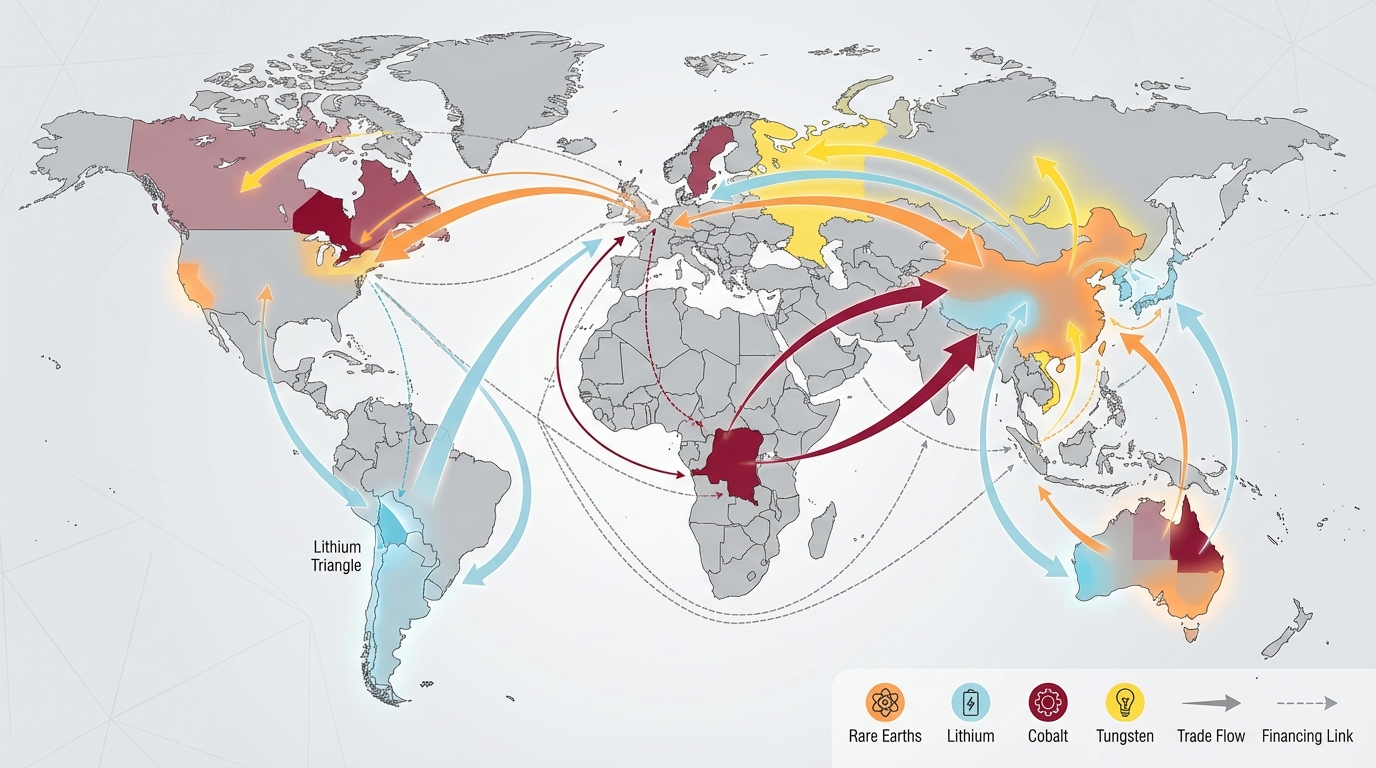
    Geopolitical map of key China-plus-one mining jurisdictions in Africa and Latin America.
    Geopolitical map of key China-plus-one mining jurisdictions in Africa and Latin America.
    • Any renewed revision of mining codes or tax regimes in the DRC, particularly if accompanied by retroactive contract reviews.
    • Concrete progress—or lack thereof—on non‑Chinese anchored rail and port upgrades, especially along Atlantic routes.
    • Changes in the political and security landscape that affect cross‑border traffic between the DRC, Zambia, and coastal export hubs.

    The direction of these variables will determine whether diversification in this corridor remains largely nominal or becomes operationally meaningful.

    Southern African Lithium: Zimbabwe and Emerging Peers

    Zimbabwe has moved rapidly from a marginal lithium producer to one of Africa’s key hard‑rock lithium hubs, with operations such as Bikita and Arcadia attracting significant Chinese investment and offtake interest. Neighbouring countries, including Namibia and, further afield, Mali, have also seen a surge of spodumene exploration and project announcements, many carrying Chinese equity or pre‑finance structures.

    Export and processing mandates as double‑edged tools. Zimbabwe’s policy shift toward restricting the export of unprocessed lithium ore and pushing for domestic beneficiation is emblematic. On one hand, these measures support the logic of China‑Plus‑One by aiming to embed more value‑added processing capacity within Africa, potentially diversifying away from Chinese refiners. On the other hand, abrupt rule changes, opaque implementation, and capacity constraints in local processing have introduced new continuity risks. Short‑term dislocations have included stockpiling at mine sites, delays in export permitting, and disputes over what qualifies as “sufficiently processed” material.

    Power and currency instability. Chronic load‑shedding and grid instability in Zimbabwe feed directly into lithium processing uptime, especially at concentrators and potential chemical conversion plants. Parallel foreign‑exchange challenges complicate procurement of spares, reagents, and mining services, increasing the probability of lengthier shutdowns when equipment fails. These factors do not necessarily negate the geological appeal, but they compress the margin for error across the supply chain.

    Chinese capital as both enabler and constraint. Many Southern African lithium projects have advanced thanks to Chinese balance sheets, engineering expertise, and offtake commitments. This accelerates development timelines, a clear positive for global supply. At the same time, it tends to lock in significant volumes to Chinese converters, limiting the flexibility that China‑Plus‑One agendas aim to create. Where alternative buyers seek access, negotiations often revolve around secondary streams, spot parcels, or future expansion phases rather than core volumes.

    Brazilian Nickel and Rare Earths: A More Stable but Complex Hub

    Brazil occupies a distinct position in the China‑Plus‑One landscape. It combines large lateritic nickel deposits, significant high‑grade iron ore, and, increasingly, promising rare earth and niobium projects. At the same time, it has comparatively developed institutions, domestic capital markets, and an established mining services ecosystem.

    Nickel operations and grid robustness. Established nickel operations in Brazil benefit from deeper integration into the national grid and proximity to ports with existing bulk export capacity. From an operational continuity standpoint, this reduces the risk of prolonged power‑related stoppages, although localised curtailments and transmission constraints still occur. Rail and road networks in mining states such as Pará and Goiás are far from perfect but generally more predictable than those in many emerging African producers.

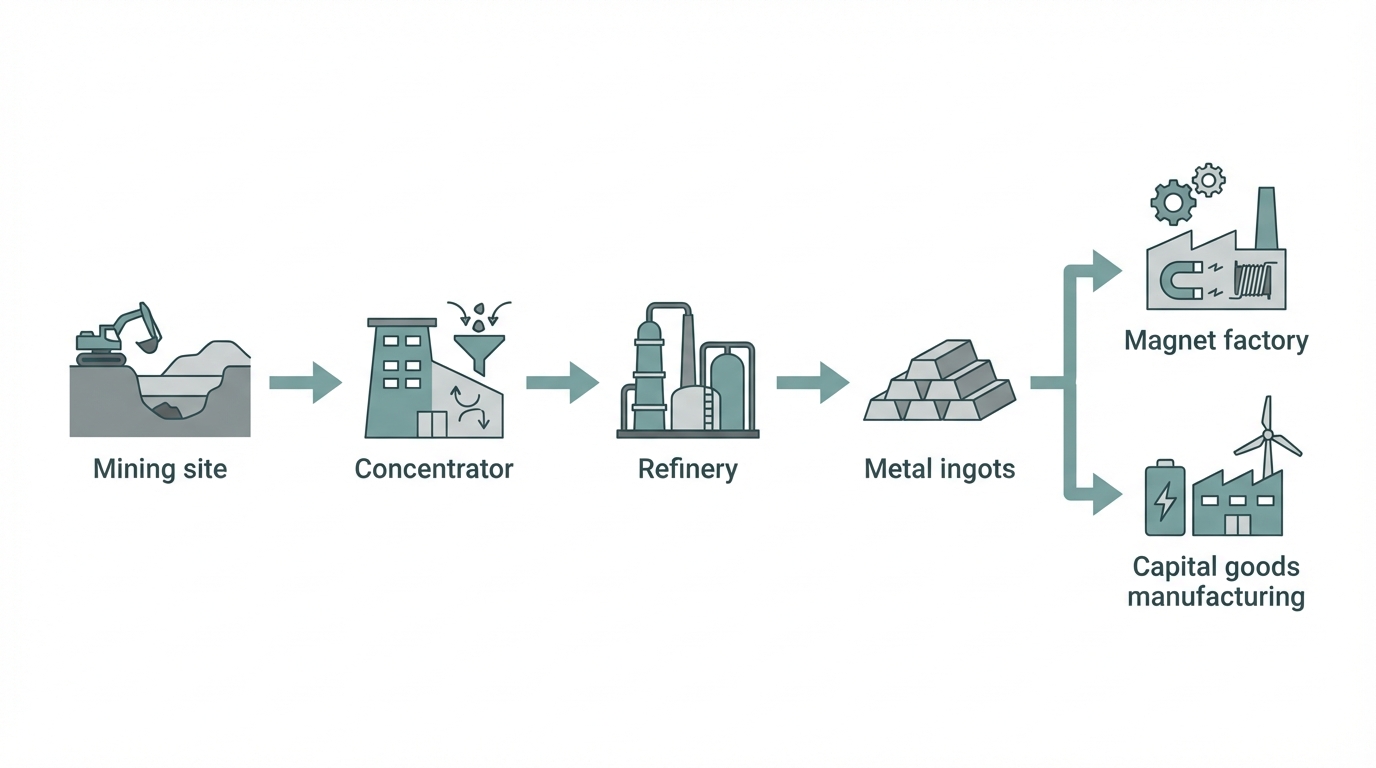
    Diagram of critical mineral flows from African and Latin American mines into global supply chains.
    Diagram of critical mineral flows from African and Latin American mines into global supply chains.

    Licensing tempo as the main bottleneck. Environmental and social licensing in Brazil is often cited by operators as the primary schedule risk. Multi‑year approval processes, complex interactions between federal and state agencies, and active civil society oversight can delay both greenfield projects and brownfield expansions. For China‑Plus‑One strategies, this tends to front‑load risk in the pre‑production phase rather than during operations, but delays have material consequences for supply timing.

    Rare earths and diversified offtake. Emerging rare earth projects such as Serra Verde are attracting interest from Japanese, European, and North American end‑users, not just Chinese buyers. Offtake patterns here appear more diversified than in many African projects, reflecting both geopolitical demand and the relative novelty of Brazil’s rare earth sector. The key operational question is whether extraction and processing can scale while keeping radiation, tailings, and reagent management under control; so far, early‑stage operations have signalled that this is feasible, though not trivial.

    Lithium Triangle: Chile and Argentina as Contrasting Models

    The Lithium Triangle—Chile, Argentina, and Bolivia—holds a dominant share of known brine‑based lithium resources. For China‑Plus‑One frameworks, Chile and Argentina are particularly salient: both host producing operations with a mix of Western, regional, and Chinese ownership, and both are experimenting with new policy models for strategic minerals.

    Chile: State‑led strategy with gradual diversification. Chile’s “National Lithium Strategy” announced in 2023 reaffirmed state stewardship over lithium while leaving space for partnerships with private operators, including non‑Chinese groups. Existing salar operations continue under current contracts, but new projects involve a negotiated role for state entities. From an operational continuity lens, Chile scores relatively well: robust grid infrastructure in the north, mature port facilities, and strong institutional capacity reduce day‑to‑day disruption risk. The main uncertainty lies in contract design and future tax or royalty adjustments rather than in security or infrastructure breakdowns.

    Argentina: Provincial mosaic and policy volatility. Argentina offers abundant brines and a welcoming stance toward foreign mining capital at the provincial level, but a more volatile macroeconomic backdrop. Projects like Cauchari‑Olaroz and other salars in Jujuy, Salta, and Catamarca illustrate both sides of the coin. On the positive side, multiple operators from different countries share the landscape, and several are experimenting with direct lithium extraction technologies to reduce water use and accelerate production. On the risk side, inflation, currency controls, and periodic shifts in export taxes or incentives create uncertain planning horizons. Community opposition over water usage and land rights can also trigger stoppages or force design changes mid‑stream.

    Chinese participation is significant but not exclusive. In both Chile and Argentina, Chinese entities hold stakes in high‑profile projects and have secured offtake from several. However, Western, Japanese, and South Korean counterparts are also present as equity partners and long‑term buyers. Compared with parts of Africa, the Lithium Triangle presents more balanced offtake portfolios, though Chinese refiners still play an outsized role in converting carbonate and hydroxide into cathode‑ready materials.

    Cross‑Cutting Themes: Where China‑Plus‑One Meets Operational Reality

    Taking these corridors together, several recurring themes frame the operational viability of China‑Plus‑One strategies in Africa and Latin America.

    Mining versus refining asymmetry. Even where mining equity and offtake are diversified, mid‑stream and refining capacity often remains concentrated in China. Brazil’s rare earth projects, Argentina’s brines, and Zimbabwe’s spodumene all illustrate this pattern. As long as conversion capacity outside China scales more slowly than mine supply, China‑Plus‑One strategies at the resource level will have limited impact on ultimate supply chain dependence.

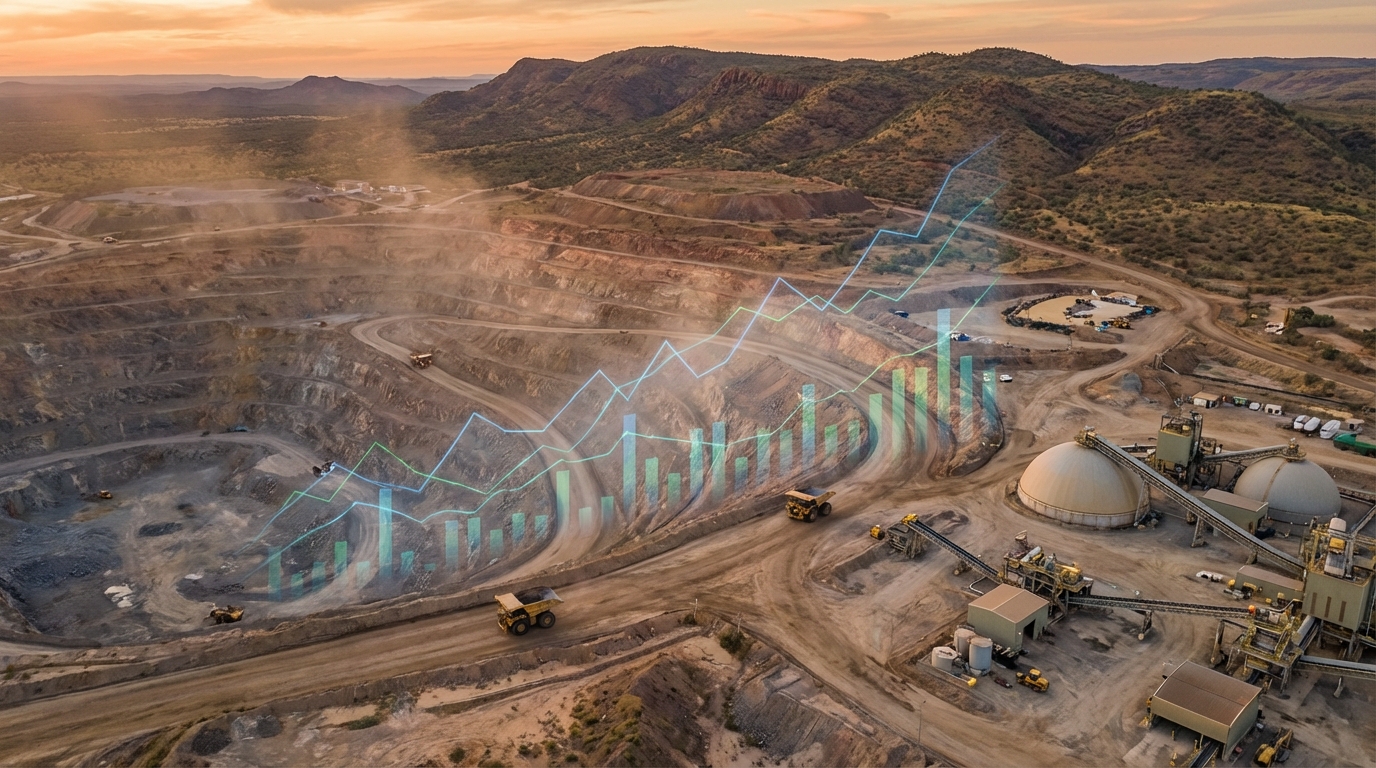
    Representative view of large-scale copper and cobalt mining operations in Central Africa.
    Representative view of large-scale copper and cobalt mining operations in Central Africa.

    Infrastructure‑anchored influence. Railways, ports, power plants, and transmission lines are critical nodes in critical mineral chains. In the DRC, Angola, and parts of Latin America, Chinese financing and engineering have underpinned many of these assets. This does not automatically translate into supply disruption risk, but it does mean that diversification often occurs within systems that Chinese state‑linked entities helped design and, in some cases, operate or maintain. The leverage associated with this role is structural, even when mine ownership is mixed.

    ESG and social license as supply‑side governors. In Latin America especially, community and environmental litigation can be as consequential for operating continuity as national‑level policy. Mapuche protests in Chile, water‑use controversies in Argentina, and long‑running debates over rainforest protection in Brazil all constrain how fast mining and processing can expand. For China‑Plus‑One planners, this introduces a temporal dimension: even where geology and jurisdictional risk are favourable, scale‑up may be slower than headline announcements suggest.

    Sanctions and export controls as emerging variables. While Africa and Latin America have not seen the same level of mineral‑specific sanctions observed in some other regions, the possibility is increasingly part of scenario planning, especially where Chinese‑owned assets intersect with broader geopolitical tensions. This is most salient in countries with contentious governance records or where strategic minerals are highly concentrated in a small number of operations.

    Key Structural Signals to Watch

    From an operational continuity and supply chain perspective, several indicators serve as early signals of strengthening or weakening conditions in China‑Plus‑One mining jurisdictions across Africa and Latin America:

    • Power system reforms and grid investments in the DRC, Zambia, Zimbabwe, and northern Chile, especially projects that directly link to major mine districts.
    • New royalty, export tax, or beneficiation mandates targeting lithium, cobalt, nickel, and rare earths, and whether they include grandfathering for existing contracts.
    • Announcements of non‑Chinese refining and mid‑stream plants tied to African and Latin American feedstock, including locations in Europe, North America, or within the regions themselves.
    • Shifts in offtake composition at flagship assets—such as increasing volumes allocated to Japanese, Korean, or Western cathode and alloy producers.
    • Security and community incident frequency around major mine clusters, tracked through public disclosures, NGO reporting, and local media.

    Changes in these indicators often precede more visible disruptions such as shipment delays, force majeure declarations, or abrupt policy announcements. For supply chain planners mapping China‑Plus‑One pathways, they function as practical gauges of how theoretical diversification is translating into day‑to‑day operating resilience.

    Conclusion: Diversification Under Constraint

    The current phase of China‑Plus‑One in mining is characterised less by clean breaks from Chinese supply chains and more by incremental diversification within systems where Chinese capital, engineering, and refining capacity remain deeply embedded. Africa and Latin America play central roles in this transition, but each corridor carries its own operational fingerprint.

    The Central African Copperbelt offers unmatched cobalt and high‑grade copper but carries pronounced risks in power reliability, logistics, and security, alongside entrenched Chinese ownership. Southern African lithium presents rapid growth potential with substantial Chinese financing, balanced against policy volatility and grid constraints. Brazil provides relatively robust infrastructure and institutional depth, with licensing tempo as the main limiting factor. The Lithium Triangle, finally, offers structural scale and somewhat more diversified ownership, yet is governed by evolving state strategies and intense local scrutiny over water and land use.

    Looking ahead, the success of China‑Plus‑One strategies in these regions will hinge on whether mid‑stream and refining capacity outside China can scale in tandem with mining output, and whether host governments can calibrate policies that capture more value locally without generating stop‑start operating conditions. The underlying geology in Africa and Latin America is not in question; the decisive variables lie in grids, rails, ports, contracts, and communities. Those are the levers through which operational continuity—and genuine supply chain diversification—will ultimately be determined.

  • Review: key midstream processors (separators, refiners) outside china: Latest Developments and

    Review: key midstream processors (separators, refiners) outside china: Latest Developments and

    Review Scope: Midstream Separators and Refiners Beyond China

    Across six months of monitoring corporate disclosures, policy announcements and technical papers, a consistent pattern emerged: midstream processing capacity for rare earths and other strategic metals outside China remains structurally thin, especially for heavy rare earth elements (HREEs). The facilities examined here – a mix of separators, refiners and recycling plants – sit between mine and end‑user and therefore determine whether upstream ore and downstream magnet or catalyst factories can operate without disruption.

    This review focuses on a dozen key midstream nodes outside China, emphasizing rare earth elements (REEs) but also touching on platinum group metals (PGMs) and related critical minerals. The lens is operational continuity and supply chain risk over a 2024-2026 horizon, with particular attention to:

    • Exposure to heavy REE bottlenecks (dysprosium, terbium, holmium and others essential for high‑temperature magnets)
    • Readiness and reliability of separation/refining circuits, rather than just nameplate capacity
    • Geopolitical and regulatory context, especially alignment with U.S., EU and allied policy objectives
    • Logistics, energy, water and reagent dependencies that can act as hidden choke points

    Much of the public debate lumps “non‑Chinese capacity” into a single bucket. On closer inspection, the picture is more fragmented. A few Australian and U.S. facilities anchor light rare earth (LREE) supply, several pilot and demonstration plants are pushing into HREEs, and a small but growing recycling segment is emerging. that said, the combined system still relies heavily on Chinese technology, reagents or downstream customers, and remains vulnerable to policy or market shifts in Beijing.

    Methodology, Time Horizon and Bottleneck Framework

    The facilities considered were selected based on three criteria: (1) relevance to rare earth or strategic metal separation/refining outside China; (2) public disclosure of at least an indicative flow sheet or processing concept; and (3) linkage to defense, EV, renewable or semiconductor supply chains. Information on capacities and timelines reflects public company guidance and industry analysis circulated up to late 2024, along with forward‑looking scenario assumptions for the 2025–2026 period. These future‑dated figures should be treated as indicative rather than certain.

    For comparative assessment, a composite lens was applied:

    • HREE versus LREE focus: Facilities with credible dysprosium, terbium or other HREE output score higher in strategic criticality, given continued concentration of HREE separation in China and Myanmar.
    • Capacity relative to global deficit: Non‑Chinese HREE output remains well below global demand in most scenarios, while LREEs such as NdPr show tighter but somewhat more manageable gaps.
    • Geopolitical and policy alignment: Operations in U.S. allies and partners often benefit from grant programs and offtake frameworks, but can also face stricter environmental and social requirements.
    • 2024–2026 operational readiness: Actual or near‑term operating circuits are weighted over distant projects still at concept stage.

    Across the set, three generic bottlenecks recur. First, permitting and social license for hydrometallurgical plants and tailings facilities in OECD jurisdictions add multi‑year uncertainty. Second, logistics for reagents – particularly acids and organophosphorus extractants – expose a dependency on global chemical supply chains in which Chinese producers play an outsized role. Third, qualification cycles with automotive and defense OEMs often run 18–24 months, so any slippage at the plant level can echo through the supply chain.

    Critical Findings: Structural Realities in the Non‑Chinese Midstream

    When the twelve facilities are viewed as a system rather than as stand‑alone projects, several structural realities become clear. These represent the critical findings of the review and frame the rest of the site‑by‑site analysis.

    • Light REEs are gradually de‑risking; heavy REEs remain a hard bottleneck. Operations such as Lynas’s Mt Weld/Kalgoorlie chain and MP Materials’ Mountain Pass complex are building a credible non‑Chinese base for NdPr. In contrast, HREE separation outside China is still concentrated in small‑scale efforts like Northern Minerals’ Browns Range pilot and early‑stage concepts at projects such as Round Top in Texas.
    • A few midstream hubs carry disproportionate system risk. Kalgoorlie, Mountain Pass, and to a lesser extent White Mesa and Eneabba function as anchor plants. Any extended outage, regulatory suspension, or major engineering problem at these sites would ripple across multiple downstream OEM programs.
    • Energy, water and community constraints are no longer peripheral issues. From water‑stressed Western Australia to power‑constrained South Africa and Malawi, local infrastructure and social license increasingly set the real ceiling on throughput, regardless of stated nameplate capacity.
    • Recycling and co‑processing are promising but still small. Facilities such as pH7 Technologies in Canada and HyProMag’s planned recycling plants attached to Mkango bring valuable optionality, yet volumes remain modest relative to primary mine feeds.
    • Policy support has accelerated project pipelines but not eliminated execution risk. Grants and offtake frameworks in the U.S., Australia and the EU have moved several projects forward; they have not removed technical scale‑up challenges or market exposure to any future Chinese export or pricing policies.

    Australia: Core Node for Non‑Chinese Separation

    Lynas Rare Earths – Mt Weld and Kalgoorlie Separation Plant (Western Australia)

    In operational continuity terms, Lynas remains the single most critical midstream asset outside China for light rare earths. Mt Weld provides a high‑grade concentrate, while the Kalgoorlie Separation Plant (KSP) handles cracking and separation. Public material has suggested several thousand tonnes per year of separated REO capacity, with a strong focus on NdPr, and discussions have referenced ambitions to expand and add heavier elements over time.

    From a supply chain risk standpoint, the main advantages are jurisdictional stability and extensive operational experience in both Australia and Malaysia. However, site visits and stakeholder discussions highlight several operational friction points. Water supply in the Goldfields is structurally constrained, logistics for acids and other reagents remain sensitive, and environmental scrutiny around the company’s processing operations has proven persistent. While none of these constitute immediate show‑stoppers, they represent ongoing conditions that can limit flexibility during ramp‑ups or reconfigurations.

    Iluka Resources – Eneabba Rare Earths Refinery

    Eneabba represents a different but complementary model: leveraging monazite‑rich mineral sands tailings for rare earth feed. The company has outlined a staged build‑out from relatively modest initial throughput towards more substantial volumes by the latter part of the decade, with a flow sheet targeting high‑purity oxides and scope for HREE recovery from its feedstock mix.

    Operational continuity at Eneabba hinges on two main variables. The first is logistics from Iluka’s mining operations – particularly rail and port capacity – which determines how consistently feedstock arrives. The second is the regulatory interface under Australia’s environmental legislation, which governs tailings, radioactivity and chemical handling. These are manageable but bring expansion risk: any tightening of standards or public opposition could slow later stages of the ramp.

    Northern Minerals – Browns Range Pilot Plant

    Browns Range is one of the few genuinely HREE‑focused projects outside China operating at pilot scale. The xenotime‑hosted ore offers dysprosium and terbium potential, and trial operations have produced dysprosium oxide for export. From a supply chain diversification standpoint, even relatively small volumes have meaningful impact because the non‑Chinese HREE base is so thin.

    Global distribution of key non-Chinese midstream rare earth and PGM processing hubs.
    Global distribution of key non-Chinese midstream rare earth and PGM processing hubs.

    The fragility lies in scale and location. Ore grades are modest, operating costs are structurally higher than large Chinese operations, and the site is extremely remote, increasing exposure to fuel, labor and reagent disruptions. Funding to move from pilot to commercial‑scale has also been stop‑start. As a result, Browns Range should be seen as a strategic option and technology demonstrator rather than a near‑term bulk supplier.

    Arafura Resources – Nolans Project (Northern Territory)

    The Nolans project links rare earth separation with a significant phosphate co‑product, targeting NdPr as its main output. Public communications have described a multi‑thousand‑tonne NdPr oxide ambition, underpinned by Australian and allied government support and a suite of conditional offtake arrangements, including with automotive OEMs.

    From an operational continuity angle, Nolans faces a different risk set to Lynas or Iluka. The remote inland location exposes the project to wet‑season logistics, power and water infrastructure challenges, and heightened scrutiny regarding engagement with Traditional Owners. Any delays in infrastructure build‑out or in reaching durable arrangements with local communities would directly influence the timing of midstream availability from Nolans.

    North America: Re‑Establishing Mine‑to‑Magnet Chains

    MP Materials – Mountain Pass Mine and Separation Facility (California)

    Mountain Pass is central to U.S. rare earth industrial policy. The operation combines a large bastnäsite orebody with an evolving separation plant and downstream magnet ambitions. Company statements have referenced tens of thousands of tonnes per year of REO concentrate production, alongside a multi‑phase plan to reach several thousand tonnes of NdPr oxide and ultimately magnet alloy output.

    Operational continuity has improved significantly compared with earlier ownership cycles, with closed‑loop water systems and investments in tailings stability. Nevertheless, two constraints remain prominent. First, Mountain Pass is largely a light rare earth story, offering no direct relief for HREE scarcity. Second, the expansion path for separation and magnet facilities intersects with U.S. permitting processes for waste management and emissions, which can introduce timing risk even when political support is strong.

    Energy Fuels – White Mesa Mill REE Circuit (Utah)

    White Mesa’s rare earth circuit adds a different flavor to the North American picture. Built around an existing uranium mill, the plant processes imported monazite sands into mixed rare earth products, with a stated ambition to move further downstream into separated oxides. Pilot and early commercial campaigns on Brazilian monazite feeds have demonstrated the technical concept.

    From a risk perspective, White Mesa sits at the intersection of nuclear, indigenous rights and critical minerals politics. Community and tribal opposition to any perceived expansion of radioactive material handling is a persistent factor, while the reliance on overseas monazite feeds from Brazil and potentially Vietnam creates exposure to maritime logistics and exporting‑country policy. At the same time, the plant’s ability to switch between uranium, vanadium and rare earth campaigns provides some operational resilience.

    A non-Chinese rare earth separation facility illustrating the scale and infrastructure required for midstream processing.
    A non-Chinese rare earth separation facility illustrating the scale and infrastructure required for midstream processing.

    pH7 Technologies – Vancouver Refinery (British Columbia)

    pH7 represents a cluster of emerging “low‑carbon” refining technologies that target critical metals from secondary feeds, including REE‑bearing wastes and PGMs. The company has promoted a closed‑loop chemical process, aiming to reduce emissions and reagent consumption relative to conventional smelting or solvent extraction.

    In continuity terms, the strengths are flexibility and environmental profile; the constraints are scale and feedstock availability. Early campaigns have been measured in the low hundreds of tonnes of material, and the business model relies on securing consistent streams of suitable scrap, catalyst or end‑of‑life components. Canadian permitting timelines for new chemical plants also inject uncertainty around how quickly pilot operations can become fully commercial.

    USA Rare Earth – Round Top Refining Concept (Texas)

    The Round Top project in Texas is often cited in policy circles because of its potential to produce a broad suite of HREEs and co‑products such as gallium. The processing concept revolves around in‑situ or low‑impact leaching followed by separation, with an eye to supporting aerospace, defense and semiconductor supply chains.

    At the time of this review, Round Top remains at a pre‑production stage. The primary operational risks relate to water rights, environmental permitting and the complexity of managing a multi‑metal flow sheet. Any future refinery at the site would reduce import dependence for certain niche elements, but execution risk on both the mining and processing sides is material.

    Stillwater Critical Minerals – Montana PGM Refinery

    Stillwater’s refining complex in Montana anchors U.S. PGM processing, with platinum and palladium production feeding autocatalyst and potential fuel cell applications. The company has also signaled interest in leveraging its metallurgical competencies for broader critical mineral processing.

    Key operational continuities include deep refining experience and integration with a long‑lived mining district. Risks relate to gradual ore grade decline, skilled labor availability in a remote region, and exposure to North American automotive cycles. While PGMs are not rare earths, the facility’s role as a non‑Chinese midstream hub for another set of critical metals is strategically analogous.

    Africa and Southeast Asia: Emerging but Volatile Nodes

    Mkango Resources – Songwe Hill and HyProMag Recycling (Malawi, UK, Canada)

    Mkango combines a greenfield rare earth project at Songwe Hill in Malawi with HyProMag’s magnet recycling technologies in the UK and Canada. The upstream project is designed to produce a mixed rare earth concentrate, while the recycling arm focuses on hydrogen‑based demagnetization and recovery of NdFeB alloys from scrap and end‑of‑life components.

    From an operational risk standpoint, Songwe Hill faces the familiar challenges of power reliability, transport to port, and policy stability in a lower‑income jurisdiction. Reports of extended port dwell times and occasional grid failures highlight the fragility of logistics. The HyProMag plants, by contrast, are located in high‑infrastructure environments but depend on building reliable scrap supply chains and scaling a relatively novel processing route.

    Schematic of the mine-to-OEM value chain highlighting the midstream separation bottleneck.
    Schematic of the mine-to-OEM value chain highlighting the midstream separation bottleneck.

    Vietnam Rare Earth JSC – Dong Pao Separation Plant (Lai Châu Province)

    Vietnam has emerged as a potential alternative rare earth hub, with Dong Pao frequently cited as the flagship project. Public commentary has pointed to pilot‑scale operations moving towards larger separation capacity later in the decade, potentially with a mix of LREEs and HREEs.

    The strategic attraction is clear: proximity to large Asian manufacturing centers and a government signaling interest in diversification from Chinese control. However, there are also substantial risks. Chinese investors and technology providers are already present in parts of the Vietnamese rare earth value chain, which could blunt the diversification impact. Environmental protests and evolving export licensing frameworks add policy risk that could mirror, rather than offset, dynamics seen in China.

    Anglo American Platinum – Mogalakwena Refinery (South Africa)

    Although primarily a PGM operation, Anglo American Platinum’s Mogalakwena complex in Limpopo Province is a cornerstone of global platinum and palladium refining, with some research into co‑processing critical metals. For fuel cell and catalytic converter supply chains, this refinery is a key non‑Chinese midstream node.

    Operational continuity is challenged by systemic issues in South Africa’s power and labor environment. Recurrent Eskom load‑shedding, labor actions, and infrastructure constraints have all caused intermittent disruptions. These are not project‑specific issues but arise from wider structural factors, which complicates mitigation. Any expansion into rare earth or other critical metal processing at Mogalakwena would inherit these same baseline risks.

    Risk Inflection Points Across the Non‑Chinese Midstream

    Several “risk inflection points” emerge when the above facilities are considered collectively – areas where changes in policy, operations or market conditions could sharply improve or degrade supply security.

    • Heavy rare earth availability: The trajectory of Browns Range, Round Top and any HREE elements within Vietnamese or African projects will determine whether the current near‑monopoly in HREE separation remains intact. Delays or under‑performance here keep magnet producers reliant on Chinese HREE streams, regardless of LREE diversification.
    • Chinese export and investment policy: Stricter export controls on certain REE products or technologies from China would increase the strategic weight carried by Lynas, MP Materials, Dong Pao and White Mesa. Conversely, aggressive Chinese pricing or investment in third‑country projects could undercut economic viability for some marginal non‑Chinese plants.
    • Community and environmental outcomes: Legal challenges around waste facilities in Australia, indigenous consultations in North America, and environmental protests in Vietnam or Malawi all have the potential to pause or reshape project timelines. Experience at several sites suggests these factors are now core operational variables, not peripheral.
    • Reagent and logistics chains: Sulfuric acid, hydrochloric acid, caustic soda and organic extractants are often sourced via global chemical markets in which Chinese producers hold large shares. Any prolonged disruption in these inputs – whether from trade policy, shipping incidents or industrial accidents – could constrain throughput even at well‑funded plants.
    • Downstream qualification and offtake patterns: Automotive and defense OEMs typically require extended testing and qualification of new material sources. Plants that have already secured multi‑year offtake frameworks tend to run closer to steady‑state utilization, while those still in the qualification queue face greater volume volatility.

    Operational Continuity Outlook to 2026

    Looking out to the mid‑2020s, the non‑Chinese midstream for rare earths and other critical metals appears on a path from acute scarcity towards a still‑fragile but more diversified system. The anchor facilities – Lynas’s chain in Australia, Mountain Pass in the U.S., Eneabba and White Mesa – are steadily building track records that downstream OEMs can qualify against. Recycling‑focused players such as pH7 and HyProMag contribute incremental resilience and a lower‑emissions angle, even if their tonnages remain modest.

    However, several structural constraints are unlikely to resolve quickly. HREEs remain the central vulnerability; policy support has accelerated project announcements but not yet delivered large‑scale, non‑Chinese separation. Environmental and social expectations in OECD jurisdictions raise the bar for new hydrometallurgical capacity, trading off speed for sustainability and community acceptance. Meanwhile, chemical and logistics dependencies link even “non‑Chinese” projects to global supply chains in which China remains an important actor.

    In this context, the twelve facilities profiled here function as both assets and signals. Their construction progress, permitting outcomes, incident history, and offtake patterns offer early clues about whether midstream capacity outside China is converging towards a stable equilibrium or remains one policy decision or equipment failure away from renewed disruption. Continuous monitoring of these operational realities, rather than attention only to mine openings or headline policy announcements, will be central to any informed assessment of rare earth and critical metal supply security through 2026.

  • How to score supplier resilience for strategic materials

    How to score supplier resilience for strategic materials

    In late-stage battery, defense and electronics programs, the most disruptive supplier failures around rare earth elements (REEs), lithium, cobalt, tungsten and platinum group metals have often come from balance-sheet fragility rather than from the most obvious geopolitical hotspots. That observation led several teams to codify a structured 0-100 resilience score, with financial health as the anchor and geopolitical, ESG and operational dimensions layered on top.

    The framework below summarises how to score supplier resilience for strategic materials in a way that can be replicated across vendors and refreshed as markets, regulations and capital structures change.

    Key Operational Points

    • Tradeoffs: A 50% weight on financial metrics often shifts the supplier universe toward larger, more stable groups and away from niche specialists with outstanding technical performance but thinner balance sheets.
    • Risks and failure modes: Data gaps for private or state-owned suppliers, static scores that ignore rapid leverage build-up, and underestimating jurisdictional risk around export controls and logistics bottlenecks.
    • Signals to watch: Deteriorating liquidity, rising debt-to-equity, shrinking interest coverage, regulatory actions (e.g. permits, ESG enforcement), and recurring delivery deviations against plan.
    • Regulatory overlay: The EU Critical Raw Materials Act and new battery and ESG rules in major jurisdictions increasingly link financial resilience to a supplier’s ability to carry the cost of compliance.

    1. Scope, Material Coverage and Data Assembly

    The first step in a resilience score is defining which parts of the strategic materials chain are in scope: upstream mining, intermediate processing (e.g. REE separation, cobalt refining), and downstream conversion (e.g. NdFeB magnets, cathode active material). Each tier has different disclosure patterns and risk drivers.

    In practice, teams start by mapping critical suppliers by material and process step, then assemble a data pack that typically includes:

    • Financial statements and ratios from public filings (EDGAR, SEDAR, ASX, HKEX) or, for private entities, lender packs and audited summaries where accessible.
    • Credit and risk ratings from services such as S&P Global Supplier Risk Management or similar 0-100 scales.
    • Jurisdiction and logistics risk data from platforms like Everstream Analytics, focusing on export controls, sanctions, infrastructure reliability and climate-related disruption.
    • Compliance and ESG disclosures linked to REE, cobalt and lithium traceability requirements and to tightening EU and US regulations.
    • Operational performance history: delivery reliability, quality incidents, production outages and maintenance shutdowns.

    For listed suppliers, assembling this dataset is often a 2-4 week exercise. For non-listed entities in opaque jurisdictions, access to dependable balance sheet and cash flow data can extend the initial scoring effort to several weeks more. Some teams handle this by using a provisional score flagged as “data constrained” until fuller disclosure is obtained.

    2. Building the Financial Health Pillar (50% of the Composite Score)

    Financial health forms the backbone of the rubric and typically carries around half of the total weight. The underlying premise, confirmed in several 2025 pilot programs, is that financial distress signals often appear quarters before visible supply failures, especially in capital-intensive segments such as REE separation, lithium conversion and deep-level PGM mining.

    A common structure for the financial pillar uses four core ratios, normalised to a 0–50 sub-score:

    • Liquidity (20% of composite score; 0–20 points). Based on metrics such as the current ratio or available cash against short-term obligations. Rubrics often allocate the highest scores when liquidity exceeds roughly 2.0x, mid-range scores for ratios in the 1.5–2.0x band, and low scores when liquidity falls below that. For REE processors or lithium converters with large working-capital swings, this metric has repeatedly flagged stress well before missed shipments.
    • Debt-to-equity (around 15% of composite; 0–15 points). Leverage is scored more favourably when below roughly 0.5x, falls into a neutral band between about 0.5x and 1.0x, and drops sharply when leverage climbs beyond that. In South African PGM mining, for example, highly leveraged operators have proven particularly exposed to wage shocks and logistics interruptions.
    • Free cash flow (around 10% of composite; 0–10 points). Persistent positive free cash flow (FCF) after sustaining capex generally attracts higher scores, indicating capacity to self-fund expansions and ESG compliance. Extended periods of negative FCF, as seen in some lithium producers during market downturns, tend to compress resilience scores even when headline earnings remain positive.
    • Interest coverage (around 5% of composite; 0–5 points). An interest coverage ratio above roughly 5x often sits in the top scoring band, 3–5x in a middle band, and below 3x in a high-risk band. In volatile rate environments, this parameter has been a sensitive early-warning indicator.

    In the pilots that inspired this framework, a diversified REE producer with liquidity comfortably above 2x, moderate leverage and positive FCF-profiles similar to MP Materials in the US-typically landed in the upper 40s out of 50 on the financial pillar. Conversely, several small single-asset lithium developers scored below 30, largely driven by thin liquidity and leverage tied to project finance.

    Across a sample of strategic metals suppliers, more than half of the subsequent disruptions traced back to balance sheet weakness, even where operations and quality metrics had previously appeared stable. This experience underpins the decision to allocate around 50% of the total resilience score to financial health.

    Global supply chains for strategic materials and their interconnected risks.
    Global supply chains for strategic materials and their interconnected risks.

    3. Geopolitical and Jurisdictional Adjustments (up to ~20 Points)

    Once the financial sub-score is calculated, the framework applies jurisdiction-specific modifiers reflecting geopolitical, regulatory and logistics risk. These adjustments typically account for up to 20 points of the composite score, and are derived from structured country and route risk assessments rather than subjective impressions.

    Common adjustment categories include:

    • Sanctions and export controls. Suppliers in or heavily exposed to jurisdictions with active or potential sanctions regimes (for example, Russian PGMs or certain Chinese REE segments subject to export licence regimes) frequently receive downward adjustments.
    • Resource nationalism and permitting risk. Countries with a track record of abrupt royalty changes, licence reviews or moratoria on new projects, particularly for lithium and cobalt, often trigger score deductions even where corporate finances are solid.
    • Infrastructure and logistics reliability. South African PGM value chains, for instance, have been affected by rail and port constraints; Myanmar’s tin and cobalt flows have faced intermittent disruptions; certain Latin American bulk mineral exports have contended with port congestion and climate-related events.
    • Rule of law and contract stability. Australian, Canadian, EU and US jurisdictions often receive neutral or slightly positive adjustments for legal predictability, balanced against longer permitting timelines.

    Risk analytics providers such as Everstream typically express these factors as geo-risk scores that can be translated into modest point bonuses or deductions. A Chinese REE separator with strong finances but heavy exposure to quota-based export controls, for example, may lose several points relative to a financially comparable Australian or North American peer.

    4. ESG-Linked Financial Pressures (around 15 Points)

    In strategic materials, ESG factors often translate directly into balance sheet stress or resilience. Environmental compliance expenditure, rehabilitation obligations, carbon costs and social licence all affect long-term solvency. Rather than treat ESG as an entirely separate dimension, many teams translate it into a distinct 0–15 point block tightly linked to financial impact.

    Typical scoring elements include:

    • Access to sustainability-linked finance. Suppliers that have secured sustainability-linked loans or green bonds tied to clear environmental performance targets often demonstrate both market confidence and lower funding risk. Iluka Resources’ Eneabba rare earths development in Australia is a frequently cited example of ESG-linked financing bolstering perceived resilience.
    • Regulatory and community disputes. Repeated fines, litigation or community opposition-such as those seen around some REE processing facilities in Southeast Asia—can drive negative adjustments due to the risk of forced shutdowns or expensive retrofit requirements.
    • Traceability and human rights exposure. Cobalt supply chains with exposure to artisanal mining in the DRC, or gold sourced from conflict-affected areas, often carry a higher risk of regulatory or reputational shocks. Robust traceability systems can partially offset that risk.
    • Carbon and energy intensity. PGM smelting, alumina refining and some REE processes are energy-intensive. Exposure to volatile power markets or tightening carbon regimes in the EU and UK can erode margins and raise financing costs, feeding back into financial scores.

    In several battery and electronics case studies, suppliers that invested early in ESG compliance and traceability improved their ESG sub-scores by a few points and, more importantly, preserved access to capital at acceptable terms when new regulations took effect.

    5. Operational Performance and Continuity Metrics (around 15 Points)

    The remaining portion of the composite score—often about 15 points—captures the day-to-day ability of a supplier to deliver material reliably and at consistent quality. Financially robust firms can still underperform here, and operational fragility can amplify the impact of even moderate financial stress.

    Framework for scoring supplier resilience using a composite 0–100 rubric.
    Framework for scoring supplier resilience using a composite 0–100 rubric.

    Operational sub-metrics commonly used include:

    • On-time, in-full (OTIF) performance. Historical delivery records over several years, adjusted for force majeure events, provide a direct view of execution capability. Strategic metals vendors supplying defense and aerospace programs often track this at high granularity.
    • Asset concentration. Single-mine or single-smelter suppliers of PGMs, tungsten or tantalum are more exposed to site-specific failures than diversified producers such as Glencore with multiple copper–cobalt or nickel operations.
    • Redundancy and maintenance practices. The presence of backup equipment, alternative processing lines or tolling partners can materially reduce disruption risk.
    • Quality consistency. Frequency of quality excursions, particularly for battery-grade chemicals or magnet-grade REEs, directly impacts downstream yield and can create hidden resilience risk.

    A recurring discovery in REE and lithium programs has been that some suppliers with impeccable OTIF histories but weak financials experienced sudden service failures when credit lines tightened, whereas suppliers with slightly lower OTIF but stronger balance sheets weathered shocks more effectively.

    6. Composite Scoring, Thresholds and Refresh Cycles

    Bringing the pieces together, many teams adopt a 0–100 composite score with indicative weights such as:

    • Financial health: 50 points
    • Geopolitical and jurisdictional risk: 20 points
    • ESG-linked financial impact: 15 points
    • Operational performance and continuity: 15 points

    Scores are usually banded. In pilot applications across dozens of strategic metals suppliers, those with composite scores below roughly 60 were disproportionately represented among subsequent disruption events, while suppliers above 80 rarely experienced severe interruptions. Overall, the rubric showed an approximate 85% correlation between risk bands and actual disruption avoidance in those pilots, which encouraged further refinement.

    Initial scoring campaigns for a new supplier panel often require 4–6 weeks, reflecting the time needed to obtain data, reconcile discrepancies and validate metrics with internal finance and risk teams. Once baselines are established, quarterly refresh cycles in the range of 1–2 weeks have been common, anchored on new financial reports, updated geo-risk assessments and any significant ESG or operational events.

    Illustrative examples often cited internally include:

    • Lynas Rare Earths. Refinancing and regulatory developments around its Malaysian processing plant altered leverage and permitting risk over time, creating noticeable shifts in both the financial and ESG/jurisdictional sub-scores.
    • Albemarle. Large growth capex programs in lithium, combined with market downturns, compressed free cash flow and affected the financial pillar, even as operational capabilities remained strong.
    • Glencore. Diversified asset portfolios and multi-region exposure helped offset risks from specific assets such as copper–cobalt operations in the DRC when scenario stress tests were applied.

    7. Stress Testing and Scenario Analysis

    Static scores give only a snapshot. Stress testing examines how a supplier’s resilience score would evolve under adverse but plausible scenarios over a one- to three-year horizon.

    Typical scenarios for strategic materials include:

    • Export controls and trade restrictions. For REEs and critical battery raw materials, teams model the impact of tighter export licence regimes or quotas, particularly for Chinese-origin feedstocks, on revenue, cash flow and capital access.
    • Operational disruption. Strikes, tailings incidents, power shortages or key equipment failures at a single-asset PGM or tungsten mine are modelled as multi-month production losses, with consequences for liquidity and covenant headroom.
    • Regulatory tightening. Implementation of the EU Critical Raw Materials Act or updated EU Battery Regulation can introduce additional compliance costs and potential temporary curtailments for suppliers without robust ESG systems.
    • Macroeconomic shocks. Changes in interest rates or demand cycles that affect financing conditions and debt service.

    The stress test output is then translated into revised financial, ESG and operational sub-scores. In several applications, scenarios that pushed liquidity and interest coverage below the higher scoring bands reduced the composite resilience score by more than 10 points, reclassifying some suppliers into higher-risk categories even before any real-world incident occurred.

    Analyzing supplier financial health as the foundation of resilience scoring.
    Analyzing supplier financial health as the foundation of resilience scoring.

    8. Common Failure Modes in Supplier Resilience Scoring

    Several recurring issues have emerged across organizations attempting to score supplier resilience for strategic materials:

    • Data gaps and opacity. Private or state-linked suppliers, especially in parts of Asia and Africa, may provide limited visibility into debt structures or related-party transactions. Some teams have used bond yields, trade credit insurance pricing and banking relationships as proxies, but these remain approximations.
    • Static scores. Scores frozen for a year or more have repeatedly failed to capture rapid leverage build-up or deteriorating liquidity, particularly in fast-moving segments such as lithium or cobalt where market conditions can change quickly.
    • Over-weighting historical performance. Long-standing on-time delivery records have, in some cases, obscured emerging financial stress. Several disruptions in REE and silver supply chains occurred at suppliers with near-perfect historical OTIF but eroding balance sheets.
    • Over-complex rubrics. Extremely granular scorecards with dozens of inputs per pillar tend to suffer from missing data and inconsistent application across suppliers, undermining comparability.

    One practical learning has been that a concise set of well-understood metrics, refreshed regularly and combined with structured scenario analysis, has outperformed more elaborate models in anticipating disruptions.

    9. Summary: A Finance-First Lens on Supplier Resilience

    Across defense, battery, aerospace and electronics supply chains, scoring supplier resilience for strategic materials has gradually converged on a finance-first, 0–100 rubric. Financial health typically accounts for half the score, with clear thresholds on liquidity, leverage, free cash flow and interest coverage. Geopolitical context, ESG-linked financial impacts and operational continuity fill in the remaining dimensions.

    In 2025 pilot implementations, this structure correlated strongly—around 85%—with the ability to anticipate and sidestep disruptions, particularly for REE, lithium and PGM suppliers. Case work on companies such as Lynas Rare Earths, MP Materials, Albemarle, Glencore and Iluka Resources illustrated how different balance sheet profiles, jurisdictions and ESG trajectories translate into distinct resilience scores, even when headline production volumes appear similar.

    For organizations dealing with tight markets and heightened regulatory scrutiny, the key insight has been that a quantified, finance-anchored resilience score offers a common language for supply chain, finance, risk and ESG teams to assess strategic metals suppliers and to compare tradeoffs across jurisdictions, technologies and business models.

  • Weekly dispatch #4: price spikes, contract disputes, and force‑majeure notices

    Weekly dispatch #4: price spikes, contract disputes, and force‑majeure notices

    Market shift: concentrated export controls trigger price shocks and legal cascades

    Rare‑earth markets in early 2026 are experiencing sharp price re‑ratcheting and a wave of contractual disruption tied to China’s April 2025 export licensing regime. Prices for light rare‑earth oxides such as NdPr have moved above $120/kg in China and roughly $140/kg ex‑China, while heavies-dysprosium and terbium-have surged several hundred percent, creating immediate supply, logistics and compliance stresses across defense, EV and industrial magnet supply chains.

    • New fact: Export licensing from China (April 2025) is driving NdPr domestic/ex‑China price bifurcation and HREE spikes (dysprosium ~ $930/kg; terbium > $4,000/kg ex‑China).
    • Why it matters: Contract performance is strained-multiple force‑majeure notices and ICC/LCIA arbitrations have emerged, disrupting magnet deliveries and certification schedules for aerospace, EV and robotics sectors.
    • Immediate risk: 3-6 month delivery delays, substitution-driven performance losses, and legal disputes that lengthen procurement cycles and complicate compliance under U.S. DoD and EU critical‑materials rules.
    • Signals to watch: MOFCOM quarterly quota releases, port rejection rates at Shanghai/Tianjin, arbitration filings/hearings, and new capacity ramps at non‑Chinese processors (Mountain Pass, Kalgoorlie, Ucore).

    Policy trigger and market mechanics

    China’s licensing regime formalized in April 2025—administered by MOFCOM—introduced end‑user certification and quarterly export quotas for key rare earths, with a 90‑day grace period for legacy contracts. Post‑grace, carriers reported high rejection rates for shipments tied to defense or dual‑use end‑users; market participants cite 40-60% denial rates for certain applications. The result is a domestic/export price split and producers limiting spot liquidity, feeding short‑term scarcity and premium pricing ex‑China.

    Price and supply impacts

    Price moves are concentrated at both light and heavy ends. NdPr oxide crosses $120/kg (China) and ~$140/kg ex‑China; dysprosium oxide has moved near $930/kg and terbium oxides exceed $4,000/kg ex‑China. These movements reflect inventory drawdowns, tighter official export quotas and longer port processing times—Dalian and other hubs reporting average delays increasing markedly versus pre‑2025 norms. Non‑Chinese capacity growth lags current demand from EVs, automation and defense, leaving a structural shortfall that is unlikely to close before mid‑to‑late 2027 without significant new HREE projects.

    Global rare earths supply chain and export control chokepoints, 2026
    Global rare earths supply chain and export control chokepoints, 2026

    Contract disputes and force‑majeure trends

    Force‑majeure notices proliferated from Q4 2025 into 2026. Chinese processors have increasingly cited quota exhaustion and MOFCOM denials as grounds for non‑performance; counterclaims from Western buyers invoke anticipatory breach and substitution clauses. High‑profile cases include an ICC arbitration arising from a Shenghe Resources force‑majeure on a multi‑thousand‑ton NdPr supply agreement and LCIA proceedings over dysprosium‑doped magnet deliveries. Jurisdictional outcomes vary: some U.S. forums view the 2025 policy as foreseeable (reducing success for supplier notices), while other tribunals accept governmental act defenses where direct causation is documented by port rejection letters and MOFCOM correspondence.

    Rare earth price volatility driving contract renegotiations and disputes
    Rare earth price volatility driving contract renegotiations and disputes

    Operational implications for supply chains

    Operational impacts are material: magnet lead times extend 3-6 months in many supply corridors, certification cycles for aerospace and defense components lengthen (example: terbium substitution delayed a German robotics firm’s certification by ~60 days), and production rationing has been reported in high‑HREE applications. Suppliers outside China—Mountain Pass (MP Materials), Lynas (Kalgoorlie), Ucore (pilot HREE refining)—have gained strategic importance, though their combined capacity does not fully offset the near‑term shortfall.

    Tradeoffs evident in procurement behavior

    Market participants are balancing cost and delivery security: Chinese spot supplies remain cheaper but carry regulatory and force‑majeure risk; Western sources command premiums but provide greater contract enforceability and traceable compliance for DoD/CBAM rules. Reported commercial responses include longer‑dated offtakes with non‑Chinese processors, intensified arbitration activity, and limited substitution to lower‑grade magnets with measurable performance penalties in turbines and precision actuators.

    How export controls translate into force-majeure notices and arbitration
    How export controls translate into force-majeure notices and arbitration

    Signals to watch

    • MOFCOM quarterly quota publication dates and approval/denial ratios for export licenses.
    • Port rejection and detention statistics at Shanghai, Tianjin and Dalian.
    • ICC/LCIA arbitration filings and landmark rulings that clarify force‑majeure scope for regulatory actions.
    • Ramps and commissioning notes from Mountain Pass, Kalgoorlie, Ucore and other non‑Chinese processors.
    • Policy moves by the U.S. DoD/DOE and EU (CBAM, Critical Raw Materials Act) that affect procurement requirements and subsidies.

    Materials Dispatch Signal: The current episode exposes how policy‑driven supply constraints propagate into legal and operational risk across the rare‑earth value chain. Expect elevated arbitration activity, persistent ex‑China premiums for HREEs, and growing strategic interest in non‑Chinese processing capacity as primary themes through 2026–2027.

  • Tech deep dive: processing flowsheets for gallium, germanium, and rare earths

    Tech deep dive: processing flowsheets for gallium, germanium, and rare earths

    **Gallium, germanium and rare earth processing in current U.S. projects is not constrained by geology but by flowsheet reality: impurity management, solvent extraction hydrodynamics, and scale‑up of electrochemical and membrane systems define what can actually operate at industrial scale between 2022-2025.**

    Tech Deep Dive: Processing Flowsheets for Gallium, Germanium, and Rare Earths

    Processing flowsheets for gallium (Ga), germanium (Ge), and rare earth elements (REEs) have moved from background engineering topics to front-line supply security issues. The core technical reality is simple: ores and byproducts are increasingly accessible, while proven, compliant, and scalable processing routes remain the hard constraint. The current U.S.-led projects between 2022 and 2025 illustrate this tension with unusual clarity.

    The United States is rebuilding capabilities in materials where China currently dominates refined supply: refined Ga and Ge are heavily concentrated, and REEs are still largely processed through Chinese-controlled solvent extraction (SX) hubs. DOE-funded programs, university-industry pilots, and national lab initiatives are testing a new generation of flowsheets using coal byproducts, acid mine drainage (AMD), and unconventional carbonatites. This article dissects those flowsheets from an operational perspective: unit operations, energy and reagent demands, impurity management, and the failure modes that emerge when bench chemistry hits continuous pilot scale.

    Across Ga, Ge, and REEs, the pattern is consistent. Leaching and initial dissolution are relatively mature. Real bottlenecks appear where selectivity, phase behavior, and equipment reliability intersect: co-precipitation in pH-controlled impurity removal, SX organic degradation under real impurity loads, and electrode or membrane fouling in advanced electrochemical systems. These are not academic issues; they directly determine whether domestic projects can meaningfully offset China-centric processing in the medium term.

    1. Context and the Operational Question

    Export licensing controls on Chinese gallium and germanium products from 2023 onward exposed how concentrated these supply chains had become. Public data and industry statistics show that China accounts for the overwhelming majority of refined Ga and Ge output and a dominant share of REE separation capacity. At the same time, U.S. and allied industrial policy-through instruments such as the Bipartisan Infrastructure Law (BIL) and targeted DOE funding calls-has pushed for domestic or friendly-jurisdiction recovery from secondary feeds: coal/lignite, zinc residues, AMD, and carbonatite deposits.

    The operational question is no longer whether gallium, germanium, and REE units exist in those feedstocks. They clearly do, typically in the tens to hundreds of ppm range for Ga and Ge and percent-level for REE oxides in enriched ores and concentrates. The question is whether flowsheets can deliver consistent, on-spec material at industrially relevant scale without prohibitive energy, reagent, or compliance penalties. That requires a sober look at each unit operation across three intertwined systems:

    • Gallium flowsheets, largely as a byproduct from zinc, bauxite, coal, and carbonatites.
    • Germanium flowsheets, from zinc slags and coal-derived concentrates.
    • REE flowsheets, from monazite, bastnäsite, coal byproducts, AMD, and carbonatites, often co-recovering Ga and Ge.

    The following sections analyze representative flowsheets being tested in U.S. pilots and lab-pilot bridges, with specific attention to the points where laboratory yields collapse or OPEX escalates once hydrodynamics, erosion/corrosion, and real-world feed variability are introduced.

    2. Gallium Processing Flowsheets: Unit Operations and Constraints

    Gallium is classically a byproduct metal. It is present in bauxite (via the Bayer process), zinc refinery residues from sphalerite ores, coal and lignite ash, and certain carbonatites. Contemporary U.S. pilots draw heavily on zinc residue and coal-based flowsheets, adapted from historical European and Australian practice but updated with modern SX chemistry and emission standards. A typical zinc-residue-based flowsheet proceeds through leaching, impurity precipitation, solvent extraction, and electrowinning or cementation followed by refining.

    2.1 Feedstock Preparation and Acid Leaching

    Zinc refinery residues or similar intermediates, often containing Ga and Ge in the 0.1–0.5% range, are ground and conditioned for leaching. A benchmark flowsheet employs sulfuric acid leaching at elevated temperature, for example around 80 °C with moderate acid strength and an elevated liquid–solid ratio. Under optimized conditions reported in the technical literature, leaching recoveries can approach nearly complete dissolution for gallium and high but somewhat lower recoveries for germanium.

    The first major constraint appears immediately: co-dissolution of iron and aluminum, often contributing more than 20% of the liquor mass. Ferric iron in particular forms strong complexes, drives viscosity up, and interferes with later SX selectivity and phase disengagement. One commonly reported mitigation is partial reduction of ferric to ferrous iron using SO₂ or similar reductants, coupled with staged neutralization. This improves downstream yields but introduces its own CAPEX and permitting footprint, including gas handling and off-gas treatment infrastructure.

    From an execution standpoint, leaching is not limited by chemistry but by impurity management strategy. Plants that under-invest in front‑end impurity control find that they have simply moved the problem into larger, more complex, and more sensitive downstream circuits.

    2.2 Impurity Precipitation and pH Windows

    Following leaching, the liquor carries Ga and Ge alongside a broad suite of base metal impurities (Al, Fe, Zn, Cd, Pb, Cu, and others). Standard practice uses staged pH elevation with calcium hydroxide, magnesium compounds, and sodium hydroxide to precipitate these impurities as hydroxides or basic salts. In some zinc-derived flowsheets, Mg-based reagents are used to pull germanium into a germanate-rich precipitate while leaving most gallium in solution.

    The operational difficulty lies in the narrow pH windows. Published case studies show that once pH drifts above the mid‑4 range, gallium starts to co-precipitate significantly with germanium and other hydroxides, leading to losses on the order of tens of percent from the soluble Ga pool. Conversely, running too acidic allows troublesome levels of iron, aluminum, and heavy metals to pass forward. Historic pilot work (including operations at Pasminco’s former zinc complexes) documented batch rejections of a substantial fraction of production due to variable residue composition and imperfect pH control.

    Automated pH control, rapid mixing, and sufficient residence time are not glamorous topics, yet they consistently differentiate stable flowsheets from those that oscillate between impurity breakthrough and co-precipitation losses. The most advanced chemistries cannot rescue a flowsheet where this basic control loop is fragile.

    2.3 Solvent Extraction for Gallium Recovery

    Once a reasonably clean gallium-bearing solution is prepared, SX steps in as the workhorse separation tool. Organophosphorus extractants such as D2EHPA or related phosphoric/phosphonic acids are typically deployed in multiple stages, with gallium loaded into the organic phase and then stripped with an acidic solution to yield a concentrated gallium liquor.

    Bench data commonly report gallium extraction efficiencies above the mid‑90% range with similar performance in stripping. However, those figures assume reasonably benign impurity profiles. Real residues from coal-derived feeds and complex zinc sludges routinely carry arsenic, antimony, and organic matter that can degrade the organic phases, shorten SX cycle life, and promote stable emulsions. Germanium can also co-extract at the 5–10% level, forcing either a dedicated Ge SX front‑end or complicated bleed and recycle strategies. Each added SX circuit roughly doubles the organic inventory and increases sensitivity to foaming, crud formation, and solvent losses.

    This is one of the recurring structural findings in current U.S. flowsheets: SX is extremely powerful, but every additional separation target and every poorly controlled impurity multiplies not just complexity but also the number of failure modes to monitor.

    2.4 Electrowinning and High-Purity Gallium Refining

    After SX, gallium-rich strip liquors are treated via electrowinning or cementation to recover metallic gallium. Electrowinning onto aluminum cathodes at moderate temperatures and voltages is standard. Reported current efficiencies often fall below ideal values due to hydrogen evolution, side reactions, and electrode fouling, resulting in meaningful energy consumption per kilogram of gallium produced.

    Scaling from laboratory cells to multi‑tonne per year pilots tends to reveal hidden maintenance burdens. Thin gallium deposits can spall; impurities like arsenic or silica embed in cathode films; and anode sludges accumulate faster than expected. Some pilots have reported double‑digit percentages of downtime tied to cleaning cycles and electrode replacement. Final purification to 4N (99.99%) and beyond often relies on zone refining or vacuum distillation, which add additional electricity and equipment overhead but are relatively straightforward once bulk metal is in hand.

    For defense‑grade GaAs semiconductor applications, these last refining steps are non‑negotiable. The upstream flowsheet is therefore judged not only on total recovery but also on its ability to deliver a feed that can be upgraded to electronics-grade without heroic batch rework.

    Integrated processing flowsheet for gallium, germanium, and rare earth elements from diverse feedstocks.
    Integrated processing flowsheet for gallium, germanium, and rare earth elements from diverse feedstocks.

    2.5 Coal Byproduct versus Zinc Residues: Logistics and Scale

    DOE-sponsored pilots such as the Microbeam–University of North Dakota program are pioneering gallium recovery from lignite and coal combustion byproducts. These flowsheets broadly parallel the zinc-residue route-acid leaching, impurity precipitation, gallium/germanium SX—but begin from very large tonnages of low-grade material. While this path avoids the long timelines and permitting complexity of new mines, it introduces a logistics problem: thousands of tonnes of lignite or ash need to be moved, stockpiled, and fed to central plants for relatively small amounts of Ga and Ge.

    Rail and trucking requirements, material handling infrastructure, and weather-related disruptions become non-trivial OPEX drivers. Internal analyses from project partners indicate that logistics alone can add double‑digit percentage uplifts to operating costs compared with treating concentrated zinc residues. Yet this approach can capitalize on existing power-sector waste streams and offer a compelling route to small but strategically important quantities of gallium concentrates in the low- to mid‑single‑digit MT/year range.

    3. Germanium Processing Flowsheets: Front-Loaded Selectivity

    Germanium flowsheets resemble gallium flowsheets but are typically structured to recover Ge earlier and more aggressively, reflecting its role in fiber optics, infrared optics, and specialty electronics. Ge-bearing zinc slags, coal/lignite ash, and certain polymetallic concentrates are the primary feeds in current U.S. programs, including the same Microbeam–UND integration where Ge and Ga are co-recovered from lignite-based REE concentrates.

    3.1 Leaching of Ge-Bearing Feeds

    Acid leaching with sulfuric or hydrochloric acid at elevated temperatures is again the starting point. Two-stage leaching sequences are often reported as optimal: a first aggressive leach to dissolve easily accessible germanium, followed by a second, somewhat milder stage to avoid excessive gangue dissolution. Recovery ranges into the 80–90% bracket have been cited for optimized circuits.

    However, feeds containing significant siderite (FeCO₃), common in some coal measures, buffer the acid and depress effective leaching efficiency by notable margins. Pilot work has shown that pre-roasting at temperatures around 600 °C can decompose carbonate phases, improving subsequent leach performance but generating CO₂ and SO₂ streams that complicate air permitting under tightened emissions frameworks. Roaster CAPEX and fuel costs add further friction.

    3.2 Precipitation and Early Germanium Capture

    Germanium is often captured as a hydrated oxide or germanic acid intermediate. Classical routes employ tannic acid, magnesium salts, or other organic–inorganic reagent systems to selectively precipitate germanium around pH values in the 4–5 range. Reported yields for these steps are high when the solution chemistry is well controlled.

    The tradeoff is that gallium and residual base metals can co-precipitate. Historic operations documented gallium co-precipitation in the 10–15% range when Ge was pulled early without prior SX separation. This may be acceptable where gallium is a minor byproduct, but becomes problematic in integrated Ga–Ge flowsheets. As with gallium, narrow pH windows and tight control of reagent dosing determine whether these precipitation steps deliver selective capture or simply generate mixed hydroxide sludge that requires re-treatment.

    3.3 Chlorination, Distillation, and Metal Production

    Once germanium is present as oxide, conversion to germanium tetrachloride (GeCl₄) followed by distillation remains a cornerstone of high-purity Ge production. Chlorination at elevated temperatures generates volatile GeCl₄, which can be distilled at relatively low boiling points and then hydrolyzed back to high-purity GeO₂. Subsequent reduction with hydrogen or magnesium yields metal.

    The technical and operational challenges center on corrosion and gas handling. Chlorine-containing environments at high temperature demand specialty alloys such as Hastelloy for reactors and piping, significantly lifting CAPEX compared with purely hydrometallurgical routes. In addition, some U.S. pilot work has reported non-trivial vapor losses of GeCl₄ during scale-up, pushing overall yields down from laboratory expectations. Gas capture, scrubbing, and condensate management systems therefore become central to flowsheet robustness rather than peripheral add-ons.

    Another critical constraint is hydrogen purity during final reduction. Sub‑ppm levels of oxygen, moisture, or hydrocarbons can introduce defects in optical-grade GeO₂ used for fiber optics. This pulls in high-spec gas purification, leak detection, and quality assurance infrastructure that sits well beyond conventional base-metal metallurgy.

    3.4 Variability and Real-Time Characterization

    Germanium concentrations in coal and lignite feeds can vary substantially, with ranges of tens to hundreds of ppm within a single mine or seam. The DOE-funded Microbeam–UND project explicitly addresses this issue by combining beneficiation, XRF/LIBS sensing, and dynamic blending to stabilize feed quality into the hydromet circuit. Commissioning timelines reported for such integrated setups underline an important lesson: analytical infrastructure and control logic can be as gating as any reactor or SX mixer-settler.

    In essence, germanium flowsheets are a stress test of a project’s analytical discipline. Where feed characterization and process control are strong, Ge recovery steps can run close to bench expectations. Where they are weak, variability cascades into under- or over-dosing of reagents, phase instability, and ultimately wide swings in product purity.

    4. Rare Earth Elements: Complex SX Cascades and New Electrochemical Routes

    Rare earth element processing sits at the heart of contemporary critical materials debates. While Ga and Ge flowsheets involve recovering ppm-level byproducts from base-metal or coal circuits, REE flowsheets deal with percent‑level REO concentrates but face the opposite challenge: separating 17 chemically similar elements to multiple purity tiers across different end uses. U.S. projects under BIL and DOE FOAs are revisiting both classic solvent extraction approaches and newer electrochemical and membrane routes.

    Representative hydrometallurgical facility for critical mineral processing in a modern industrial setting.
    Representative hydrometallurgical facility for critical mineral processing in a modern industrial setting.

    4.1 Beneficiation and Leaching of REE Ores and Byproducts

    Classical hard-rock deposits such as bastnäsite and monazite undergo crushing, grinding, and flotation to yield REO concentrates. Carbonatite deposits like Sheep Creek in Montana, pursued by US Critical Materials, have reported total rare earth grades in the high‑teens percent range and notable gallium credits in the 180–385 ppm band. Coal-based REE projects instead target fly ash, bottom ash, or specially processed coal-derived concentrates, typically with REE grades in the thousands of ppm. AMD projects treat large throughputs of acidic drainage with dissolved REEs at lower concentrations but continuous flow.

    Leaching chemistries vary with mineralogy. Sulfuric acid under elevated temperature and sometimes pressure is standard for many carbonatites and monazites, while hydrochloric systems may be favored for coal and AMD streams to facilitate chloride-compatible downstream separation. Fluoride-bearing feeds such as bastnäsite introduce another layer of complexity: formation of HF can drive severe corrosion, requiring titanium-lined autoclaves and upgraded ventilation and scrubbing, adding materially to plant CAPEX.

    4.2 Group Separation via Solvent Extraction

    Once in solution, REEs are commonly separated into light (LREE) and heavy (HREE + Y) groups via SX with extractants such as HEH(EHP) (often cited as P507). Light rare earths load more readily, enabling initial separation into a light-enriched organic phase and a heavy-enriched raffinate. Multiple mixer-settler stages (often in the range of several per group step) and complex pH gradients are used to sharpen separation.

    The selectivity factors between adjacent rare earths in these systems, however, are modest—often low single-digit numbers. Achieving high-purity oxides (99.9% and above) for dysprosium, terbium, neodymium, and others requires cascades of hundreds of stages when using conventional solvent and configuration choices. Energy usage per unit volume of liquor handled and organic solvent losses become structurally significant. Emulsion formation, crud accumulation, and phase inversion events are recurrent operational risks, particularly for coal-derived and AMD feeds carrying organic matter, sulfate soaps, and fine solids.

    This is where the gap often appears between planning documents and reality: theoretically elegant SX trains need to confront the fact that every additional stage is another chance for mechanical or chemical instability to propagate.

    4.3 Individual Separation, Precipitation, and Calcination

    After group splits, individual rare earths are produced through finer-grained SX circuits, ion exchange, or combinations thereof. Oxalic acid or carbonate precipitation then converts REE-bearing solutions into solid intermediates, which are calcined at temperatures around 800 °C to yield REE oxides. Further metal production uses metallothermic reduction or, in advanced research programs, ionic liquid electrolysis and plasma-based processes.

    Each additional separation step carries a tradeoff between purity, recovery, and plant complexity. For example, mid‑REEs such as samarium and gadolinium can exhibit poorer stripping efficiency than the lightest or heaviest lanthanides, driving up recycle flows and solvent inventory. Field data suggest double‑digit annual solvent losses in some pilot operations, underlining the importance of solvent regeneration and waste handling strategies both for OPEX and for environmental compliance.

    4.4 Electrochemical Membrane Reactors: Promise and Constraints

    An emerging variant is the electrochemical membrane reactor (EMR) approach being developed by Idaho National Laboratory with US Critical Materials for carbonatite leachates containing both REEs and gallium. In this concept, electrical potential, water, and nitrogen are used to drive selective transport and recovery of target metals without large volumes of organic solvents or classical extractants. Project communications indicate targeted REE and Ga recoveries exceeding 90% at bench scale.

    Early data show notable practical constraints. Silicate and other colloidal impurities in carbonatite leachates tend to foul membranes, reducing effective membrane life to hundreds of hours before cleaning or replacement is required. Overpotentials at industrially relevant current densities increase energy consumption per unit of REE recovered compared with optimized SX. Gas handling, electrode materials, and scaling behavior across large membrane areas are unresolved at industrial scale.

    The key insight is that EMR-style systems trade solvent management and large SX hall footprints for membrane integrity and electrochemical stability challenges. They do not eliminate complexity; they rearrange it.

    4.5 Co-Recovery of Other Critical Minerals

    Several AMD and coal-based REE projects aim to co-recover lithium, cobalt, nickel, gallium, and germanium. While technically attractive, this multi-target strategy can strain selectivity. For example, extractants tuned for lithium can exhibit significant loading of certain rare earths, contaminating lithium product streams and complicating downstream carbonate or hydroxide production. Conversely, REE-centric SX circuits may drag lithium or transition metals into raffinate or intermediate phases where they are harder to recover efficiently.

    The lesson from the most advanced flowsheets is that parallel circuits and selective bleed streams, rather than simple “catch-all” extractant systems, tend to offer more controllable outcomes—even at the expense of higher apparent complexity. Attempts to solve too many separation problems in a single SX or IX circuit often build in chronic cross-contamination that is expensive to remove later.

    5. Integrated Ga–Ge–REE Flowsheets in Current U.S. Pilots

    Several U.S. initiatives now integrate gallium, germanium, and REEs within single flowsheets, aiming to extract maximum value from unconventional feeds.

    Microbeam–UND lignite project (North Dakota). This DOE-funded effort processes lignite-derived REE concentrates via acid leaching, followed by SX circuits for Ge and Ga, and then REE separation. Conceptual designs target concentrated Ge/Ga outputs in the single-digit MT/year range from a feed of roughly hundred‑tonne‑scale MREE concentrates per year. Technical disclosures highlight feed variability in Ge and Ga content (tens to hundreds of ppm), driving the adoption of real-time LIBS/XRF sorting and blending before leaching. Process flow diagram finalization has reportedly lagged behind initial timelines due to the need to stabilize this front‑end variability.

    US Critical Materials–INL Sheep Creek carbonatite program (Montana). Here, high-grade carbonatite ore with substantial REE and gallium content is treated via EMR-based electrochemical recovery instead of classical SX. Publicly available materials present a “no additional reagents” vision using electricity, water, and nitrogen. Practically, this still entails careful control of gas purity (for nitrogen and other process gases), electrode materials, and pre-filtration to limit membrane fouling from silicate and carbonate particulates. External industrial gas supply logistics, especially in remote locations, become as critical as ore hauling.

    Contrasting the key process differences between gallium, germanium, and rare earth element flowsheets.
    Contrasting the key process differences between gallium, germanium, and rare earth element flowsheets.

    AMD-based REE and co-product recovery under DOE FOA 2619. Selected projects process sizeable AMD flows—hundreds of gallons per minute—through SX-based circuits designed to produce tens of tonnes per year of REE products, with side-streams aimed at Ga and Ge recovery where feed chemistry allows. These flowsheets bypass greenfield mining and instead turn a legacy environmental liability into a critical-mineral source. At the same time, permitting for AMD capture and treatment infrastructure often front-loads two or more years of engagement with environmental regulators, landowners, and existing mine operators.

    Across all three models, two cross-cutting constraints dominate: impurity management (As, Sb, silica, organic matter) that degrades SX and membranes, and the systematic loss of recovery when scaling from beaker to continuous pilot. Bench-top yields in excess of 90% often translate to 70–80% in pilot operation once real hydrodynamics, phase disengagement times, and recycle loops come into play.

    6. Common Constraints and Operational Tradeoffs

    Despite differences in feedstocks and target products, gallium, germanium, and REE flowsheets encounter a common set of technical choke points. These can be summarized by unit operation, typical constraint, and operational impact.

    Unit Operation Typical Constraint Impact on Yield / OPEX Observed Mitigation Approaches (2022–2025 U.S. Pilots)
    Leaching Co-dissolution of Fe/Al and carbonate buffering Yield loss and higher downstream reagent demand Pre-roasting, reductive conditions, staged acid addition
    pH-Controlled Precipitation Narrow pH windows; co-precipitation of Ga/Ge Batch rejections; Ga/Ge losses in sludges Multistage pH cascades, improved mixing, real-time pH and ORP monitoring
    Solvent Extraction (Ga/Ge/REE) Limited selectivity between similar species; emulsions; organic degradation More stages; higher energy and solvent makeup; downtime Optimized extractant systems, demulsifiers, continuous crud management
    Electrowinning / Electrolysis Electrode fouling; side reactions (H₂ evolution) Lower current efficiency; maintenance-driven downtime Pulse current regimes, refined electrolyte chemistry, scheduled cleaning cycles
    Electrochemical Membrane Reactors Membrane fouling by silicates and organics; overpotentials Shorter membrane lifetimes; higher kWh per kg metal Pre-filtration, slurry conditioning, membrane module redundancy

    A recurring pattern emerges from this comparison. Leaching is typically not the rate‑limiting step; relatively standard chemical engineering approaches can achieve high dissolution rates. Instead, the constraints are dynamic: pH drift, phase behavior in SX, and physical fouling in electrochemical units. In other words, what appears as a purely “chemical” problem on paper is often a control and materials-handling problem in the real plant.

    There is also a clear tradeoff between reagent intensity and equipment intensity. Classic hydrometallurgical flowsheets (acid leaching + SX + precipitation) consume significant reagents and generate sizable liquid and solid wastes but rely on well-understood, relatively forgiving equipment. Newer EMR or membrane-based approaches aim to reduce reagents and waste volume at the cost of high-spec membranes, more sophisticated electrochemical control, and tighter water quality requirements.

    7. Compliance, Environmental, and Logistical Realities

    Environmental compliance is not a parallel track; it directly shapes flowsheet design. Rare earth and Ga/Ge circuits inherently involve acids, bases, chloride or sulfate systems, and potentially toxic impurities like arsenic and cadmium. Wastewater treatment, neutralization, solid residue stabilization, and air emissions control define not only permitting timelines but also long-term operating risks.

    In the United States, major DOE-supported pilots fall under NEPA review, with environmental assessments and, in some cases, full environmental impact statements. These can stretch timelines by several quarters but also create a framework for robust water management, tailings or residue handling, and emissions control. Projects introducing novel reagents or extractants may also intersect with TSCA requirements, particularly if organic SX systems or ionic liquids fall outside existing regulatory experience.

    On the logistical side, the contrast between centralized, high-grade operations and distributed, low-grade feed utilization is stark. AMD and coal byproducts offer short lead times and no exploration risk, but they imply high volumes, dispersed sites, and sensitive stakeholder relationships (utilities, mining legacies, landowners). Carbonatite or hard-rock REE operations carry more traditional mining footprints but can deliver far higher grades and simpler logistics for the processing plant, at the cost of longer mine permitting and development sequences.

    Resilience-oriented analysis therefore often focuses less on headline capacities and more on the vulnerability of each flowsheet to single-point failures: a rail line outage for lignite shipments, a nitrogen supply disruption for EMR-based gallium circuits, or a SX organic supplier issue for REE separation plants.

    8. Scenarios and Structural Options for Ga, Ge, and REE Processing

    Considering the technical and regulatory landscape, several structural configurations for Ga, Ge, and REE processing are emerging in North America and allied jurisdictions:

    • Byproduct-centric hubs. Zinc, aluminum, and coal-related sites add Ga/Ge/REE recovery circuits, leveraging existing infrastructure and permitting but dealing with complex impurity suites and logistics.
    • Dedicated REE + Ga carbonatite plants. High-grade deposits such as Sheep Creek anchor integrated plants that use SX, EMR, or hybrids to co-produce REE oxides and gallium concentrates, with germanium potential where present.
    • AMD treatment clusters. Regional AMD sources feed centralized processing, allowing modular expansion and flexible feed blending at the expense of strong dependency on environmental and regulatory frameworks.

    Historically, similar patterns were seen in the evolution of niobium and tungsten processing. Early niobium production tied to pyrochlore projects was dominated by a handful of integrated mines with captive processing, while secondary recovery from slags and byproducts struggled to find stable flowsheets. Tungsten has likewise oscillated between mine-centered and scrap/byproduct-centered supply, with flowsheet complexity often determining which route dominated at any given time.

    The key structural insight is that flowsheets act as amplifiers of upstream volatility. Flexible, impurity-tolerant flowsheets can accommodate variable byproduct streams and incremental expansions. Highly optimized but narrow-window flowsheets deliver excellent economics under ideal conditions but are brittle under feed or regulatory shocks. Ga, Ge, and REE projects now being built will reveal over the next few years where along this spectrum the current generation of technologies truly sits.

    9. Conclusion: What Really Governs Ga, Ge, and REE Flowsheet Performance

    Across gallium, germanium, and rare earth processing, one pattern recurs: geology sets the stage, but hydrometallurgical and electrochemical flowsheets decide industrial reality. High leach recoveries on paper do not guarantee viable supply; the decisive factors are impurity management, SX and membrane stability, and the interaction between control systems and variable feeds.

    Hydrometallurgical circuits with extensive SX deliver high purity and proven scalability but carry heavy reagent, water, and waste burdens. Electrochemical and membrane-based innovations promise leaner reagent footprints and potentially smaller environmental stacks but transfer complexity into materials science and electrochemical control. Integrated Ga–Ge–REE flowsheets increase value density yet multiply interfaces where instability can emerge.

    Materials Dispatch tracks these developments as indicators of future supply resilience, watching not only headline announcements but also weak signals from pilot data, permitting documentation, and technical disclosures from programs such as DOE FOA 2619 and related initiatives. The way these early flowsheets handle impurities, scale-up losses, and regulatory constraints will quietly determine how much of the Ga, Ge, and REE supply chain truly diversifies in the coming decade.

    Note on Materials Dispatch methodology Materials Dispatch integrates patent filings, technical papers, DOE and USGS reporting, and policy releases from entities such as MOFCOM to reconstruct how flowsheets evolve in practice, not just in design. This article combines open technical data on Ga/Ge/REE processing with analysis of end-use purity requirements in semiconductors, magnets, and optics to identify where operational bottlenecks are likely to emerge first.

    10. Sources and Further Reading

    • NETL / DOE Project FE0032124 – Microbeam Technologies and University of North Dakota lignite-based REE, Ga, and Ge recovery project documentation.
    • Technical papers on gallium and germanium recovery from zinc refinery residues and coal byproducts presented at international Pb-Zn and ICSOBA conferences.
    • US Critical Materials and Idaho National Laboratory materials on electrochemical recovery of gallium and rare earths from Sheep Creek carbonatite.
    • DOE BIL Critical Minerals FOA 2619 project selection summaries for REE and critical mineral advanced processing.
    • USGS Germanium statistics and related critical mineral assessments detailing global production and refining concentration.
    • Recent solvent extraction optimization studies for coal-based REE streams in peer-reviewed chemical engineering journals.
  • Tech deep dive: wide‑bandgap devices supply chains from mine to module: Latest Developments and

    Tech deep dive: wide‑bandgap devices supply chains from mine to module: Latest Developments and

    **Wide‑bandgap (WBG) GaN and SiC devices are reshaping EVs, data centers, 5G and defense, but the real constraint is no longer transistor design-it is a fragile, highly concentrated materials and substrate chain running from gallium‑rich bauxites and high‑purity silicon to 200-300 mm wafers and thermally robust power modules under tightening export controls.**

    Tech Deep Dive: Wide‑Bandgap Devices Supply Chains from Mine to Module

    Wide‑bandgap (WBG) semiconductors based on gallium nitride (GaN) and silicon carbide (SiC) have moved from niche to system‑defining in less than a decade. They now sit at the heart of EV traction inverters, fast chargers, 5G base stations, AI data center power supplies, and radar and electronic warfare systems. Market analysis from SkyQuest projects the GaN/SiC power semiconductor segment will grow from roughly $3.63 billion in 2025 to $22.48 billion by 2033, implying a compound annual growth rate above 25% [7].

    This pace of deployment collides with a supply chain that was never designed for strategic scale. Gallium is largely a byproduct of alumina and zinc refining, not a primary mined commodity; SiC begins with metallurgical‑grade silicon and carbon in highly energy‑intensive furnaces; and the transition from 150 mm to 200 mm and ultimately 300 mm substrates magnifies defect sensitivity at every step. Export controls, carbon policies, and forced labor regulations further complicate sourcing strategies.

    Structured differently from silicon logic, the WBG stack concentrates technical and geopolitical risk in a handful of upstream and midstream nodes-particularly refined gallium and high‑purity SiC substrates-while downstream module assembly remains comparatively flexible. Understanding this asymmetry is critical for any OEM, Tier‑1, or government agency relying on WBG devices for electrification and digital infrastructure.

    This deep dive traces the WBG chain from mine to module, focusing on gallium and SiC raw materials, substrate and epi capacity, wafer fabrication, and final module integration. It emphasizes operational chokepoints for the 2024-2033 period: where supply concentration is highest, where scaling physics is most unforgiving, and where regulatory moves can instantaneously reprice technical roadmaps.

    1. Upstream Materials: Gallium, Silicon and Carbon as Strategic Precursors

    For GaN, the critical mineral is gallium; for SiC, the critical precursors are high‑purity silicon and carbon. Unlike copper or nickel, these WBG feedstocks are not typically mined as primary products. Gallium is recovered from Bayer liquor in alumina refineries and from zinc process streams; silicon comes from quartzite reduction; and carbon is often petroleum‑based coke or coal‑derived. This byproduct character structurally limits supply elasticity.

    USGS reporting and IEA critical mineral assessments both underline gallium’s concentration risk, with China historically accounting for the overwhelming majority of refined primary gallium output, well above 90% of the global total. Market work cited in Deloitte’s GaN/SiC overview and other sources approximates current gallium production around 500 metric tonnes per year, with the bulk originating from a very small number of alumina and zinc smelters [2].

    1.1 Gallium from Bauxite and Zinc: Process and Geography

    In the Bayer process for alumina, bauxite is digested in caustic soda at high temperature and pressure, dissolving alumina and co‑dissolving trace gallium. Gallium accumulates in the spent liquor over multiple cycles. Recovery typically involves cementation (using aluminum metal to displace gallium), solvent extraction, and electrolysis or distillation to produce crude gallium metal. Further refining (often multiple passes of zone refining) yields 4N-6N purity feedstock for GaN epitaxy.

    Operationally, gallium recovery layers new unit operations on legacy alumina flowsheets: solvent extraction mixers, electrolytic cells, high‑temperature distillation columns, and zone‑refining furnaces. These stages consume electricity and reagents but, more importantly, require tight process control to avoid contaminating gallium with sodium, iron, or other metallic impurities that would degrade GaN epitaxial quality.

    On the ground, a few facilities dominate:

    • Jinchuan Group and associated refineries in China (e.g., Gansu, Inner Mongolia): Integrated with large alumina operations that process bauxite from Bayan Obo and other deposits, these facilities are frequently cited as controlling a substantial share of global refined gallium output. Industry analysis referenced in [2] and [9] attributes around 30% of world gallium production to Jinchuan alone and indicates material is upgraded to roughly 4N purity for downstream GaN substrate producers, including Japanese and global customers.
    • ENRC (Eurasian Resources Group) assets in Kazakhstan: Gallium is recovered as a byproduct from aluminum smelting, with public expansion plans targeting incremental capacity in the mid‑2020s. Logistics via the Caspian and Black Seas create routing exposure to geopolitical disruptions and maritime chokepoints.
    • Additional gallium streams from Europe and Russia: Smaller refineries in France and Russia contribute non‑trivial volumes but remain constrained by aging smelter infrastructure and, in Russia’s case, by sanctions and financing restrictions.

    China’s July 2023 export licensing regime on gallium and germanium already illustrated how policy can reprice WBG devices. Scenario analysis in sources such as [9] explores potential next steps, including formal export quotas or tighter end‑use controls post‑2025. In modeled cases where non‑aligned exports are capped, spot gallium prices are projected to spike substantially—some scenarios cite levels around $1,200/kg by 2026—before stabilizing once alternative recovery lines ramp.

    From an operational risk standpoint, a single export licensing decision in Beijing can now propagate through epitaxy lines in Japan, substrates in Europe, and EV inverter production in North America within one model year. That linkage between alumina byproduct policy and traction inverter availability is structurally new.

    1.2 Silicon and Carbon Streams for SiC

    SiC begins with metallurgical‑grade silicon (MG‑Si) and carbon, typically produced via carbothermal reduction of high‑purity quartz in submerged‑arc furnaces. The classical Acheson or similar processes operate at temperatures above 2,000 °C, drawing substantial electrical power. The output is a mix of SiC and byproducts that undergo crushing, classification, and further refining steps.

    Upgrading to semiconductor‑grade SiC requires progressively tighter impurity control. Metallic contaminants (Fe, Al, Ti), oxygen, and nitrogen must be reduced to very low ppm or ppb levels, depending on target device breakdown voltage and lifetime. This upgrade typically relies on combinations of high‑temperature recrystallization, chemical vapor deposition (CVD) feedstock purification, and in some cases zone refining of silicon precursors prior to SiC boule growth.

    Key nodes include:

    • Quebec and other hydropower‑backed MG‑Si operations: Facilities such as Rio Tinto’s operations in Quebec produce MG‑Si and SiC precursors using hydropower, reducing direct emissions but exposing operations to hydrological variability and regional carbon policy shifts. Public reporting highlights capacities for both metallurgical silicon and higher‑purity streams suitable for downstream SiC applications [4].
    • Russian and Central Asian silicon producers: Prior to recent sanctions, plants in the Urals and Siberia supplied European and Asian SiC value chains. With sanctions tightening, scenario work assumes these flows either reorient toward non‑OECD buyers or become stranded, forcing EU device producers to rely more heavily on domestic or allied MG‑Si.
    • High‑purity carbon suppliers: Petroleum‑based cokes and specialty carbons used in SiC growth face their own ESG scrutiny due to upstream oil sands and heavy oil exposures. Substitution toward lower‑sulfur, lower‑metal carbons or bio‑based feedstocks is technically non‑trivial and introduces variability into boule growth processes.

    IEA’s Critical Minerals Review underscores that, while quartz and basic carbon sources are abundant, the bottleneck for SiC is the small subset of facilities able to consistently deliver ultra‑high‑purity precursors at scale. Power prices, carbon pricing, and environmental permitting all act as first‑order constraints on further capacity additions.

    2. Substrates: From Boules to 150–300 mm Wafers

    Once purified precursors are in hand, the next structural bottleneck is substrate production. SiC and GaN substrates define defect density, yield, and voltage capability; they also account for a disproportionate share of WBG device cost. Industry benchmarks routinely show SiC wafers priced an order of magnitude higher than equivalent‑diameter silicon wafers, largely because defect densities remain orders of magnitude higher and boule growth cycles are slow.

    For SiC, Physical Vapor Transport (PVT) dominates. High‑purity SiC source material and a seed crystal are held at elevated temperatures in graphite crucibles; SiC sublimates and recondenses on the seed, forming a boule. Thermal gradients and impurities can drive dislocations, micropipes, and basal plane defects. For GaN, substrate options include bulk GaN, GaN‑on‑SiC, and GaN‑on‑Si, typically realized via Hydride Vapor Phase Epitaxy (HVPE) or MOCVD on engineered templates.

    Conceptual visualization of the wide-bandgap device supply chain from raw materials to power modules.
    Conceptual visualization of the wide-bandgap device supply chain from raw materials to power modules.

    The structural bottleneck in WBG is no longer rare‑earth mining; it is the conversion of purified gallium and silicon into low‑defect 150–300 mm substrates under tight thermal and impurity control. Every incremental gain in wafer diameter or defect density ripples directly into EV range, data center power usage effectiveness (PUE), and radar performance.

    2.1 SiC Substrate Expansion: U.S., Japan, Europe, India

    Industrial reporting and company disclosures cited in [3], [4], and [6] highlight large SiC substrate expansions across the U.S., Japan, and Europe, often co‑funded under CHIPS‑style programs and national industrial policies.

    • Wolfspeed’s U.S. SiC projects: Wolfspeed has announced multi‑billion‑dollar programs in North Carolina and elsewhere to scale 200 mm SiC wafer production, with roadmaps and some third‑party commentary discussing eventual moves toward 300 mm formats [3][10]. PVT reactors, crystal furnaces, and slicing/polishing lines are all energy‑intensive and require highly skilled operators. Industry commentary points to tight labor markets—running into the low thousands of specialized engineers and technicians—as a non‑trivial ramp constraint.
    • Japanese expansions (e.g., Mitsubishi Electric): Public plans referenced in [6] describe significant capex into 200 mm SiC capacity for traction inverters and railway applications. Japan’s industrial base offers strong process discipline, but yen depreciation and imported tool costs have raised capex intensity when measured in local currency.
    • European substrate capacity (STMicroelectronics, onsemi, others): SiC substrate investments in Italy, Germany, and France link into broader EU efforts to secure power electronics supply for EVs, renewables, and grid applications. EU Chips Act provisions on local content and state aid create guardrails but also add compliance overhead for expansions [6].
    • Emerging Indian SiC initiatives: Announcements such as SiCSem’s planned fab highlight India’s intent to enter the SiC substrate and device value chain [8]. These projects typically target 150 mm and 200 mm wafers initially, with indigenous PVT reactor development and heavy dependence on imported precursors and tools.

    Across these nodes, reported defect reductions over the early‑to‑mid 2020s have improved usable wafer yields materially—industry sources discuss improvements on the order of tens of percent—but aggregate global capacity for 200 mm‑class SiC still lags projected EV and industrial demand well into the second half of the decade [3][4].

    2.2 GaN Substrates and Templates: GaN‑on‑SiC vs GaN‑on‑Si

    GaN relies on a more diverse substrate landscape:

    • GaN‑on‑SiC: Preferred for high‑power RF, radar, and some defense communication systems due to superior thermal conductivity and breakdown performance. Substrate suppliers in China, Japan, the U.S., and Europe use SiC boules sliced and polished to support MOCVD GaN growth, frequently targeting dislocation densities around 1×10⁹–1×1010 cm‑2 for RF applications [1].
    • GaN‑on‑Si: Dominant in consumer and data center power supplies, USB‑C chargers, and some automotive DC‑DC converters. Larger wafer diameters (200 mm and 300 mm) and lower substrate costs offset lower thermal conductivity compared with SiC. Dislocation densities are intrinsically higher due to mismatched lattice constants and thermal expansion; device architectures and buffer layers compensate.
    • Bulk GaN: Still smaller volume but strategically relevant for next‑generation vertical GaN devices targeting 1,200 V and above. Bulk GaN substrates require their own growth infrastructure (HVPE or ammonothermal processes) and compete directly with SiC for high‑voltage traction and grid roles.

    Supply risk is asymmetric. GaN‑on‑Si substrate lines can, in principle, attach to legacy silicon wafer infrastructure, with foundries in Taiwan, Europe, and the U.S. adding epitaxial reactors. GaN‑on‑SiC, by contrast, is doubly exposed—to gallium constraints and to SiC boule availability. Chinese integrated players such as San’an and SICC, as noted in [1], operate large GaN‑on‑SiC substrate and epi facilities, many of which are subject to export scrutiny under various RF and defense‑related control regimes.

    3. Epitaxy and Wafer Fabrication: The Foundry Layer

    Epitaxial growth adds the active device layers—drift regions, channels, buffer layers—onto substrates. For GaN this primarily uses MOCVD; for SiC it often uses epitaxial CVD. These steps are among the most technically sensitive in the chain, determining breakdown voltage, on‑resistance, switching speed, and long‑term reliability.

    Wafer fabrication for WBG devices uses many standard CMOS unit operations (lithography, dry etch, implant or diffusion, metallization), but with higher temperature budgets, different die layouts, and higher stress from packaging. GaN high‑electron‑mobility transistors (HEMTs) are commonly lateral at 650 V; SiC MOSFETs are vertical up to and beyond 1,200 V. Vertical GaN roadmaps target 1,200 V and above, blurring role boundaries with SiC [3].

    3.1 Key Foundry and IDM Nodes

    The WBG foundry landscape mixes pure‑play foundries with integrated device manufacturers (IDMs):

    • Taiwan‑based GaN/SiC foundries: Facilities such as Powerchip’s P5 fab in Tongluo, discussed in [1], combine GaN and SiC processing on 200 mm and, over time, 300 mm lines. Their relevance extends beyond discrete devices to co‑packaged memory and power solutions for AI data center modules, blending DRAM and GaN power management on shared packaging platforms.
    • Infineon’s Kulim (Malaysia) and Villach (Austria) sites: Following the acquisition of GaN Systems, Infineon has positioned Kulim as a hub for high‑volume GaN‑on‑Si epi and device manufacturing on 300 mm wafers [6][8]. Villach complements this with GaN and SiC power module assembly for data centers and renewables. Monsoon flooding and regional climate risk introduce intermittent physical disruption risk to Kulim, while energy prices and labor markets weigh more heavily in Austria.
    • onsemi and STMicroelectronics in Europe and North America: onsemi’s EliteSiC platform and ST’s Catania SiC lines are central to EV and industrial drive markets [4][6]. Both companies increasingly internalize epi on captive substrates, reducing external dependency but raising capital intensity and tool supply risk.
    • GlobalFoundries and U.S. GaN foundries: Sites such as GlobalFoundries’ Vermont fab provide GaN‑on‑Si capacity for 5G front‑ends and data center power supplies, often under security and export‑controlled frameworks [8]. These fabs benefit from established 200 mm/300 mm toolsets but face qualification demands for defense and aerospace customers.
    • Chinese GaN/SiC fabs: A growing cluster of Chinese foundries and IDMs serve domestic 5G, EV, and industrial demand. While some of this capacity is cost‑competitive, access for foreign customers is constrained by both Western export controls and Chinese policies prioritizing internal supply for “new infrastructure” and strategic sectors.

    Across these sites, the key equipment set—MOCVD reactors, SiC epi tools, high‑temperature furnaces—relies on a narrow group of suppliers primarily in Europe, Japan, and the U.S. Export controls on advanced tools for compound semiconductors have so far been more targeted than for leading‑edge logic, but policy proposals in the U.S. and allied countries increasingly mention GaN and SiC due to their role in high‑power RF and directed‑energy systems.

    3.2 Technical Scaling: 200 mm and 300 mm Transitions

    Moving SiC and GaN from 150 mm to 200 mm and 300 mm wafer diameters is not a simple rerun of silicon’s historical scaling. Crystal growth, wafer bow, thermal budget, and defect propagation all become more challenging. Industry roadmaps cited in [3] and [4] describe a multi‑year progression in which 200 mm becomes the workhorse diameter for SiC in the mid‑2020s, with 300 mm as a longer‑term target requiring substantial materials innovation.

    The 300 mm transition in SiC behaves less like a routine node shrink and more like building an entirely new materials industry inside the existing semiconductor stack. Learning curves on new boule diameters, slicing, and polishing drive yield volatility, while capex for larger‑chamber reactors and crystal furnaces scales non‑linearly with diameter.

    Some analyses, including [3], model 300 mm SiC adoption as capable of lowering cost per die on the order of 30–40% once high yields are reached. that said, those same models assume stabilization periods of well over a year between pilot production and high‑volume manufacturing, during which defectivity and line output fluctuate. For risk managers, this introduces a timing problem: aligning EV and inverter platform launches with a substrate generation still working through ramp instability.

    Geographic distribution of critical wide-bandgap materials and manufacturing capacity.
    Geographic distribution of critical wide-bandgap materials and manufacturing capacity.

    4. From Die to Module: Packaging, Thermal Interfaces, and Reliability

    WBG devices realize system‑level benefits only once embedded in robust modules: discrete packages for chargers, half‑bridge and full‑bridge modules for EV traction, multi‑chip RF line‑ups for radar and base stations. Packaging is where semiconductor physics meets copper, ceramics, and thermal grease.

    SiC MOSFETs for 800 V EV platforms typically sit in modules that must handle repetitive high dV/dt and dI/dt, wide temperature swings, and mechanical vibrations. GaN devices for data center power supplies run at higher switching frequencies, shrinking magnetics and capacitors but compressing thermal margins in smaller form factors.

    4.1 Module Technologies and Emerging Bottlenecks

    Key technical features of modern WBG power modules include:

    • Substrates and baseplates: Direct‑bonded copper (DBC) or active metal brazed (AMB) substrates, often based on alumina, aluminum nitride, or silicon nitride ceramics, balance thermal conductivity, mechanical robustness, and cost. Si3N4 is gaining share for high‑reliability automotive and rail applications.
    • Interconnects: The industry is shifting from traditional aluminum wire bonds to copper wire, copper clips, or sintered silver and copper layers. Analyses referenced in [4] describe cost reductions of roughly 20% in some module families when moving from gold wire bonding to high‑volume copper clip processes, alongside improved current handling and thermal performance.
    • Thermal management: Junction‑to‑case thermal resistance remains a primary constraint, especially for compact GaN modules. Figures around 0.5 K/W or lower are often targeted for high‑power automotive modules, demanding careful stacking of die attach, substrate, baseplate, and interface materials.
    • Reliability and standards: Automotive‑grade GaN and SiC modules must pass AEC‑Q101/Q102 and extended mission‑profile testing. Grid and aerospace applications impose their own qualification regimes, further lengthening time‑to‑market for new package designs.

    Packaging supply chains are geographically more diverse than substrate or epi capacity. Module assembly occurs in North America, Europe, Japan, Southeast Asia, and China. Labor and land cost differentials favor Southeast Asia and parts of China for high‑volume, cost‑sensitive modules, while security‑sensitive or defense‑linked modules often remain in the U.S., Japan, or Europe under controlled supply chains.

    Compliance adds friction. U.S. regulations such as the Uyghur Forced Labor Prevention Act have already led to detentions of some electronics imports where polysilicon, metals, or other upstream materials trace to high‑risk regions. Even when WBG module BOMs do not explicitly include those inputs, traceability systems increasingly need to map back through suppliers’ suppliers, adding overhead for sourcing and audit teams.

    5. Cross‑Cutting Risks 2024–2033: Geopolitics, Scaling Physics, and ESG

    The WBG chain faces three intertwined classes of risk: geopolitical concentration and controls; scaling physics at substrates and epi; and ESG‑driven policy and financing constraints. None of these operate in isolation.

    5.1 Geopolitical Concentration and Export Controls

    Gallium is structurally the most exposed. With China historically responsible for the overwhelming majority of refined gallium output and Europe, Japan, and the U.S. heavily dependent on imports, the 2023 export license regime was a clear signal. Scenario modeling in [2] and [9] explores tighter regimes from 2025 onward, including volume caps differentiated by country group and explicit end‑use screening for RF and defense applications.

    On the device side, U.S. and allied export controls are increasingly attentive to GaN and SiC as enablers for advanced radar, electronic warfare, and hypersonic systems. Proposals often grouped under “BIOSECURE” or similar banners in U.S. legislative discussions contemplate restrictions on sourcing from, or manufacturing in, Chinese fabs for critical‑infrastructure and defense‑adjacent applications. Even if such measures are phased in gradually, they introduce planning uncertainty for OEMs relying on mixed‑geography supply chains.

    Russia‑related sanctions further complicate MG‑Si and carbon feedstock flows into Europe, with some SiC precursor streams effectively off‑limits for EU and U.S. buyers since 2022–2023. Arctic or alternative routes often imply longer transit times and higher shipping costs, reshaping relative economics between regional supply options.

    5.2 Scaling Physics and Capacity Ramps

    Substrate and epi scaling risks differ from the familiar Moore’s Law template. In WBG, higher voltage ratings and current densities often demand more material and higher crystal quality, not less. Moving from 650 V to 1,200 V devices raises requirements on epitaxial thickness, doping uniformity, and defect control, increasing processing time and tool utilization even before diameter scaling.

    Industry analyses such as [3] suggest that each new wafer diameter generation for SiC can consume 12–18 months of yield‑learning before stabilizing at high‑volume manufacturing yields. During this window, effective capacity is materially lower than nameplate. Foundries and IDMs frequently prioritize automotive and defense‑linked contracts under allocation, leaving smaller industrial and consumer segments more exposed to shortages or lead‑time spikes.

    In WBG, CAPEX alone does not guarantee supply; process maturity and defect learning curves are the real currency of capacity. Large, subsidized fabs can still run “empty” in yield‑adjusted terms if crystal growth, epi, and process integration issues are not solved on schedule.

    5.3 ESG, Water, and Carbon Constraints

    Upstream, bauxite mining and alumina refining face increasing scrutiny over red mud disposal, water use, and community impacts. Adding gallium recovery to these flows may improve the overall value and critical‑mineral profile of existing assets but does not eliminate underlying ESG concerns. Projects in water‑stressed regions, such as parts of Inner Mongolia, have already been subject to output or expansion constraints linked to local water regulations.

    Structure of a silicon carbide power module used in high-voltage EV traction inverters.
    Structure of a silicon carbide power module used in high-voltage EV traction inverters.

    SiC precursors, produced in high‑temperature furnaces, are electricity‑intensive. Where grid mixes are coal‑heavy, SiC embedded emissions can be materially higher than for silicon produced in hydro‑backed regions. As EU and other jurisdictions consider product‑level carbon labeling and border adjustment mechanisms, these upstream profiles begin to matter for downstream device and module acceptance, not only for corporate ESG scoring but for regulatory compliance.

    At the fab and module‑assembly level, WBG expansion intersects with local air, water, and waste rules. Nitrides and fluorinated gases used in etch, deposition, and cleaning steps fall under evolving HF, NF3, and F‑gas regulations. Wastewater from polishing and slicing of SiC boules contains fine particulate SiC and metals that require advanced treatment systems. These compliance layers add fixed and variable costs and elongate permitting timelines for new projects.

    6. Observed Supply Configurations and Trade‑Offs

    The WBG supply chain is not converging on a single optimal configuration. Instead, distinct patterns are emerging, each with its own risk and cost profile.

    6.1 Deeply Integrated vs Distributed Models

    Some IDMs pursue vertical integration from substrate through module, especially in SiC for EVs and industrial drives. This model internalizes substrate and epi risk but raises capital intensity, tool dependency, and single‑company exposure to process‑yield challenges. It tends to favor companies large enough to amortize high fixed costs across multi‑sector demand.

    In parallel, a distributed model persists in which substrate specialists, epi houses, foundries, and outsourced assembly and test (OSAT) providers each handle one link. This configuration can be more flexible and cost‑efficient, but it depends on contract structures, long‑term wafer agreements, and the durability of cross‑border logistics under political stress.

    6.2 GaN vs SiC Allocation by End‑Use

    Allocations between GaN and SiC are also evolving rather than fixed. Deloitte’s work and other market analyses [2][7] broadly associate SiC with high‑power EV traction, rail, and industrial drives, and GaN with high‑frequency, mid‑power applications such as data center PSUs, consumer fast charging, and RF. Over the next decade, however, vertical GaN progress, combined with packaging and cooling innovation, could push GaN further into roles currently dominated by SiC, especially in regions or segments more constrained on SiC substrate supply.

    Conversely, SiC could displace some GaN in automotive on‑board chargers and DC‑DC converters where OEMs and Tier‑1s prefer single‑material platforms for qualification efficiency and long‑term reliability data accumulation.

    6.3 Industrial Resilience and Financing Logic

    From the standpoint of industrial resilience and operational continuity, WBG fabs, substrate plants, and even key upstream smelters are increasingly treated as critical infrastructure rather than just production assets. Public subsidies, loan guarantees, and long‑term off‑take agreements in the U.S., EU, Japan, and elsewhere are less about financial return optimization and more about ensuring that high‑voltage EV platforms, defense systems, and national grids are not hostage to a single foreign bottleneck.

    In practice, this leads to hybrid financing structures. Large SiC programs blend corporate capex with government grants and strategic offtake commitments; gallium recovery expansions attach to broader alumina upgrades justified partly on critical‑mineral security grounds. For risk managers, the key is that these facilities now sit under a different political and regulatory lens than commodity smelters or generic OSAT houses.

    7. Conclusion: A Materials‑First View of WBG Power

    The WBG revolution is often narrated through device metrics—on‑resistance, breakdown voltage, switching frequency. A materials‑first view tells a different story. It shows how 500 metric tonnes per year of gallium, produced largely as a byproduct in a few bauxite refineries, and a limited number of ultra‑high‑purity SiC boule lines now constrain the trajectory of EVs, AI data centers, and strategic defense systems.

    Technical advantage in WBG is increasingly defined not just by who designs the fastest transistor, but by who controls and de‑risks substrate, epi, and module capacity under tightening regulatory and ESG constraints. Choices around integration depth, geographic diversification, and technology roadmaps (GaN vs SiC, 200 mm vs 300 mm) will shape how resilient national and corporate electrification strategies prove to be under stress.

    Materials Dispatch continues to track weak signals across this chain—from MOFCOM export filings and USGS gallium data to tool shipment patterns, utility interconnection queues for new fabs, and changes in automotive inverter specifications—that will determine how the WBG supply landscape actually evolves versus headline projections.

    Note on Materials Dispatch methodology Materials Dispatch links text monitoring of regulatory and policy sources (including MOFCOM releases and U.S./EU export control updates) with market and capacity data from industry reports and company disclosures. These are cross‑checked against end‑use technical specifications in EV, data center, telecom, and defense systems to understand not only where bottlenecks lie today, but how changes in materials, wafer formats, or packaging will propagate through real industrial architectures.

    Sources

    • [1] Stratistics Market Research, Compound Semiconductor Foundry Services
    • [2] Deloitte, Beyond silicon: GaN and SiC semiconductor technology
    • [3] TokenRing article, The power revolution: How GaN and SiC semiconductors are electrifying the AI and EV era
    • [4] Global Market Insights, Silicon Carbide Market
    • [5] Market Data Forecast, Silicon Carbide Market
    • [6] Precedence Research, Power Semiconductor Market
    • [7] SkyQuest, GaN and SiC Power Semiconductor Market
    • [8] GlobeNewswire, Compound Semiconductor Materials Market
    • [9] Discovery Alert, Investment Psychology & Critical Minerals Capital Allocation
    • [10] Semiconductor Industry Association, Chip Supply Chain Investments
    • USGS, Gallium Statistics and Information
    • IEA, Critical Minerals Market Review 2025
  • Weekly dispatch #5: port congestion, sanctions, and insurance withdrawals: Latest Developments and

    Weekly dispatch #5: port congestion, sanctions, and insurance withdrawals: Latest Developments and

    Weekly Dispatch #5: Port Congestion, Sanctions, and Insurance Withdrawals

    A confluence of port congestion at major hubs, continuing Chinese export licensing controls on key rare earths and a pullback of insurance capacity from high‑risk maritime zones is materially tightening logistics and delivery windows for rare earth elements (REEs), platinum‑group metals (PGMs) and strategic battery metals in 2026. Market reporting and freight analysis show longer routings, elevated demurrage and sharper insurance premia that are already reshaping sourcing and routing decisions across defence, EV and electronics supply chains (S&P Global; Xeneta).

    • New fact: Port congestion plus sanctions and insurer withdrawals are creating 10-120+ day shipment slowdowns for critical REE/PGM flows in 2026 (reported operational delays and license timing from recent industry dispatches).
    • Why it matters: Heavy rare earth shortages (dysprosium, terbium, lutetium) and PGM routing constraints directly affect magnet production for defence/aviation and catalyst supply for EV/hydrogen tech, raising landed‑supply risk and qualification timelines.
    • Immediate risk: Longer Cape‑of‑Good‑Hope routings and Arctic/Murmansk congestion raise demurrage and insurance premiums; observable near‑term signals include vessel bunching in Rotterdam/Antwerp and insurer capacity cuts for Red Sea transit.
    • Signals to watch: licence issuance rates for China’s April 2025 REE controls (pause through Nov 10, 2026 reported), Lloyd’s/major reinsurer capacity notices for the Red Sea and berth wait statistics at LA/Long Beach, Durban and Rotterdam.

    Top affected facilities and route nodes (concise assessment)

    Facilities and routes are ranked by strategic criticality-defence/aerospace exposure highest-using disclosed capacities and reported operational impacts where available.

    Global trade routes and congestion hotspots for critical metals in 2026
    Global trade routes and congestion hotspots for critical metals in 2026
    • Mountain Pass, USA (Ca.) – Reported 40,000 MT/yr REE oxide capacity (ramp targets cited). Exports delayed by Long Beach/LA berth waits and inland trucking congestion; dysprosium flows cited as facing multi‑week delays (S&P Global).
    • Mt Weld / Lynas (Australia) — Significant non‑Chinese HREE source feeding new Texas refinery; Fremantle/Rotterdam congestions and Indian Ocean insurance hikes reported to extend lead times via Cape routing.
    • Mogalakwena (Anglo American, South Africa) — Major PGM output; Durban congestion and Houthi‑zone insurance withdrawals have driven Cape diversions and multi‑day export delays for PGM concentrates (Xeneta reporting).
    • MP Materials separation (Fort Worth, TX) — U.S. separation capacity scaling; Houston/Galveston port bottlenecks and delayed Australian concentrate arrivals reported to affect trial dysprosium throughput.
    • Iluka / Eneabba and other Australian processors — Monazite and HREE processing capacity expanding, but West Australian port crowding and insurance premia for Asia lanes are elevating landed timing variability.
    • Norilsk / Russian Arctic routes — Large palladium volumes persist but face insurer capacity gaps on Arctic/Baltic legs and Murmansk congestion that have redistributed flows and increased delivery risk to EU/Asia buyers.
    • Zimplats (Zimbabwe) and Sibanye‑Stillwater (South Africa) — Regional PGM suppliers absorbing spillover demand from Russia; Beira, Richards Bay and other southern African ports show elevated berth times associated with weather, labor and recovery operations.
    • Arafura / Nolans, Greenland prospects — Development‑stage HREE projects noted as diversification levers; port constraints (Darwin, Nuuk) and permitting timelines still material to near‑term supply relief.

    Logistics, sanctions and insurance: how the mechanics are changing

    Port congestion at Rotterdam, Antwerp and U.S. gateways is causing vessel bunching and extended demurrage exposure; South African ports face compounded labor/weather risks. China’s April 2025 export licensing regime for several REEs—reported to remain constrained through a November 10, 2026 pause—continues to slow legal outbound flows for dual‑use HREEs. Concurrently, reinsurer capacity withdrawn from Red Sea/Houthi‑adjacent areas has driven war‑risk premia and rerouting to longer Cape or Arctic legs, with observable increases in quoted freight and insurance leads (S&P Global; Xeneta).

    Operational impacts reported include shipment delays of 10-120+ days depending on route and sanction exposure, demurrage events at major hubs, and insurer re‑quoting that has disrupted scheduled rollings of separated oxides and PGM concentrates. These effects are concentrated where defence‑grade HREEs and high‑value PGM bars transit through single chokepoints.

    Port congestion driving delays and costs in critical minerals supply chains
    Port congestion driving delays and costs in critical minerals supply chains

    Observed mitigation approaches and compliance considerations

    Industry responses reported in the field include route diversification (Suez vs Cape trade‑off modeling), higher buffer inventories for defence‑critical magnet feedstocks, qualification of alternate non‑Chinese processors and tighter audit trails for dual‑use licence compliance. Insurer notices and regulator timelines (including Section 301 transshipment scrutiny and EU carbon rules affecting PGM smelters) are cited as drivers for supply‑chain redesign rather than short‑term tactical fixes.

    Interlocking impacts of port congestion, sanctions, and insurance risk on maritime trade
    Interlocking impacts of port congestion, sanctions, and insurance risk on maritime trade

    Signals to monitor

    • Licence issuance cadence for Chinese REE export controls and any MOFCOM guidance updates (key date referenced: Nov 10, 2026).
    • Berth‑wait and demurrage statistics at Rotterdam, Antwerp, LA/Long Beach, Durban and Richards Bay.
    • Public reinsurer/Lloyd’s capacity statements for Red Sea/Houthi and Arctic corridors.
    • Regulatory actions on transshipment and CBAM enforcement impacting PGM origin certification.

    Materials Dispatch Signal: The current alignment of port congestion, export controls and insurer retrenchment is catalyzing a structural re‑rating of logistical risk for HREEs and PGMs. Near‑term volatility and delivery uncertainty are likely to persist until routing patterns stabilize, insurer capacity normalizes or additional non‑Chinese separation capacity comes online. Market participants are shifting from single‑route dependency toward multi‑node sourcing, with implications for qualification lead times, compliance documentation and inventory strategy.