Author: Anna K

  • Yttrium Supply Crisis: China Export Controls Hit Aerospace and Semiconductors

    Yttrium Supply Crisis: China Export Controls Hit Aerospace and Semiconductors

    **Yttrium has shifted from obscure rare earth to immediate bottleneck for aerospace and semiconductor operations, with China’s April 2025 export controls triggering a 95% collapse in US imports and multi‑thousand‑percent price spikes in ex‑China markets. The constraint is structural, rooted in geology, processing concentration, and qualification cycles-not a short‑term trade spat.**

    Yttrium 2025: The Overlooked Element Heading for a Supply Crisis

    Executive context: Yttrium has long sat in the shadow of neodymium, dysprosium, and terbium in rare earth discussions. That era is over. The combination of China’s April 2025 export controls and structurally thin non‑Chinese capacity has turned yttrium from a specialty oxide into a single‑point failure for jet engine coatings, industrial gas turbines, and advanced semiconductor equipment. The critical question is no longer “Is yttrium strategic?” but “Where are the real failure modes in the yttrium oxide supply chain, and how fast can industry re‑route around them?”

    Market data from 2025-2026 show the shift with unusual clarity. Reported European yttrium oxide prices have surged by several thousand percent since early 2025, while Chinese domestic prices remain at a tiny fraction of those levels, creating a dual‑price system separated by export controls rather than production cost. Chinese customs statistics cited in industry analysis indicate that US imports of yttrium products fell from 333 tonnes in the eight months before the April 2025 measures to only 17 tonnes in the eight months after-a collapse of about 95%. That is not a marginal adjustment; it is a structural cutoff.

    Materials Dispatch’s assessment is straightforward: the current yttrium squeeze is fundamentally a process and infrastructure problem, amplified by geopolitics. Ore exists outside China, but separation circuits, oxide refining capacity, and qualified downstream powders for aerospace and semiconductors remain overwhelmingly Chinese. This article tracks how that concentration interacts with dual‑use controls, what it means for industrial operations, and where the real constraints lie over the 2025-2028 horizon.

    1. Why Yttrium Matters: From Peripheral Rare Earth to Critical Material

    Yttrium is commonly grouped among the heavy rare earth elements (HREEs), although chemically it behaves as a lighter element in some systems. Its criticality comes not from bulk volume but from its role in enabling high‑temperature, high‑reliability performance. It is a textbook example of a “small tonnage, huge consequence” material.

    Key yttrium applications with limited substitution flexibility include:

    • Thermal barrier coatings (TBCs) for aerospace and industrial gas turbines, typically in the form of yttria‑stabilized zirconia (YSZ) and related compositions.
    • Plasma‑facing coatings and chamber components in semiconductor manufacturing equipment, where yttria provides erosion resistance and low contaminant generation.
    • High‑performance ceramics and refractories, including yttrium aluminum garnet (YAG) and other yttrium‑bearing phases.
    • Laser crystals and phosphors, including YAG-based lasers and Y-Eu phosphors for lighting and displays, where performance and color rendering specifications tie directly to yttrium content.

    In each of these, yttrium performs a structural or stabilizing role; it is not a pigment or cosmetic additive. Removing it often means redesigning the entire system-engine hot section alloys and coating stacks, semiconductor chamber materials, or optical architectures—then requalifying under aerospace or semiconductor standards that are inherently slow and conservative.

    This is why the current episode is more than a price spike. Yttrium has effectively become an enabling infrastructure material: small in volume, but deeply embedded in the physical stack of critical industrial systems.

    2. Upstream Reality: Where Yttrium Comes From and Why It Is Hard to Scale

    Yttrium rarely appears as a stand‑alone ore. It is typically recovered as a by‑product from rare earth mineral systems, particularly ion‑adsorption clays and xenotime/monazite concentrates. This co‑production nature is a core structural constraint: yttrium output is tied to broader rare earth mining decisions and cannot easily be ramped independently.

    2.1 Feedstock Sources: Ion‑Adsorption Clays, Xenotime, and Monazite

    The largest historical source of yttrium has been the ion‑adsorption clay deposits of southern China. In these weathered granites, rare earth elements—including yttrium and other HREEs—are loosely bound to clay minerals and can be desorbed by ammonium sulfate or similar leach solutions. The ore grades are modest, but mining and leaching can be conducted via relatively low‑capex methods such as in‑situ leaching or shallow open pits.

    Outside China, potential yttrium feedstock comes from:

    • Xenotime concentrates associated with heavy mineral sands, often recovered alongside zircon and ilmenite.
    • Monazite concentrates, usually as a by‑product from heavy mineral sands processing or historical tailings.
    • Ionic clays in other jurisdictions (for example, in parts of Southeast Asia, South America, and Africa), where exploration has identified similar weathered granitic systems.

    Each of these pathways carries specific execution constraints. Xenotime and monazite are often thorium‑ and uranium‑bearing, triggering radiological permitting and waste management requirements that extend project timelines and increase capex for tailings management, encapsulation, and monitoring. Ionic clay projects outside China frequently face community and environmental concerns due to past negative experiences with poorly managed in‑situ leaching.

    2.2 Separation and Refining: The Real Bottleneck

    Even where feedstock is available, the transition from ore to ytrrium oxide (Y2O3) is technically complex. The standard flow sheet involves:

    • Leaching and impurity removal to produce a mixed rare earth solution.
    • Solvent extraction (SX) in multi‑stage mixer–settler banks or pulsed columns to separate light, medium, and heavy rare earth fractions.
    • Further SX refinement in heavy rare earth circuits to isolate yttrium from neighboring elements such as dysprosium, holmium, erbium, and ytterbium.
    • Precipitation, calcination, and milling to generate high‑purity yttrium oxide powders.

    The SX part is capital‑ and operations‑intensive. Heavy rare earth separation typically requires very long SX trains with hundreds of stages, consuming significant organic solvent volumes and energy for pumping and agitation. Waste streams include ammonium, nitrate, sulfate, and organic residues that have to meet stringent discharge standards under modern environmental regulations.

    China has invested over decades in this SX infrastructure, building integrated rare earth hubs with shared reagent logistics, waste treatment, and technical expertise. Outside China, only a small number of facilities have comparable heavy rare earth separation capability, and fewer still have experience optimizing circuits around yttrium recovery at high purity and consistent batch characteristics.

    This is the core structural point: yttrium scarcity today is far more a midstream processing issue than a geological one. Ore bodies exist, but the hydrometallurgical circuits to turn them into aerospace‑ and semiconductor‑grade yttrium oxide are thinly distributed and slow to build under current permitting and financing frameworks.

    3. The Shock Event: China’s April 2025 Export Controls

    In April 2025, China introduced export controls covering several rare earths, with yttrium among the most tightly constrained. Public and industry reporting indicates two key control levers: quantitative export limits and dual‑use licensing requirements aimed at sensitive end uses, especially in aerospace and defense supply chains.

    3.1 Price Dislocation and Dual Markets

    Post‑control pricing behaviour demonstrates that the constraint is real, not rhetorical. European spot prices for yttrium oxide have been reported as increasing by more than fortyfold since early 2025, reaching levels on the order of a few hundred euros per kilogram. In contrast, domestic Chinese prices quoted in industry channels remain an order of magnitude lower, around single‑digit US dollars per kilogram.

    The outcome is effectively a dual‑market structure:

    • A low‑price, constrained domestic market inside China, where producers continue to sell to local consumers at prices more loosely tied to production cost.
    • A high‑price, rationed external market, where limited export‑eligible volumes clear into Europe, Japan, Korea, and other jurisdictions at premiums driven by fear of further restrictions, not incremental OPEX.

    Industry sources note that even after a broader US–China trade détente was announced in late 2025, yttrium prices outside China continued to climb. This persistence indicates that market participants interpret the controls as structural and strategically motivated, rather than as a short‑term bargaining tool.

    3.2 Volume Collapse and the “De Facto Embargo” Effect

    Price tells only half the story; volume data completes the picture. Chinese customs statistics cited in trade and policy analysis show that US imports of yttrium products fell from 333 tonnes in the eight months prior to the April 2025 controls to only 17 tonnes over the subsequent eight months—roughly a collapse from more than 40 tonnes per month to barely above 2 tonnes per month.

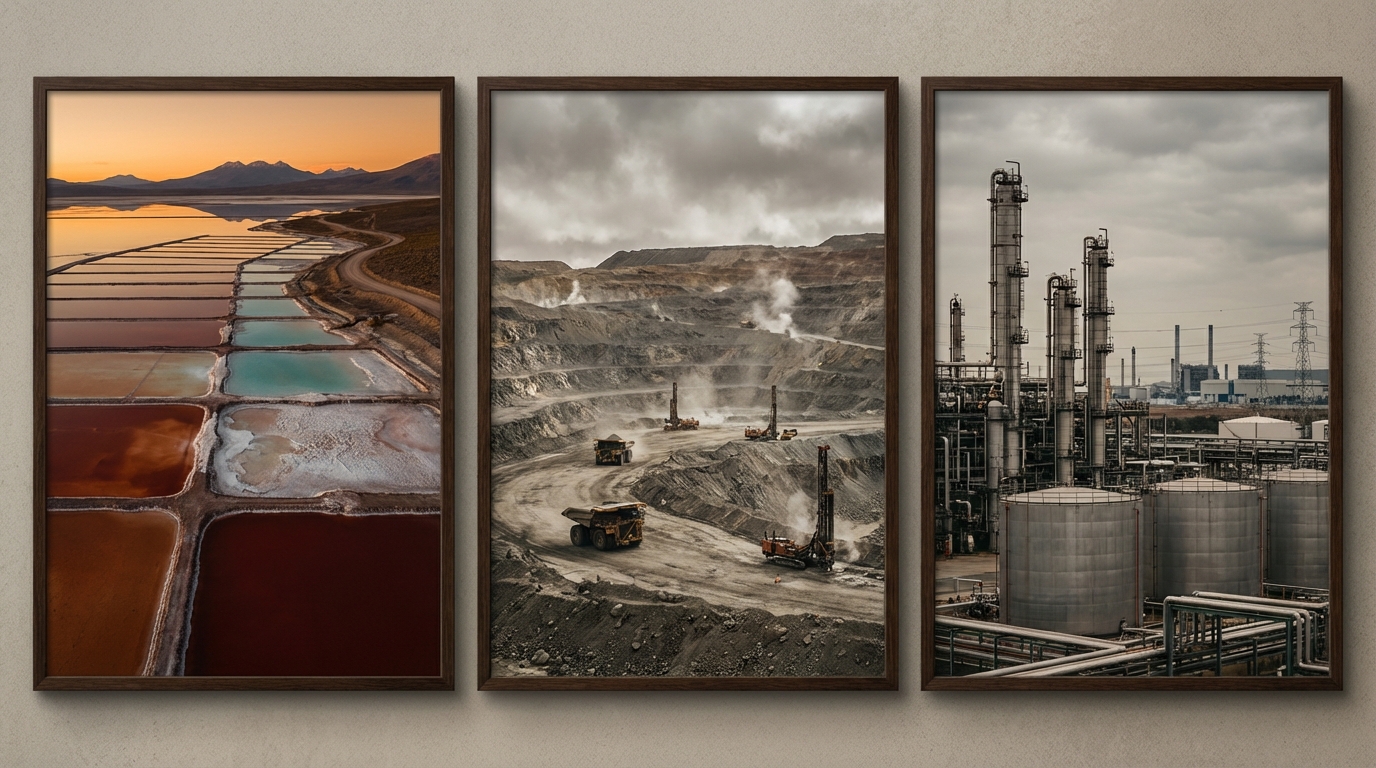
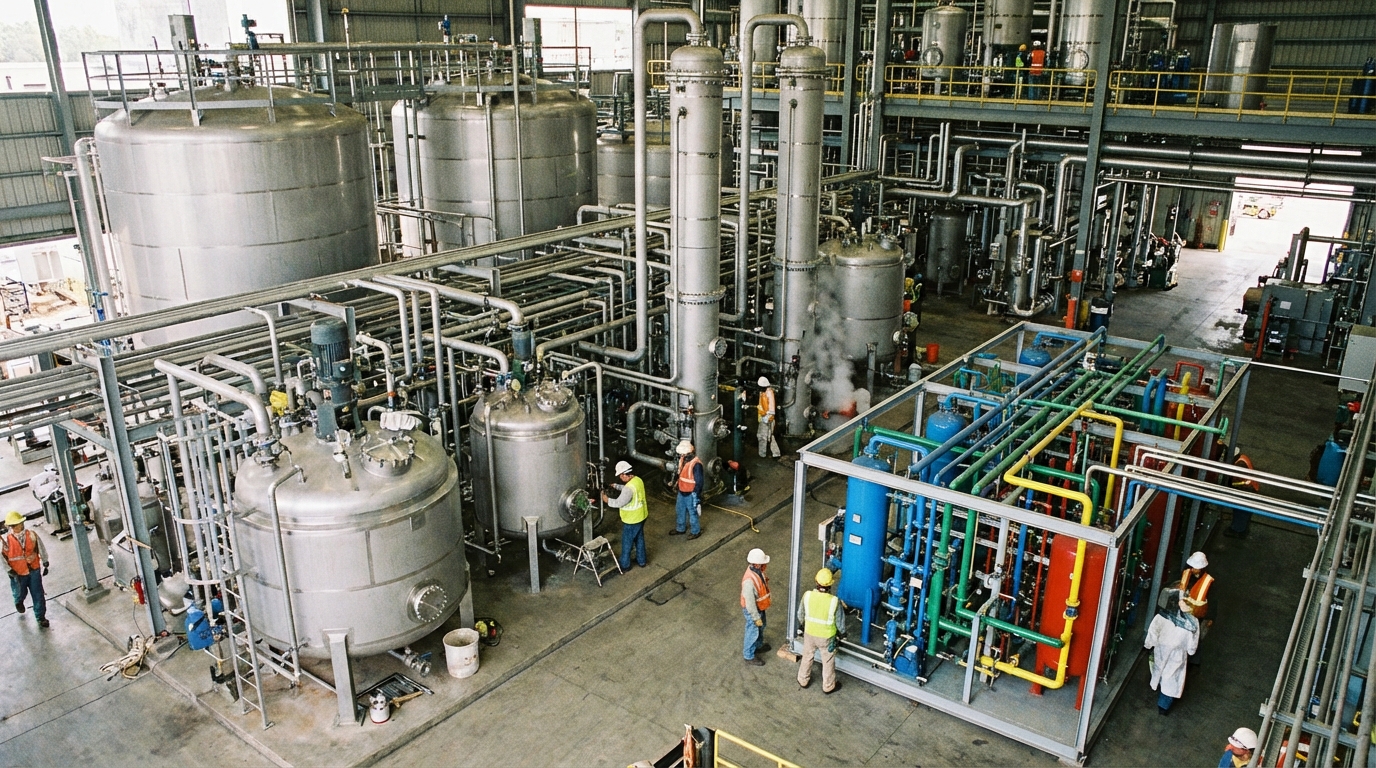
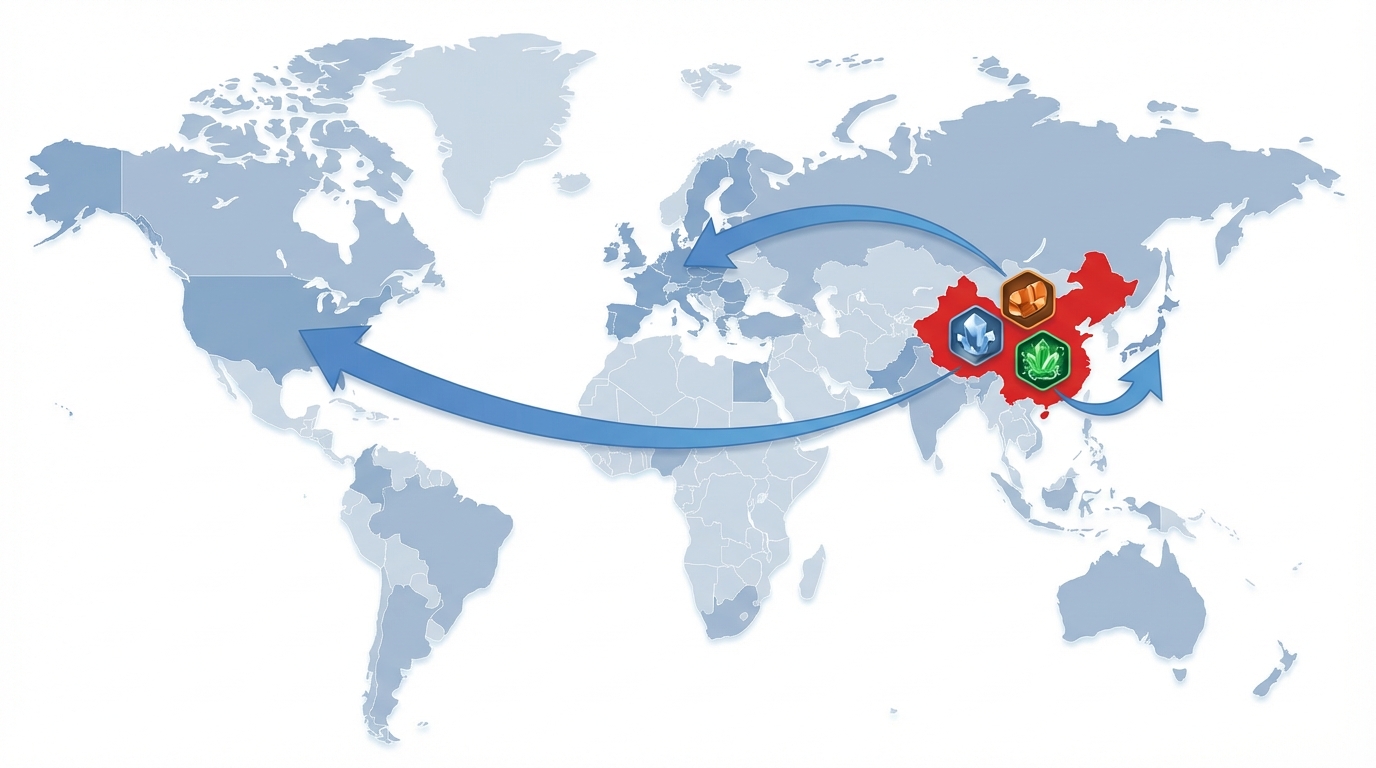
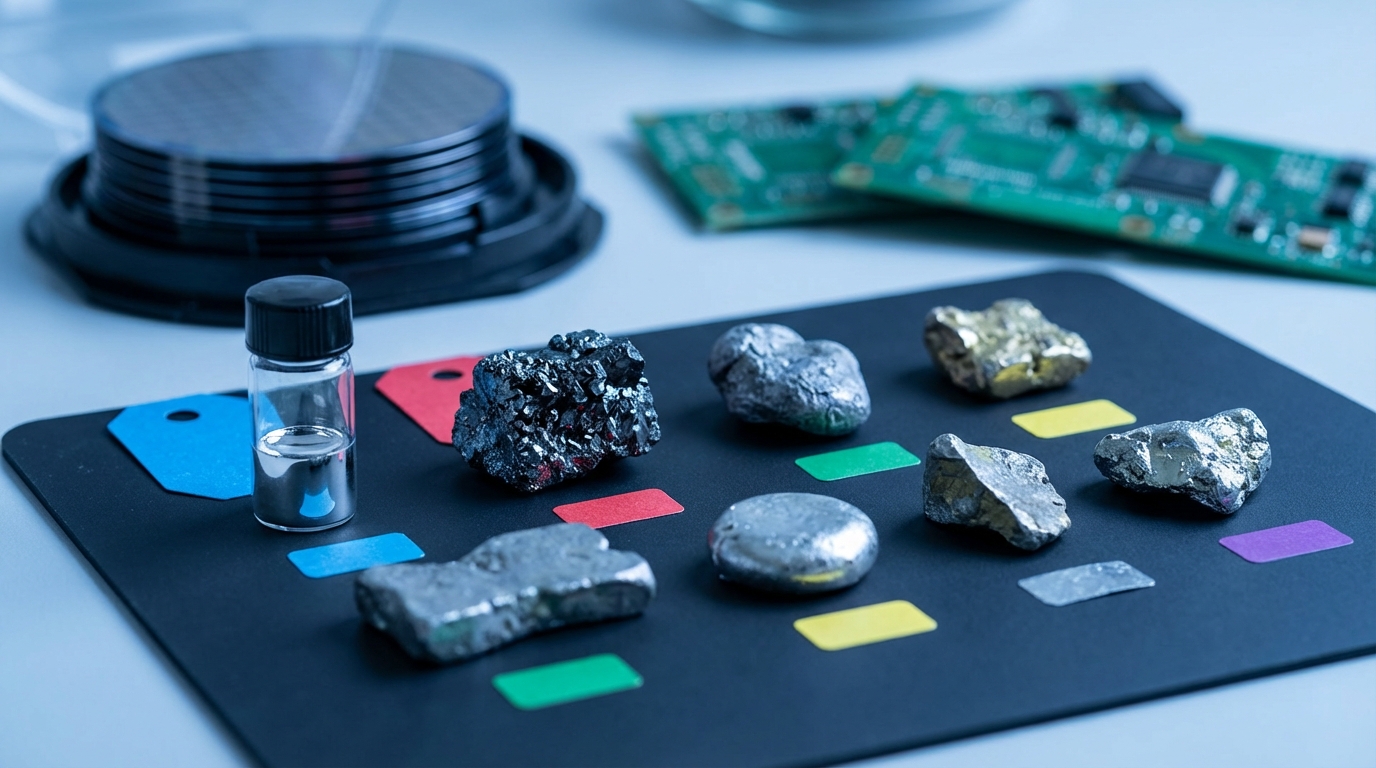
    Yttrium oxide sample in a lab setting illustrating the material at the start of the processing chain.
    Yttrium oxide sample in a lab setting illustrating the material at the start of the processing chain.

    Beyond direct China–US flows, traders report that suppliers in other jurisdictions are hesitant to redirect yttrium toward US customers, concerned that visible support for US defense‑linked supply chains could trigger Chinese retaliation against their own China‑bound shipments. That chilling effect creates a de facto embargo layer on top of the formal restrictions, further tightening the yttrium oxide supply chain.

    In practical terms, this means that nominally “open” supply from third countries is constrained by geopolitical risk calculations, not only by geology or processing capacity. For yttrium, diplomacy is now an operational parameter.

    4. Sectoral Pressure Points: Where Yttrium Shortage Hurts First

    4.1 Aerospace and Gas Turbines: Yttria‑Stabilized Zirconia as a Single‑Point Failure

    Modern high‑bypass jet engines and industrial gas turbines rely on thermal barrier coatings to insulate nickel‑ and cobalt‑based superalloy blades from combustion temperatures well above alloy melting points. The workhorse material is yttria‑stabilized zirconia (YSZ), where a controlled yttrium oxide content stabilizes a tetragonal or cubic zirconia phase, conferring low thermal conductivity, high strain tolerance, and resistance to sintering at service temperatures.

    The coating stack is typically applied by electron beam physical vapor deposition (EB‑PVD) or air plasma spray (APS), using yttria‑bearing ceramic feedstock powders or ingots. These feedstocks require tight control of yttrium content, phase distribution, and impurity levels (e.g., Si, Fe, alkali metals) to ensure lifetimes under thermomechanical cycling that align with engine overhaul intervals.

    Reports from North American coatings firms in late 2025 describe concrete impacts:

    • At least two aerospace coating manufacturers temporarily idled YSZ production lines because contracted yttrium oxide deliveries failed to arrive.
    • One supplier reportedly exhausted yttrium oxide inventory entirely, halting sales of specific coating products.
    • Rationing practices emerged, prioritizing engine OEMs and Tier‑1 integrators while deferring or refusing orders from smaller maintenance, repair, and overhaul (MRO) shops.

    This comes at a time when airframe and engine manufacturers are under pressure to ramp output to clear large post‑pandemic order backlogs. Every uncoated turbine blade or vane becomes a bottleneck in that ramp. In this context, yttrium is not just another cost line item; it is a gating factor for engine delivery schedules.

    4.2 Semiconductor Manufacturing: Yttria in the Fab

    In semiconductor fabrication, yttrium enters mainly through yttria coatings and components used in plasma etch and deposition tools, as well as through certain high‑k or passivation materials. Yttria-coated chamber parts reduce particle generation and resist chemical erosion under aggressive plasma chemistries, prolonging maintenance intervals and improving process stability.

    Fab and equipment executives quoted in industry coverage have characterized the seriousness of current yttrium constraints as “nine out of ten” on a criticality scale. One US‑based semiconductor CEO noted that shortages were already lengthening lead times for tool refurbishment, raising costs, and reducing equipment uptime, even if full line shutdowns had not yet occurred.

    Alternative ceramic materials (such as certain alumina or rare‑earth‑free composites) exist for some chamber components, but they typically degrade faster or generate more particles under advanced plasma conditions. Switching materials requires requalification of process windows, particle performance, and contamination risk—often a multi‑quarter exercise for advanced nodes. In other words, even where technical substitutes exist, time‑to‑implement is the governing constraint.

    4.3 Other Yttrium Applications: Flexible vs. Inflexible Demand

    Beyond aerospace and semiconductors, yttrium appears in phosphors, LEDs, lasers, and performance ceramics. These sectors vary widely in their ability to flex demand:

    • Lighting and display phosphors: Some scope exists to shift formulations toward alternative host lattices or phosphor mixes, especially as LED and display architectures evolve. Demand here is so relatively elastic.
    • Laser crystals (YAG and related): High‑precision industrial and defense lasers rely heavily on yttrium‑based hosts. Qualification cycles are strict, and substitution is limited, making this segment less flexible.
    • Advanced structural ceramics: Applications such as cutting tools, sealing components, and biomedical implants often use yttrium to stabilize zirconia or modify microstructures. Engineering teams may redesign using different compositions over time, but near‑term elasticity is constrained by certification and field performance requirements.

    In practice, the least time‑critical and most cost‑sensitive yttrium applications are absorbing the first wave of demand reduction, freeing limited supply for aerospace and semiconductor uses. That triage buys time, but it does not eliminate the structural deficit in high‑specification segments.

    5. Midstream Chokepoints: Inside the Yttrium Oxide Supply Chain

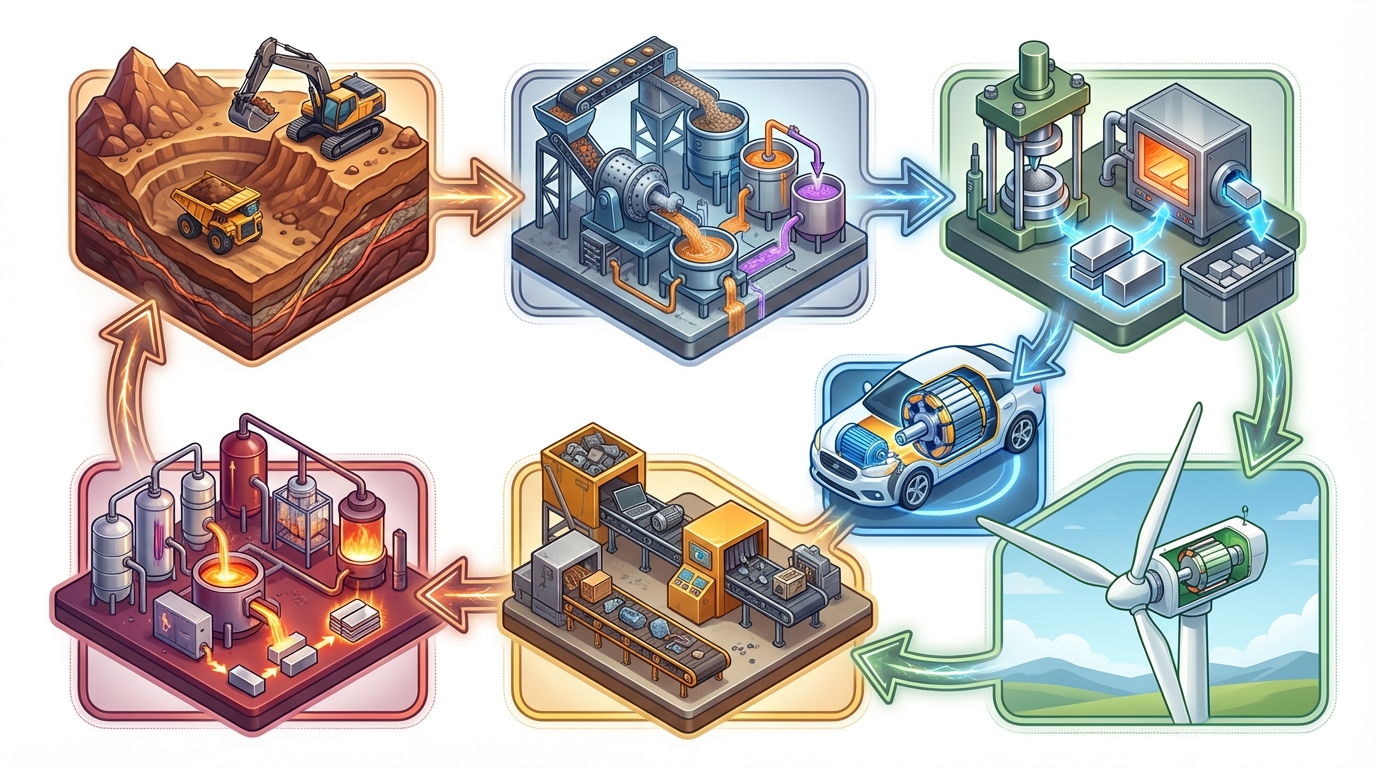
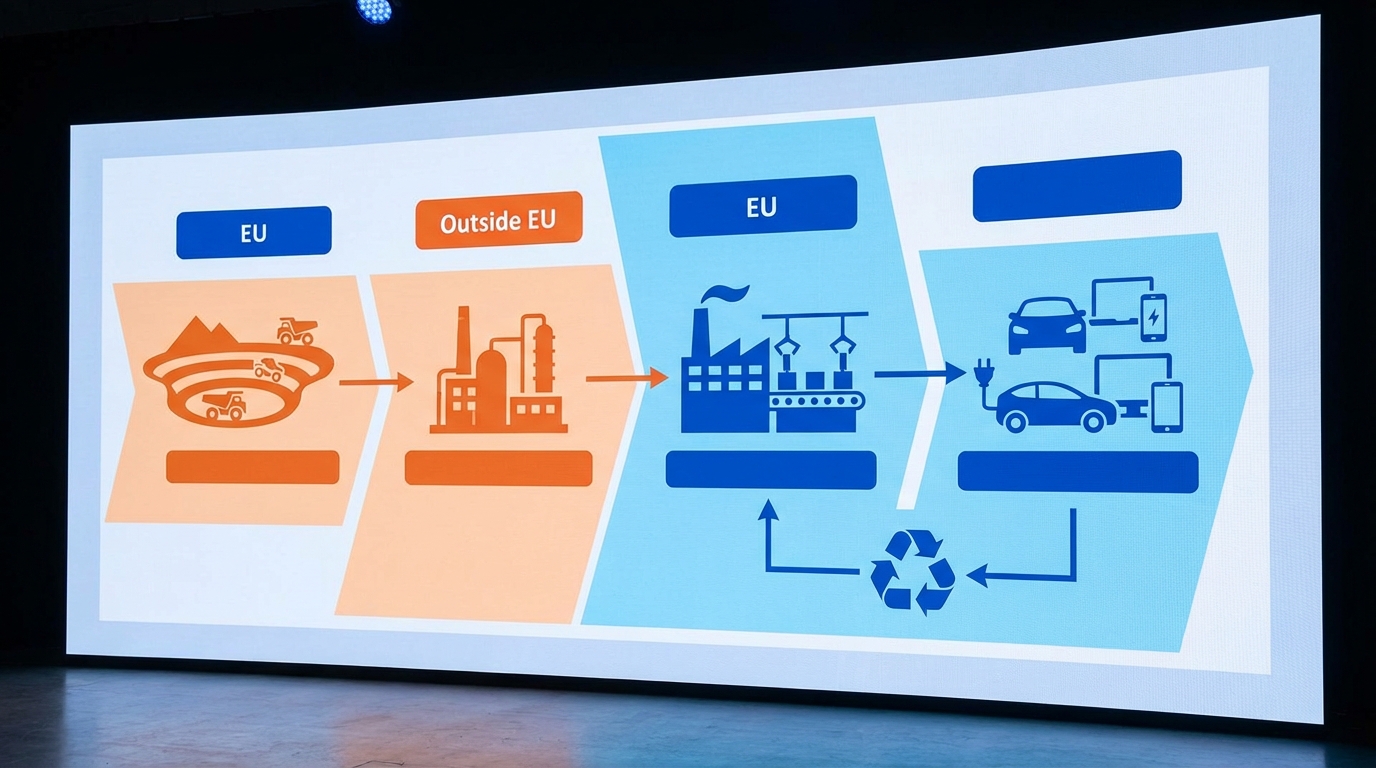
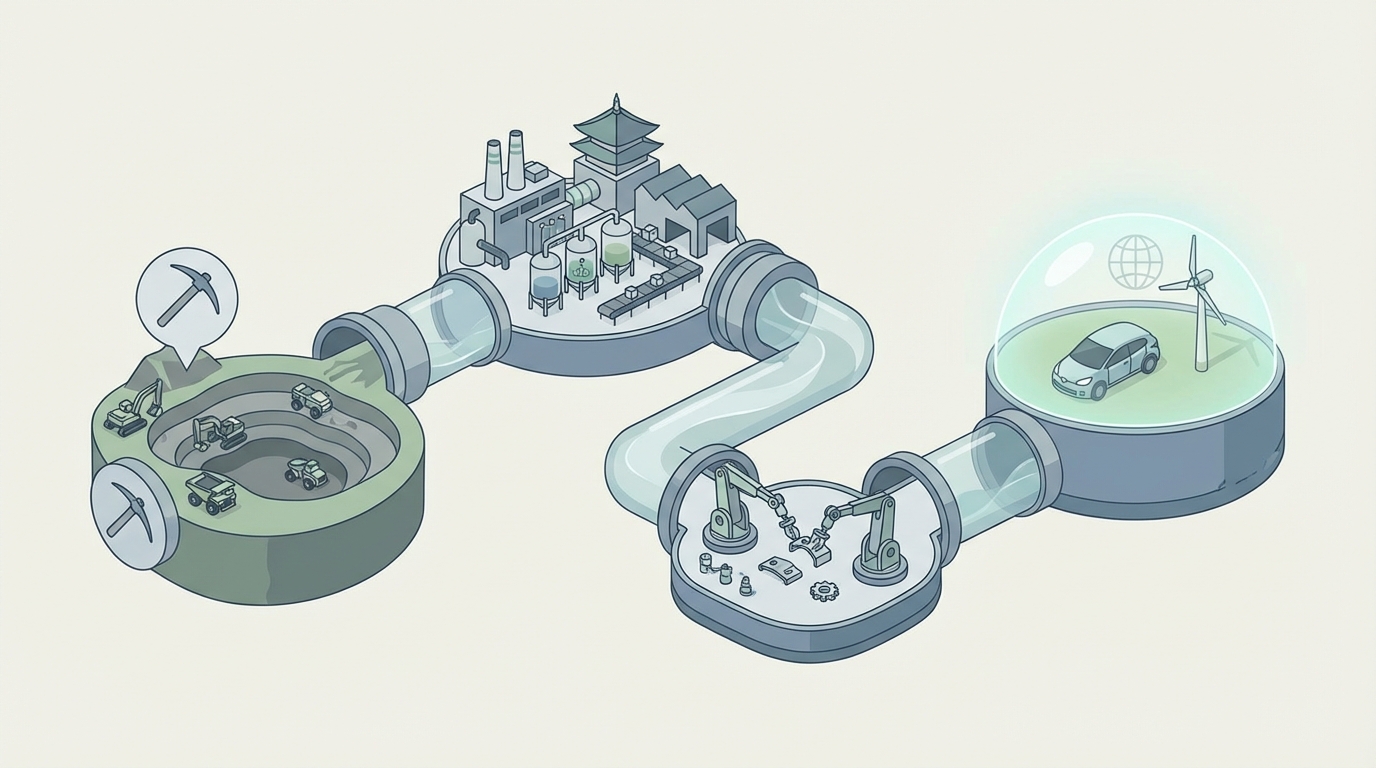
    Understanding where yttrium supply chains actually fail requires dissecting the midstream. The generic chain runs:
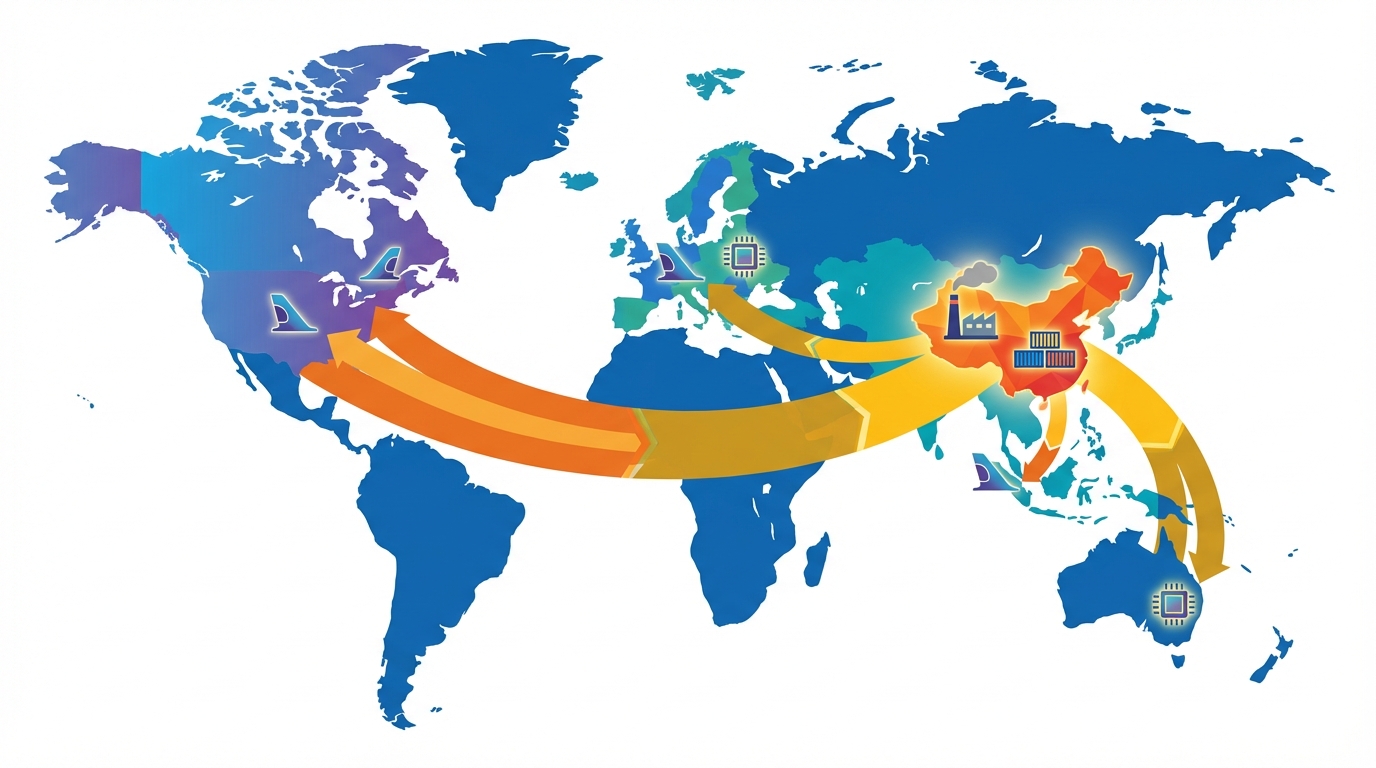
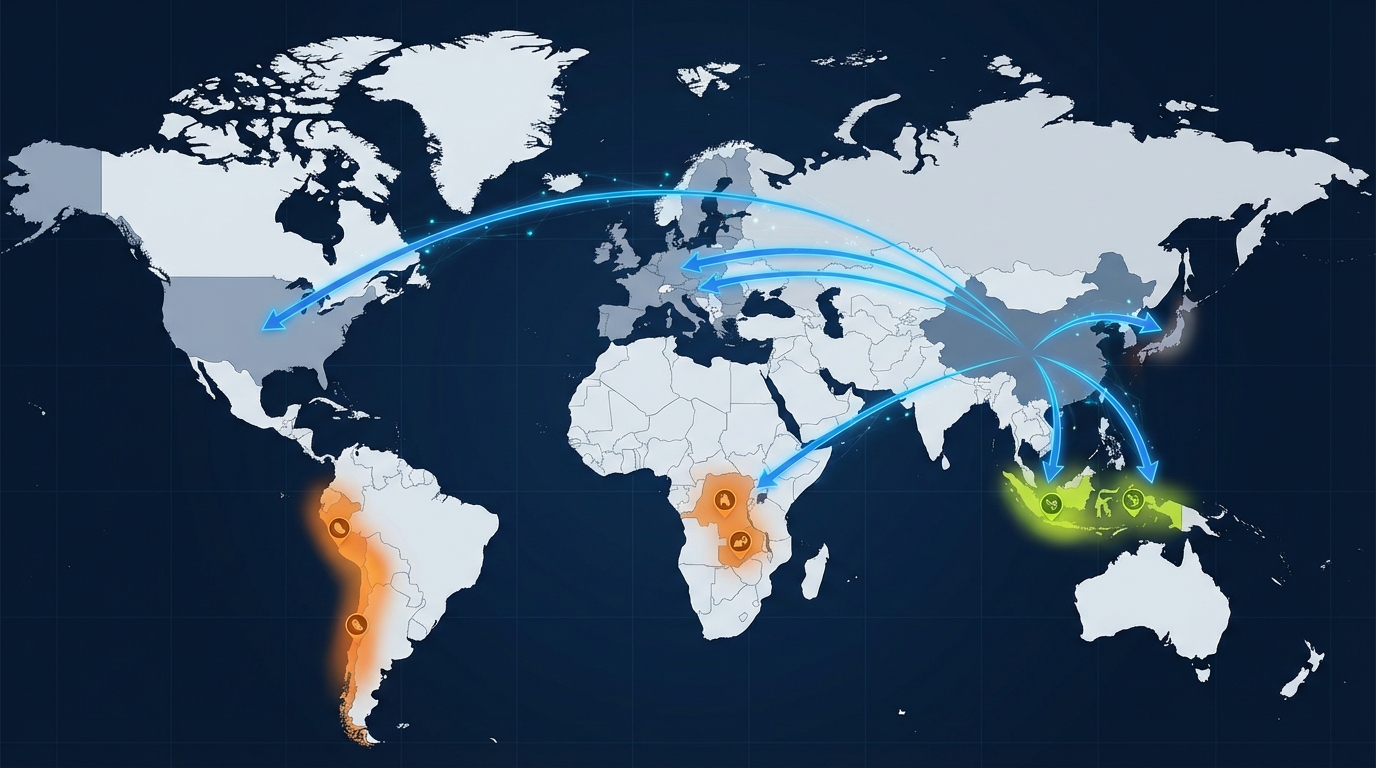
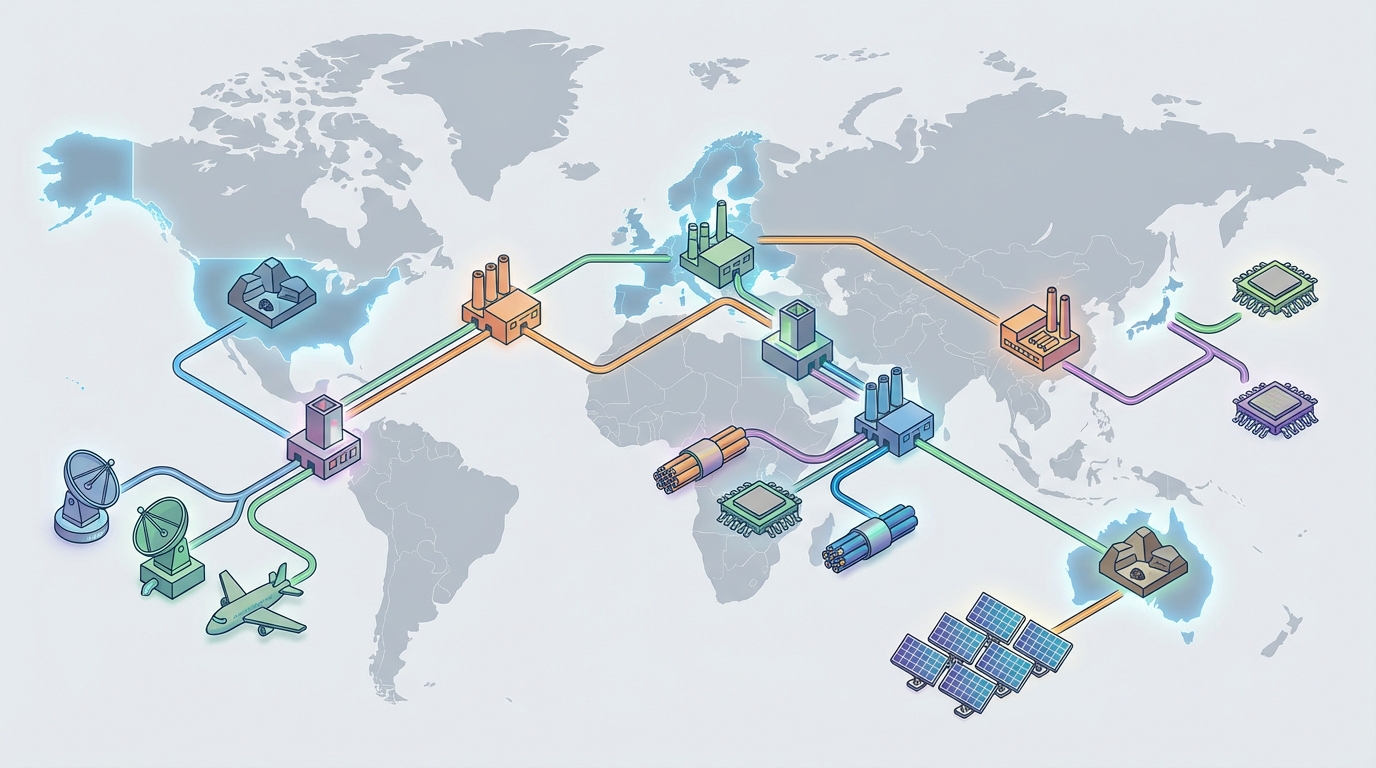
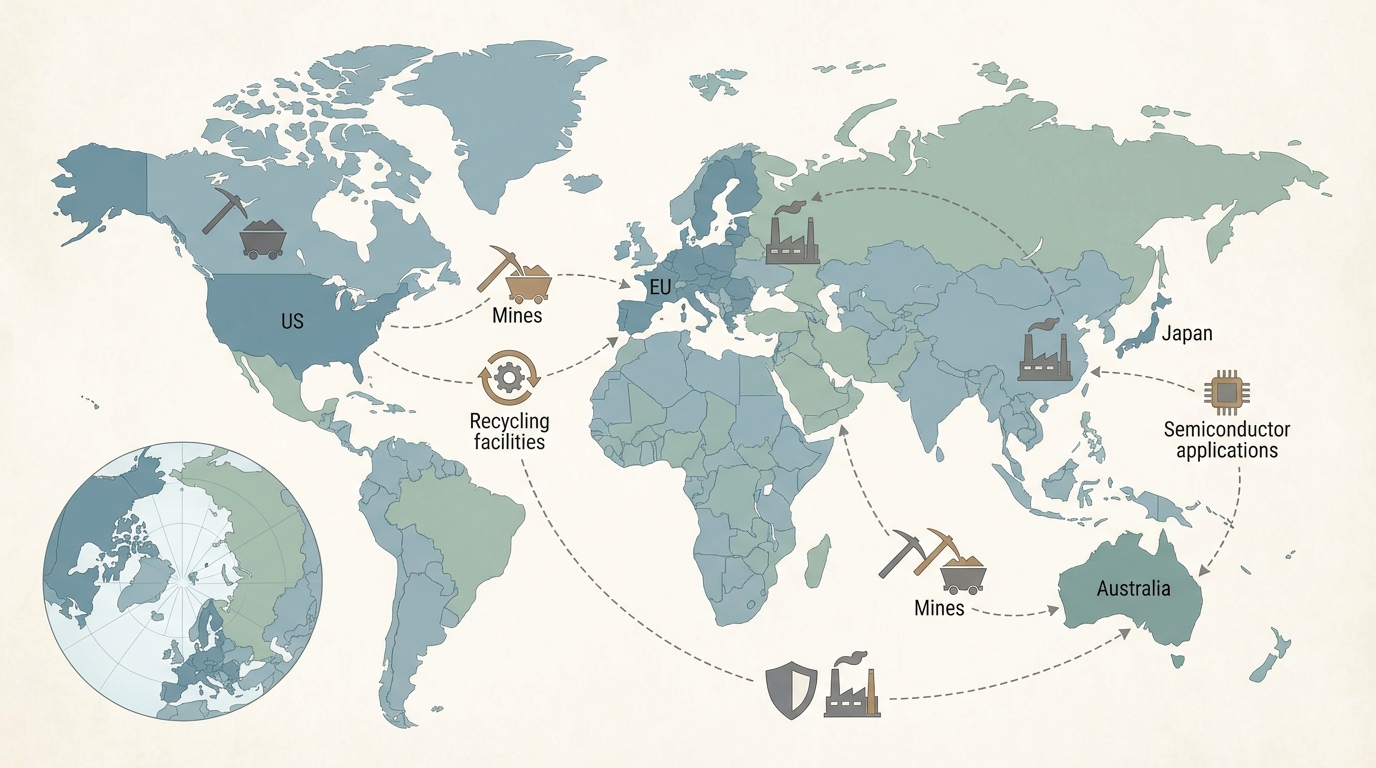
    Conceptual flow map of global yttrium supply showing concentration of production in China and export routes.
    Conceptual flow map of global yttrium supply showing concentration of production in China and export routes.
    • Mine or in‑situ leach operation → crude rare earth solution or concentrate
    • Separation plant → individual rare earth oxides (including yttrium oxide)
    • Chemical processor → engineered powders, granulates, or compounds tailored to specific applications
    • Component producer → coatings, ceramics, lasers, chamber parts, and so on

    In many critical yttrium applications, the real bottleneck is not just oxide itself, but application‑ready powder with tightly controlled properties.

    5.1 From Mixed Rare Earths to Yttrium Oxide

    At the separation plant level, yttrium is one product among many. Facilities that handle mixed rare earth feedstock allocate SX capacity across light, medium, and heavy rare earth cascades. Yttrium volumes are typically small compared with neodymium–praseodymium streams, but the capital tied up in heavy rare earth cascades is significant.

    When regulatory or market pressures hit, operators often focus on elements with the highest aggregate revenue contribution. Historically, this has meant prioritizing magnet materials (Nd, Pr, Dy, Tb) more than yttrium. Under a constrained export regime, the combination of export licensing risk and lower headline revenue per tonne can result in yttrium circuits being throttled or mothballed for external customers, even if they continue to operate for domestic demand.

    5.2 From Oxide to Engineered Powders and Coating Feedstocks

    Aerospace coatings and semiconductor chambers rarely consume generic 99.9% yttrium oxide. They require:

    • Specific particle size distributions, often sub‑micron or tightly controlled multi‑modal blends, to ensure predictable flow in thermal spray or PVD processes.
    • Ultra‑low impurity levels—for example, alkali metal, silicon, and iron contents controlled to tens of ppm or below—to prevent dielectric breakdown, phase instability, or defect generation.
    • Consistent phase composition to stabilize targeted crystal structures (e.g., fully controlled cubic or tetragonal content in YSZ).

    These characteristics are created at specialized ceramic powder plants using milling, spray‑drying, calcination, and sometimes plasma spheroidization. Process control is intensive; deviations cause coating performance drift and can trigger costly requalification campaigns with aerospace regulators or fab customers.

    Several of these powder plants have historically relied on stable, predictable yttrium oxide imports from China. The 2025 controls broke that assumption. Even when alternative oxide sources exist, aligning their impurity profiles and particle morphology with existing powders is non‑trivial. This is why, in practice, the yttrium oxide supply chain tightening translates into both physical shortage and extensive process engineering work at the midstream level.

    6. Industry Responses: Substitution, Recycling, and New Projects

    With near‑term Chinese supply constrained and non‑Chinese midstream capacity limited, actors across the value chain are pursuing three broad avenues: material substitution, recycling and scrap recovery, and development of new primary supply. Each path carries technical, regulatory, and timing constraints that define its realistic impact on the yttrium supply shortage.

    6.1 Substitution and Redesign: How Much Yttrium Can Be Engineered Out?

    In aerospace coatings, research teams are exploring alternative stabilizers and coating architectures—such as rare‑earth zirconates or multilayer systems that reduce yttrium content per coated part. Some turbine OEMs had already been testing such materials for higher turbine inlet temperatures or longer lifetimes; the supply shock has added a security‑of‑supply driver to what was previously a performance‑driven R&D program.

    The challenge is that qualification cycles in aviation are measured in years, not quarters. Introducing new TBC chemistries typically involves rig testing, engine endurance trials, and extensive materials characterization under conditions that simulate decades of service. Regulators, leasing companies, and airlines all have a stake in these decisions. This implies that, even with accelerated programs, meaningful yttrium demand reduction in commercial engines is more of a medium‑term 2027+ phenomenon than a 2025–2026 relief valve.

    In semiconductor tools, some component suppliers are redesigning parts to use alternative ceramics in less critical locations, or to reduce yttria thickness where erosion rates allow. However, core plasma‑exposed components at advanced logic and memory nodes remain strongly tied to yttria performance. Here again, substitution is possible but bounded, and extensive process requalification is a controlling factor.

    6.2 Recycling and Process Scrap Recovery

    Recycling is an under‑developed, but increasingly discussed, response. Two primary streams offer realistic yttrium recovery potential:

    • Thermal barrier coating scrap: Spent blades and vanes removed from service often retain substantial coating material. Mechanical stripping and chemical leaching processes can, in principle, recover YSZ for reprocessing into new powder or oxide feedstock.
    • Manufacturing scrap: Off‑spec powders, overspray from coating operations, and scrap ceramic components from semiconductor equipment manufacturing represent relatively high‑grade secondary sources.

    Technically, hydrometallurgical routes can dissolve YSZ and precipitate yttrium and zirconium separately. The bottlenecks are logistics (collecting and sorting scrap at scale), contamination control (avoiding cross‑metal contamination from blades and fixtures), and the economics of small‑scale, high‑purity chemical processing.

    As yttrium prices in ex‑China markets climbed to many multiples of historical levels, recycling economics have become materially more attractive, especially when framed as an industrial resilience measure rather than a purely cost‑saving exercise. However, the infrastructure for high‑purity yttrium recycling is nascent, and regulatory frameworks for handling coated aerospace scrap add additional layers of complexity.

    6.3 New Non‑Chinese Supply Projects: Timelines and Constraints

    A number of exploration and development projects have positioned themselves as alternative sources of heavy rare earths, including yttrium, in jurisdictions such as Australia, North America, and parts of Africa. Many of these involve ionic clay analogs or heavy mineral sands with xenotime and monazite.

    Turbine blade with yttrium-based thermal barrier coating to illustrate aerospace application vulnerability.
    Turbine blade with yttrium-based thermal barrier coating to illustrate aerospace application vulnerability.

    From a technical execution perspective, several structural constraints shape their contribution to the yttrium oxide supply chain:

    • Permitting and ESG compliance: Ionic clay and monazite projects face scrutiny around leaching chemistry, water use, and radioactive by‑products. Permitting timelines can stretch over many years, especially where communities recall legacy rare earth operations with poor environmental performance.
    • Capex drivers: Building a heavy rare earth SX plant is capital‑intensive not only for tanks, mixer–settlers, and columns, but also for solvent storage, fire safety systems, and wastewater treatment infrastructure. The heavier the rare earth fraction, the more stages and solvent inventory are typically required per unit throughput.
    • Throughput vs. product mix: Many projects are designed primarily around magnet materials (Nd, Pr, Dy, Tb). Yttrium may appear in feasibility studies as a secondary revenue contributor. Tuning circuits to increase yttrium recovery sometimes implies trade‑offs with other elements or higher unit OPEX.

    Industry forecasts circulated in late 2025 suggest that meaningful alternative heavy rare earth supply, including yttrium, will not reach the market at scale before 2027. Until then, the system remains fundamentally tight, with minor disruptions or permitting delays capable of extending the supply‑demand imbalance.

    6.4 Industrial Resilience and Financing Logic

    Heavy rare earth projects, including yttrium‑rich ones, have historically struggled to secure financing because small tonnages and opaque pricing made long‑term cashflows hard to model. The 2025–2026 shock has reframed that calculus for a subset of end‑users who prioritize operational continuity over commodity price optimization.

    Aerospace and semiconductor companies are increasingly structuring long‑term offtake agreements and sometimes participating in project‑level funding not purely as financial plays, but as part of critical operational continuity infrastructure. The logic is closer to securing backup power generation or redundant data centers than to trading a commoditized metal: even small guaranteed tonnages of yttrium oxide from a non‑Chinese source can materially de‑risk production schedules for specific high‑value product lines.

    From an execution standpoint, this tends to favor projects that can demonstrate:

    • Technically mature flow sheets with pilot‑scale validation, especially for heavy rare earth SX and waste management.
    • Clear paths to compliance with EU, US, or equivalent environmental and radiological standards.
    • Flexible plant designs that can adjust product mix between yttrium and other heavy rare earths as demand patterns evolve.

    These features do not guarantee project success, but they align with the industrial resilience priorities visible in current offtake negotiations.

    7. Compliance and Geopolitical Risk Architecture

    Yttrium’s status has shifted from niche chemical to controlled dual‑use material in the span of a single policy cycle. This has reshaped compliance workloads across aerospace, defense, and semiconductor supply chains.

    Key elements of the new risk architecture include:

    • Chinese dual‑use export licensing for yttrium and certain yttrium‑bearing compounds, requiring detailed end‑use declarations and subjecting shipments to extended review timelines and uncertainty.
    • US and allied export control regimes that treat advanced turbine coatings, semiconductor tools, and related know‑how as sensitive technologies, triggering “deemed export” considerations when foreign nationals access controlled data.
    • Critical raw material designations in the EU, US, and other jurisdictions, which bring both support mechanisms (e.g., permitting acceleration initiatives) and heightened reporting and due diligence expectations.

    For procurement and compliance teams, yttrium sourcing now intersects with sanctions screening, supply chain traceability, and human resources policy (for example, vetting access to coating process IP). Lead times are increasingly influenced by paperwork and licensing queues in Beijing, Washington, Brussels, and Tokyo as much as by logistics and plant throughput.

    A critical operational insight emerging from 2025–2026 is that yttrium supply risk is asymmetric: a small regulatory change can have outsized impact on a thinly diversified supply chain, whereas ramping new compliant capacity takes many years. This asymmetry is why policy developments around rare earths need to be tracked as closely as physical inventory levels.

    8. 2026–2028 Scenarios: What Drives Yttrium Tightness from Here

    Projecting yttrium market balances over the next several years is inherently uncertain, but the key structural drivers are clear:

    • Aerospace and turbine demand trajectory: Engine OEM backlog, fleet replacement cycles, and industrial turbine installations all determine coating demand. As long as ramp‑up plans remain aggressive, yttrium intensity in these sectors anchors a large inflexible demand block.
    • Semiconductor capacity build‑out: New fabs and tool installations, especially at advanced logic and memory nodes, increase demand for yttria components. Cleanroom expansions in several jurisdictions suggest continued upward pressure.
    • Policy stability or escalation: Beijing’s stance on yttrium export controls—and any analogous measures by other states—will set the baseline for ex‑China availability. Relaxation could relieve pressure rapidly; further tightening would extend or deepen the supply shortage.
    • Timing of new non‑Chinese HREE projects: Commissioning slippage, ramp‑up performance, and qualification of new yttrium oxide streams for aerospace and semiconductor use will determine when diversification efforts translate into real, high‑purity tonnes.
    • Success of substitution and recycling efforts: Effective coating redesigns or robust recycling circuits could progressively lower primary yttrium demand per unit of industrial output.

    Materials Dispatch’s read of current signals is that even under optimistic assumptions on new projects, the yttrium oxide supply chain will remain structurally tight through at least the mid‑to‑late 2020s for aerospace‑ and semiconductor‑grade material. The system is transitioning from an era of cheap abundance to one of engineered scarcity, where access depends as much on relationships, compliance posture, and willingness to underwrite new capacity as on spot market purchasing power.

    Conclusion: Yttrium as a Test Case for Critical Materials Strategy

    Yttrium has quietly become the element that exposes whether critical material strategies are built on detailed process understanding or on headline lists of “rare earths.” Its supply chain tightening is not a black swan; it is the predictable outcome of decades of processing concentration, limited attention to heavy rare earth midstream capacity, and a geopolitical environment that increasingly weaponizes dual‑use materials.

    The decisive technical realities are clear. Yttrium’s role in TBCs and semiconductor chambers anchors a block of demand that cannot be displaced rapidly without redesigning core industrial systems. Upstream ore availability is not the binding constraint; specialized separation and powder‑processing infrastructure is. Compliance overhead and geopolitical signaling now influence yttrium delivery schedules as much as shipping logistics.

    For Materials Dispatch, yttrium is an early test case of how quickly industrial systems can reconfigure around critical materials once policy shocks arrive. Ongoing monitoring of Chinese export regulations, permitting and ramp‑up progress at non‑Chinese HREE projects, and qualification timelines for alternative coatings and recycling flows will be the weak signals that define whether this remains a multi‑year squeeze or evolves into a longer‑lasting structural regime.

    Note on Materials Dispatch methodology Materials Dispatch integrates regulatory text monitoring (including Chinese MOFCOM announcements and allied export control updates), trade and customs data for rare earth flows, and technical end‑use specifications from aerospace, semiconductor, and advanced ceramics standards. This combination enables early identification of when policy moves will intersect with specific process requirements to create genuine supply chain failure points.

  • Dysprosium Supply Disruption: Myanmar, China Controls, and EV Magnet Risk

    Dysprosium Supply Disruption: Myanmar, China Controls, and EV Magnet Risk

    **Myanmar’s Kachin rare earth disruption and China’s tightened HREE export controls have combined into a structural dysprosium supply disruption, forcing magnet supply chains to trade efficiency, compliance, and resilience against sharply higher operational risk and material cost.**

    Dysprosium After Myanmar: When a Quiet Chokepoint Goes Loud

    Executive focus: The disruption of Myanmar’s heavy rare earth (HREE) output has converted a long-acknowledged vulnerability into a live constraint. Dysprosium and terbium, small-volume but system-critical inputs for high-temperature NdFeB magnets, are now governed by two simultaneous bottlenecks: conflict-exposed feedstock in Kachin rare earth districts and tightening export licensing in China, the core of the HREE supply chain. The result is not just a price shock; it is a structural reshaping of what grades can be produced, where, and under which compliance and geopolitical conditions.

    Market and policy data from 2024-2026 indicate that Myanmar’s ion-adsorption clay operations in Kachin and adjacent areas have provided a substantial share of the dysprosium and terbium units underpinning Chinese magnet alloy production, with several industry analyses characterizing Myanmar-origin material as more than half of China’s external HREE feedstock for Dy and Tb in recent years.[1][2][3] As border closures, conflict, and sanctions expand, this feedstock has become unreliable at precisely the moment when high-coercivity magnets for EVs, wind turbines, and defense systems are scaling.

    The core operational question is no longer whether the market experiences a dysprosium supply disruption-this is already visible in pricing, licensing delays, and rationing-but how magnet producers, OEMs, and policymakers recalibrate processes, specifications, and sourcing architectures under an environment where a single insurgent-controlled mining corridor and a single trade ministry in Beijing jointly define access conditions.

    Myanmar’s Role in the HREE Supply Chain: Why Kachin Rare Earth Matters

    Myanmar’s rise in HREE supply is rooted in geology and proximity. Ion-adsorption clays in northern Myanmar, notably in Kachin State and areas under non-state armed group influence, contain elevated dysprosium and terbium concentrations compared with many of southern China’s more depleted deposits. Industry assessments cited by Fastmarkets and Metal Bulletin describe potential capacity in the tens of thousands of tonnes per year of mixed rare earth concentrate from these districts, with Myanmar attributed as supplying a very large share of China’s imported heavy rare earth feedstock by the mid‑2020s.[1][2][3]

    Operationally, this material fits seamlessly into Chinese separation and refining infrastructure. Concentrate trucked north through border crossings such as Pang War enters established refining hubs in Jiangxi, Guangdong, and Inner Mongolia, where solvent extraction (SX) and ion exchange circuits split mixed rare earth solutions into dysprosium, terbium, and other HREE oxides. The combination of relatively high Dy/Tb grades, low mining costs in informal and semi-formal operations, and short logistics chains into China created a powerful economic rationale for this configuration of the HREE supply chain.

    The fragility was always political. Multiple reports highlight that much of the kachin rare earth mining belt has been taxed or controlled by armed groups such as the Kachin Independence Army (KIA), with revenues reportedly supporting military operations.[3][4] This governance structure enabled rapid extraction growth but left the system exposed to conflict, sanctions pressure, and sudden border closures-exactly the drivers that have materialized since 2024.

    From Potential Capacity to Realized Disruption

    Industry analysis referenced by Fastmarkets and others estimates that Myanmar’s Kachin-region mines had potential rare earth concentrate capacity of roughly 38,000 tonnes per year in the mid‑2020s, though realized output has been substantially lower due to conflict, seasonal access, and regulatory uncertainty.[1][3] Conflict escalations, particularly around Pang War and Chipwi, have produced border closures and transport interruptions lasting weeks at a time, cutting effective feedstock supply into Chinese refineries.

    Fastmarkets reporting for 2025, for example, describes Myanmar rare earth output falling by around a quarter year-on-year amid border closures and localized fighting, implying a loss of several thousand tonnes of concentrate feedstock relative to the theoretical capacity base.[1] When mapped into the narrow dysprosium and terbium oxide markets, these tonnages translate into significant percentage swings in available units, particularly for non-Chinese buyers accessing material only after Chinese refiners secure domestic needs.

    Seasonal factors compound conflict risk. Monsoon rains and landslides regularly disrupt road access from mine sites to border crossings, creating intermittent stoppages even in periods of relative political calm. The operational reality is that a few key roads, a handful of low‑quality staging areas, and fragile informal governance chains carry a disproportionate share of global HREE flows.

    How Myanmar Rare Earth Mining Actually Works – And Why It Breaks Easily

    Understanding the technical profile of myanmar rare earth mining is essential for assessing replacement options. Myanmar’s Kachin and northern Shan deposits are predominantly ion‑adsorption clays, similar to historic Chinese HREE sources in Jiangxi and Guangdong. In these deposits, rare earth elements are weakly bound to clay particles and can be recovered by in‑situ or heap leaching with ammonium sulfate or other salt solutions.

    The typical flow sheet in these areas, as described by regional field investigations and NGO reporting, includes:

    • Stripping of vegetation and topsoil to expose clay horizons.
    • Drilling or trenching to install simple irrigation systems.
    • Percolation of ammonium sulfate or magnesium salts through the clays to desorb rare earth ions.
    • Collection of pregnant leach solutions in lined or unlined ponds.
    • Precipitation of mixed rare earth carbonate or hydroxide concentrates by pH adjustment.

    This methodology is chemically simple but environmentally aggressive. Without rigorous process control, reagents percolate into groundwater, and tailings accumulate with limited containment. From a systems perspective, this production model creates three structural fragilities that matter for dysprosium supply disruption analysis:

    • Regulatory exposure: Governments and armed groups can shut sites quickly by cutting reagent deliveries or blocking road access; there is limited sunk capital in sophisticated plant infrastructure to anchor operations.
    • Environmental backlash risk: Documented contamination near villages and agricultural land creates a growing basis for sanctions, NGO campaigns, and future operational restrictions.[7][8]
    • Quality variability: Without consistent ore characterization and process control, Dy/Tb grades and impurity levels fluctuate, increasing the burden on downstream separation circuits in China.

    Once the mixed concentrate leaves Myanmar, the chemistry becomes more capital‑intensive. Chinese SX plants typically run dozens to hundreds of mixer-settler stages, using phosphoric, carboxylic, or organophosphorus extractants to separate closely related rare earth elements. Dysprosium and terbium occupy late stages in the separation train; any fluctuation in upstream feed chemistry or volume propagates into higher operating costs and lower asset utilization in these units.

    This is where the disruption bites: capital-intensive separation circuits designed around steady Myanmar-origin flows now face irregular feed, while alternative HREE-rich concentrates from other jurisdictions either do not yet exist at scale or require qualification work to align with solvent extraction operating windows.

    China’s MOFCOM Controls: Turning a Supply Problem into a Policy Tool

    The second layer of constraint is regulatory. In late 2025, China’s Ministry of Commerce (MOFCOM) expanded export licensing requirements to cover a wider suite of rare earth products, including heavy rare earth oxides and metals such as dysprosium, erbium, holmium, thulium, and ytterbium, explicitly citing national security and dual‑use concerns.[6] Reuters reporting on the policy shift highlights that this extension reached beyond a narrow set of high‑purity oxides to a broad family of compounds and alloys, pulling more of the value chain inside the licensing perimeter.

    Industry accounts indicate that the new regime requires detailed end-use and end‑user declarations, including for NdFeB magnet and specialized alloy applications. In practical terms, this adds days to weeks of administrative lead time and introduces outcome uncertainty, particularly for shipments to jurisdictions engaged in trade disputes or defense technology competition with China.[6]

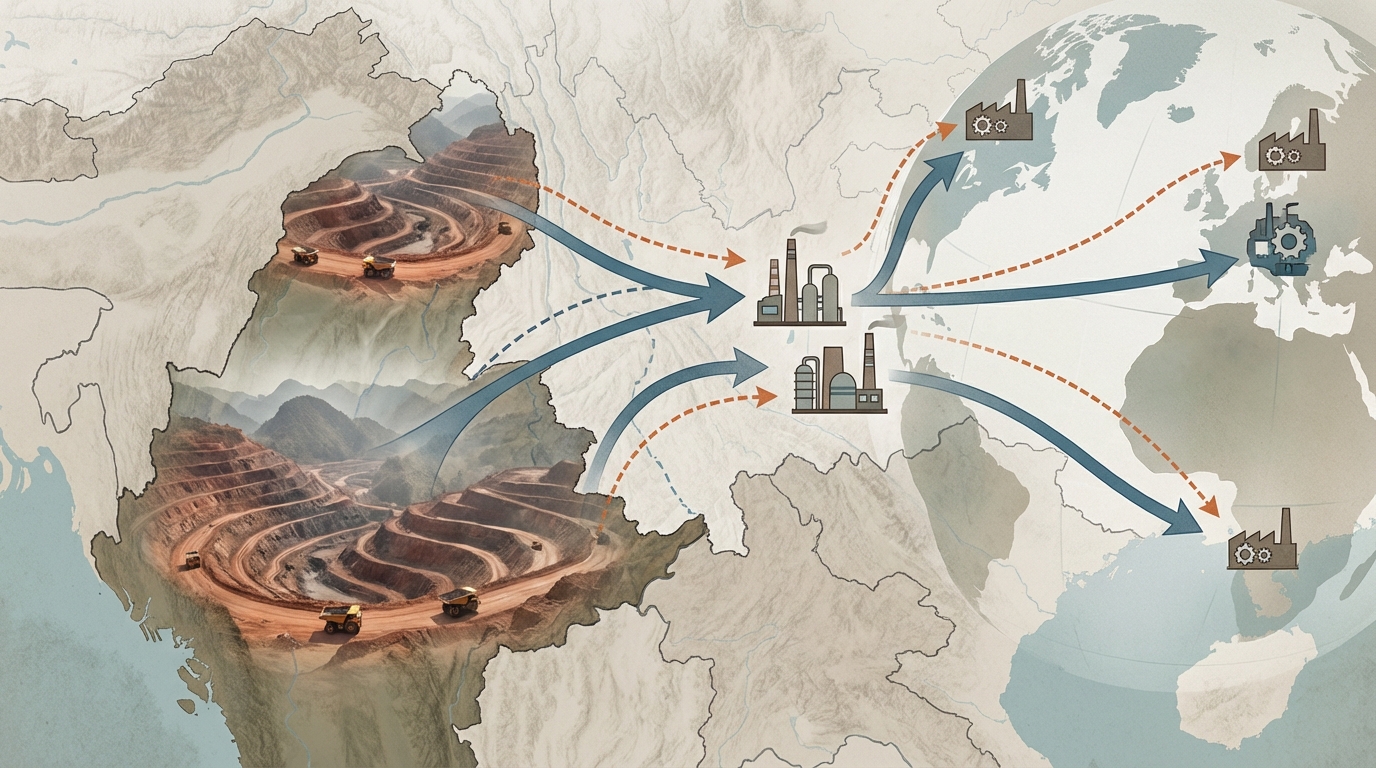
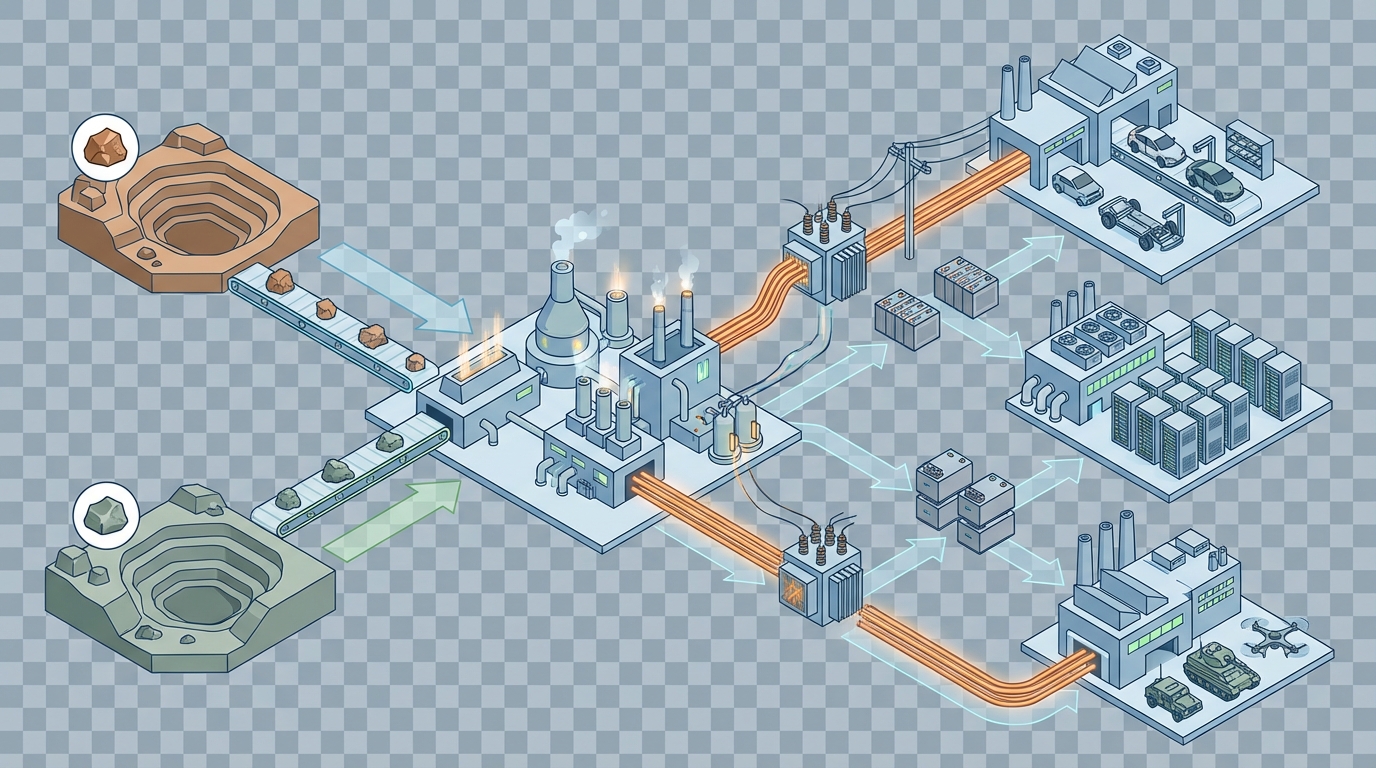
    Illustrated supply-chain map showing northern Myanmar HREE flows into Chinese refineries and onward to global magnet factories.
    Illustrated supply-chain map showing northern Myanmar HREE flows into Chinese refineries and onward to global magnet factories.

    From Border to Export Port: A Double Chokepoint

    When Myanmar feedstock instability is combined with MOFCOM licensing, the result is a double chokepoint:

    • Upstream chokepoint: Concentrate flow into China depends on control of Kachin corridors and other insurgent‑influenced routes; conflict, sanctions efforts targeting logistics and aviation fuel, and weather all intermittently constrain volumes.[1][4][7][8]
    • Midstream/export chokepoint: Once refined in China, HREE oxides and metals, as well as magnet alloys, face selective export gatekeeping through license approvals, with priority inferred for domestic EV, wind, and defense demand.

    S&P Global and other market intelligence providers describe persistent bottlenecks in rare earth exports through 2026 under these rules, with HREE‑bearing compounds particularly affected.[6] December 2025 export data cited in industry analysis shows sharp declines in heavy rare earth shipments compared with earlier in the year, interpreted by several analysts as a deliberate tightening at the export-license stage to conserve critical materials.[6]

    This is why the dysprosium supply disruption is felt more acutely outside China than inside. Chinese refiners and magnet makers generally hold some level of strategic stock; Western and regional importers depend on timely license approvals and shipping windows after domestic allocations have been satisfied. In effect, the same upstream Myanmar disruption that tightens Chinese inventory is amplified for external buyers by export licensing friction.

    Dysprosium and Terbium in Magnets: Technical Non‑Substitutability

    NdFeB permanent magnets dominate high‑efficiency electric motors and generators because of their high energy product and magnetic performance per unit mass. that said, neodymium‑iron‑boron magnets alone lose coercivity at elevated temperatures. Dysprosium and terbium are added to specific magnet grades (for example, N35H through N52UH) to increase coercivity and preserve performance at operating temperatures in the 140-200°C range and beyond.

    In technical terms, dysprosium partially substitutes into the Nd sublattice in Nd2Fe14B, raising the magnet’s anisotropy field and thus its intrinsic coercivity. Terbium acts similarly but delivers even stronger coercivity gains per unit added, albeit at higher material cost. Commercial high‑temperature NdFeB magnets typically contain low single‑digit weight percentages of Dy and, in some aerospace or specialized applications, Tb. For EV traction motors, industry case studies and teardown analyses cited in the public domain have reported dysprosium content on the order of a kilogram or more per vehicle in certain designs; offshore wind turbines can use several kilograms of Dy/Tb mix per generator.[1][5]

    Alternatives do exist, but they are not straightforward substitutions:

    • Grain boundary diffusion: Advanced processing routes concentrate dysprosium at grain boundaries instead of uniformly throughout the magnet bulk, reducing overall Dy use for a given coercivity target. This, however, requires additional heat‑treatment steps, diffusion sources, and process control, adding complexity and cost while extending production cycle times.
    • Samarium–cobalt (SmCo) magnets: SmCo offers superior high‑temperature stability without dysprosium but at higher raw material cost and with lower maximum energy products. SmCo systems also depend on samarium and cobalt supply chains, introducing different criticality and ESG profiles.
    • Ferrite or induction machines: Designs that avoid permanent magnets, such as wound‑field or induction motors, eliminate Dy/Tb exposure at the cost of larger, heavier machines and lower efficiency, especially in high‑performance and space‑constrained applications.

    These pathways reduce but do not eliminate reliance on dysprosium and terbium for high‑end traction, aerospace, and defense applications. As a result, when Kachin rare earth feedstock becomes erratic and MOFCOM restrictions tighten, the effect cascades through magnet specifications, design tradeoffs, and throughput planning.

    Quantifying the Shock: Price, Allocation, and Throughput

    Market data compiled by Shanghai Metals Market, Fastmarkets, and other price reporting agencies, as synthesized in multiple industry analyses, indicates that dysprosium oxide prices increased sharply through late 2025, with quarter‑on‑quarter gains reported in the mid‑teens percent and further strength flagged into 2026.[1][4][6] Terbium, with an even thinner market and higher strategic value per kilogram, exhibited similar or stronger percentage increases.

    The exact numbers differ by source and contract structure, but the direction and relative magnitude are consistent: a material cost base for Dy/Tb‑bearing NdFeB magnets that is substantially higher than in the early‑2020s, and significantly more volatile. Magnet manufacturers report multi‑tens of percent increases in input costs associated with Dy/Tb additions in high‑temperature grades, compressing margins where end‑product prices are locked in multi‑year supply agreements.[1][5]

    Allocation dynamics further exacerbate the disruption. Industry commentary highlights that leading Chinese magnet producers and alloy makers have prioritized domestic EV and wind turbine demand when dysprosium availability tightens, leaving export customers with delays and partial allocations.[5][6] European OEMs, particularly in Germany and Spain, have reported motor and generator line pauses or re‑sequencing linked to delays in rare earth magnet deliveries, effectively transforming a materials issue into an operational continuity problem.

    Sectoral Exposure: EVs, Wind, Defense, and Aerospace

    The dysprosium supply disruption is not uniform across sectors:

    • EV drivetrains: High‑performance permanent magnet synchronous motors rely on Dy‑doped NdFeB for both main traction and auxiliary drives. Reducing dysprosium content can be offset with magnet volume increases or more aggressive cooling, but these design changes affect vehicle range, efficiency, and packaging.
    • Wind turbines: Direct‑drive and hybrid‑drive generators in onshore and especially offshore turbines integrate significant masses of NdFeB magnets, some with Dy/Tb additions for thermal stability under varying load and temperature conditions. Substituting material or altering magnet geometry influences efficiency and maintenance intervals.
    • Defense and aerospace: Actuators, guidance systems, and satellite components often operate over extended temperature ranges and require extremely stable magnetic performance. In many of these applications, Dy/Tb‑bearing NdFeB or SmCo magnets are not easily replaced without mission profile compromises.

    These technical realities explain why even a relative minority share of global rare earth tonnage—dysprosium and terbium combined are a small fraction of total rare earth oxide production—can drive significant industrial disruption when flow is constrained.

    Alternatives to Myanmar: Technical Promise, Timing Constraints

    With Myanmar feedstock exposed, the central question for industrial resilience becomes how quickly alternative HREE supply chains can be brought online and qualified. Several projects across Australia, North America, and Africa target dysprosium‑ and terbium‑bearing deposits, but their timelines, processing readiness, and ESG profiles vary substantially.

    On-the-ground view of HREE ion-adsorption clay mining in northern Myanmar under monsoon conditions.
    On-the-ground view of HREE ion-adsorption clay mining in northern Myanmar under monsoon conditions.

    Australia – Browns Range and other HREE projects. Northern Minerals’ Browns Range project in Western Australia is often cited as a key non‑Chinese, non‑Myanmar source of Dy/Tb‑rich ore. Public disclosures describe an HREE‑focused resource with pilot production of mixed concentrates and plans for larger‑scale output.[1] However, heavy rare earth separation is technologically demanding; without domestic SX capacity, material may still require processing in China or other established hubs, partially re‑introducing geopolitical exposure.

    United States – Mountain Pass and downstream initiatives. MP Materials’ Mountain Pass mine in California produces primarily light rare earth concentrates (Nd/Pr), but the company has signaled intentions to explore heavy rare earth circuits. For now, large‑scale Dy/Tb output remains limited, and separation capabilities for HREEs are still under development.[6] Bridging the gap between geological presence of heavy rare earths and commercially viable separated Dysprosium/Terbium streams will require substantial process engineering and capital deployment.

    Africa and other emerging regions. Projects in Africa, including those associated with Rainbow Rare Earths and other operators, target tailings or hard‑rock deposits with non‑trivial HREE fractions.[3] These projects often face infrastructure gaps (power, water, transport), permitting complexity, and the need to qualify concentrates with refiners. Shipping times from central or southern Africa to major separation hubs can run to several weeks, tying up working capital and magnifying logistics risk.

    What these options share is a time dimension. Even when ore is available, ramping to consistent concentrate output, ensuring impurity control, and integrating into existing SX flows can take years, not quarters. During that window, China remains the core of the hree supply chain china for both refining and magnet manufacture, and Myanmar’s role—even if diminished—continues to influence marginal availability and pricing.

    Terbium Supply 2026: The Thinnest Slice of an Already Thin Market

    Terbium is even more niche than dysprosium in volume terms but exerts outsized influence on high‑end magnet and phosphor technologies. Several sources suggest that Myanmar has supplied a very large share of terbium units entering Chinese refining systems, given Tb’s co‑occurrence with Dy in ion‑adsorption clays.[2][4] When the same districts that underpin Dy supply experience disruption, terbium availability contracts in tandem.

    Analysts cited by Adamas Intelligence and S&P Global have highlighted the risk of a terbium supply 2026 crunch, where stored material in China is progressively drawn down if Myanmar throughput remains below pre‑conflict norms and MOFCOM continues to apply strict controls on export volumes.[4][6] Because Tb additions are concentrated in the most advanced, highest‑performance magnet and device categories, this tightening directly affects aerospace, high‑reliability electronics, and some defense segments.

    Unlike dysprosium, where some process and design substitutions are available, terbium’s unique magnetocrystalline and optical roles make it more difficult to displace without significant performance sacrifices. From an operational continuity perspective, small‑volume, high‑value Tb supply disruptions can halt specific critical programs even if bulk NdFeB production for mainstream EVs continues.

    Compliance, Sanctions, and ESG: The New Constraint Layer

    Beyond geology and policy, compliance regimes increasingly shape how dysprosium and terbium flows can be used. Civil society organizations and advocacy groups have documented environmental damage and alleged human rights violations linked to rare earth operations in Myanmar, including in zones under military and non‑state armed group control.[7][8] These reports underpin calls for sanctions on logistics chains (vessels, fuel, traders) and heighten scrutiny of any material that can be traced back to Kachin rare earth areas.

    In parallel, the European Union’s Critical Raw Materials Act and Corporate Sustainability Due Diligence Directive frameworks elevate expectations around traceability and responsible sourcing. Dysprosium or terbium originating from conflict‑linked or environmentally destructive operations face higher reputational and regulatory risk in European and allied markets. This does not necessarily reduce global production; instead, it can bifurcate the market between compliant and non‑compliant streams, with different pricing and access profiles.

    For magnet producers and OEMs, this means that even where physical material is technically available via intermediaries, using it in regulated markets may trigger audit findings, legal exposure, or exclusion from public procurement in the medium term. As compliance requirements tighten, some share of Myanmar‑origin units risks becoming effectively stranded for certain downstream applications, intensifying scarcity in the compliant segment of the market.

    Operational Responses Observed Across the Magnet Value Chain

    Under these overlapping pressures—Myanmar disruption, MOFCOM controls, and ESG scrutiny—magnet manufacturers, alloy producers, and OEMs have been forced into a set of concrete operational responses that materially affect cost structures and technical performance.

    Inventory and buffer strategies. Industry commentary from European and North American magnet producers indicates that many have increased dysprosium and terbium inventory holdings relative to pre‑disruption norms, targeting several additional months of coverage where capital constraints allow.[5] This reallocates balance sheet capacity away from growth CAPEX toward working capital, but reduces exposure to single‑month border or license disruptions. It also concentrates risk in price movements, as higher stock levels amplify gains or losses from further market shifts.

    Grade re‑engineering and material thrift. Magnet producers have accelerated the use of grain boundary diffusion and other microstructural optimization techniques to reduce Dy content in established grades while maintaining comparable coercivity. Some OEMs have also accepted shifts to lower‑Dy grades for applications with less extreme temperature profiles, trading a small performance decrement for a material cost and security benefit. These engineering choices require re‑qualification and validation, with implications for production scheduling and test capacity.

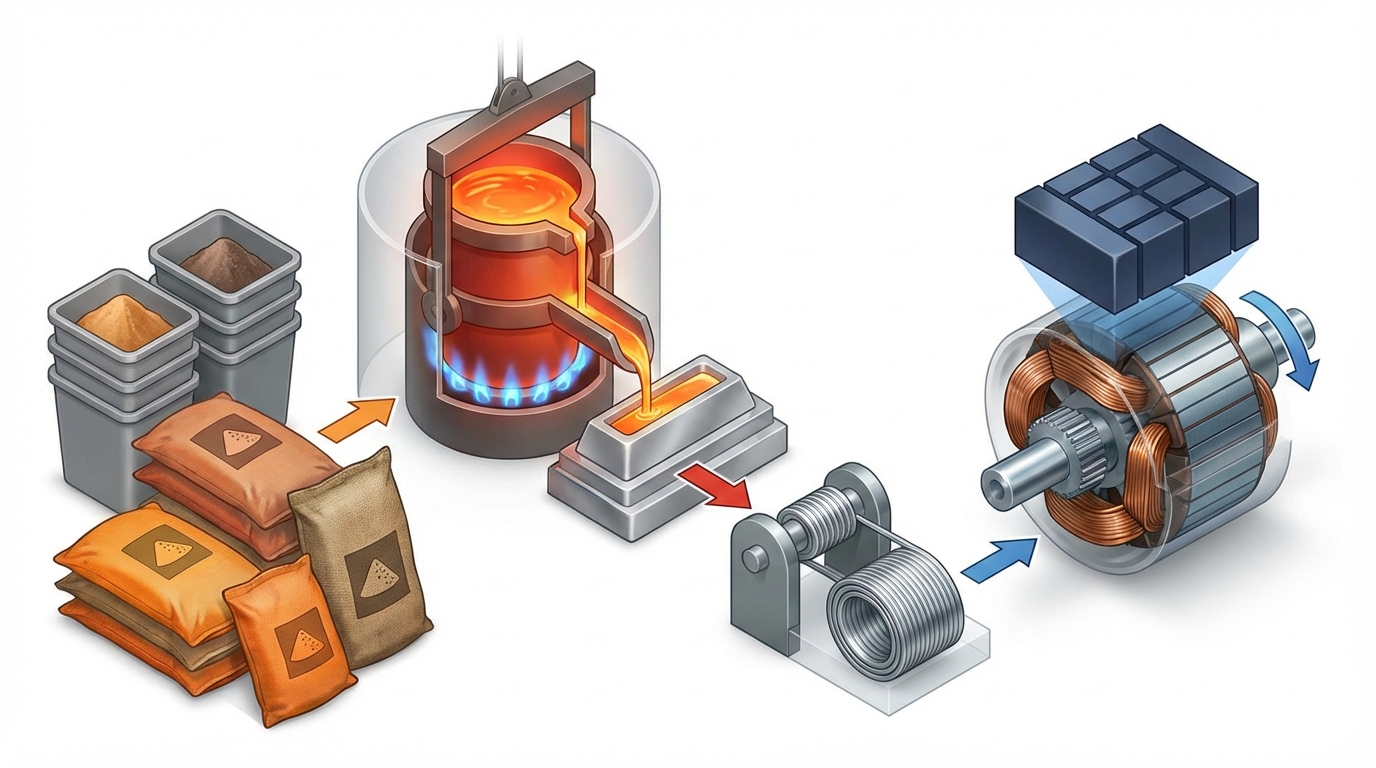
    Technical cutaway showing stages from HREE oxide feedstock to finished high-temperature NdFeB magnet.
    Technical cutaway showing stages from HREE oxide feedstock to finished high-temperature NdFeB magnet.

    Supplier diversification and dual sourcing. Sourcing teams increasingly pursue dual‑supplier models that combine major Chinese refiners or magnet producers with emerging non‑Chinese suppliers in Australia, Japan, or Europe where feasible. In practice, the universe of qualified non‑Chinese Dy/Tb magnet suppliers remains limited, especially for the highest‑grade products, but the direction of travel is clear: structural diversification where technical readiness and compliance frameworks allow.

    Design reconsideration for future platforms. For EV and wind platforms with multi‑year development cycles, engineering teams are revisiting traction motor and generator architectures with an explicit view on rare earth security. This includes increased consideration of motors that use less Dy, hybrid approaches that mix NdFeB and ferrite subassemblies, and in some cases non‑magnet motor concepts for specific market segments. These choices lock in different material footprints for a decade or more once a platform is launched.

    Scenario Framework for 2026–2027: Three Paths, Different Failure Modes

    Materials Dispatch analysis of available geopolitical, policy, and project-development data points to three broad scenarios for 2026–2027, each characterized by distinct operational risk profiles for dysprosium and terbium consumers.

    Scenario 1 – Partial Myanmar Stabilization, Continued MOFCOM Tightness

    In this scenario, localized ceasefires or de‑facto arrangements between armed groups and central authorities allow Myanmar concentrate flows to return to a substantial, though not full, share of earlier capacity. Border closures become less frequent and shorter, and logistics stabilize at a “high‑risk but operational” baseline.

    However, Chinese export controls on HREE products remain or even tighten further in response to ongoing strategic competition. Under this configuration, Chinese domestic demand for high‑performance magnets is largely satisfied, but export flows remain structurally constrained. Non‑Chinese magnet producers retain access but under a regime of chronic licensing uncertainty, modest but persistent price premiums, and a requirement for larger safety stocks to buffer administrative delays.

    Scenario 2 – Prolonged Myanmar Conflict and Expanding Sanctions

    Here, conflict in Kachin and adjoining areas intensifies, and sanctions efforts targeting Myanmar, aviation fuel, and specific logistics corridors expand. Concentrate flows drop well below prior levels, and some border crossings may close for extended periods. Environmental and human rights reporting further stigmatizes material from the region, narrowing the pool of legally and reputationally acceptable buyers.

    Under this scenario, even if MOFCOM were to ease export license issuance, overall physical availability of dysprosium and terbium deteriorates, particularly for external buyers. Prices remain elevated and volatile; OEMs in EV, wind, and defense face repeated reforecasting of magnet availability and may experience non‑trivial line stoppages. Design substitutions and alternative material development accelerate but struggle to keep pace with demand growth.

    Scenario 3 – Accelerated Non‑Myanmar HREE Build‑Out

    The most structurally transformative scenario involves accelerated commissioning of non‑Myanmar, non‑Chinese HREE projects and associated separation facilities, supported by public funding, defense‑oriented procurement guarantees, and industrial resilience frameworks. Browns Range and similar projects scale towards their targeted outputs; pilot heavy rare earth separation lines in friendly jurisdictions demonstrate reliable operation; and offtake agreements underpin multi‑year flow stability.

    Even under optimistic timelines, however, this path carries its own risk structure. Early‑stage plants frequently encounter ramp‑up delays, reagent supply challenges, and impurity‑management issues that limit output or required product purity. In addition, ESG expectations for new projects in OECD jurisdictions are significantly higher than those historically prevailing in Myanmar, raising CAPEX and lengthening permitting cycles. While this scenario materially reduces long‑term dependence on Kachin rare earth and MOFCOM export licenses, it does not provide instant relief for near‑term dysprosium supply disruption.

    What This Means for Industrial Reality in the Magnet Value Chain

    Across these scenarios, several structural conclusions emerge from the technical and policy analysis:

    • Dysprosium and terbium are shifting from quiet inputs to strategic levers. Their small volume belies their central role in enabling high‑efficiency, high‑temperature magnets. Disruptions translate directly into design compromises, higher operating costs, or reduced system performance.
    • The HREE supply chain’s center of gravity remains in China. Even as alternative projects progress, Chinese refining and magnet production continue to dominate, and MOFCOM’s export licensing regime effectively externalizes domestic security and industrial policy choices into global supply chain conditions.
    • Myanmar’s role is unlikely to disappear quickly. Given lead times for alternative HREE sources to reach scale, Kachin‑origin material—legal, semi‑legal, or illicit—will probably continue to influence marginal prices and availability in 2026–2027, albeit with rising compliance and reputational risk.
    • Operational resilience hinges on process flexibility as much as sourcing. Facilities capable of producing lower‑Dy grades, implementing grain boundary diffusion, or switching between NdFeB and alternative magnet chemistries have more levers to pull when Dy/Tb units tighten, even if underlying material scarcity remains.

    In other words, the Myanmar–China HREE axis is no longer a background assumption; it is a live variable that interacts with technology choices, compliance frameworks, and industrial policy. The geography of one insurgent‑affected border region now shapes whether an EV platform, a turbine program, or a defense system can remain on its intended trajectory.

    Conclusion: A Narrow, High‑Impact Constraint That Redefines Magnet Planning

    The dysprosium and terbium shock emanating from Myanmar’s Kachin rare earth fields and China’s HREE export controls does more than move a spot price curve. It exposes how a thin, geographically concentrated supply layer underpins a wide swath of electrification, renewable power, and defense capabilities. Once that layer becomes unstable, technical, regulatory, and geopolitical constraints align to compress optionality for magnet producers and OEMs.

    Materials Dispatch analysis indicates that the critical tradeoffs for the coming years revolve around how much performance to concede in magnet design, how much capital to tie up in Dy/Tb buffers, and how aggressively to back emergent, higher‑cost HREE projects as part of industrial resilience planning. The underlying physics of high‑temperature magnetism is not changing; the politics and process geographies around dysprosium and terbium are. As this transition unfolds, Materials Dispatch is actively monitoring weak signals—from Pang War border opening patterns to MOFCOM licensing language and pilot‑plant commissioning reports—that will define the next phase of this constrained but indispensable supply chain.

    Note on Materials Dispatch methodology Materials Dispatch integrates open‑source policy documents (including MOFCOM announcements), market data from price reporting agencies and trade statistics, and detailed end‑use technical specifications for magnets, motors, and generators. This cross‑referencing of regulatory text, volume and flow indicators, and engineering requirements underpins the scenario analysis and operational risk framing presented in this brief.

  • F-35 Rare Earth Elements: How Many Kilograms Go Into One Fighter Jet?

    F-35 Rare Earth Elements: How Many Kilograms Go Into One Fighter Jet?

    **Western fifth‑generation fighters embed hundreds of kilograms of rare earth elements in magnets, sensors, and power systems. This creates a concentrated dependency on NdFeB and SmCo magnet supply chains that remain heavily exposed to Chinese mining, separation, and alloying capacity. The operational risk is not abstract: export controls, quality incidents, and processing bottlenecks already intersect with F‑35 production, naval platforms, and advanced munitions, redefining what “critical materials” means for airpower planning.**

    How Much Rare Earth Goes Into a Fighter Jet and Why the West Has a Problem

    Executive insight: The question “how many rare earth elements sit inside a fighter jet” sounds academic until production lines slow down because a single samarium-cobalt magnet fails a security review. Rare earth content in a modern fighter is measured in hundreds of kilograms, and almost every kilogram is embedded in a function that cannot simply be designed out: thrust vectoring, flight control actuators, radar, electronic warfare, and power generation. That is where dependency becomes structural.

    The core operational question is straightforward: how exposed are Western combat air fleets, in practice, to disruptions in rare earth mining, separation, and magnet fabrication? Once the mass of neodymium, praseodymium, samarium, dysprosium, and terbium inside each airframe is quantified, it becomes clear that this is no longer a niche materials issue; it is an availability and readiness constraint for front‑line platforms.

    Materials Dispatch’s view is that rare earth exposure in airpower is fundamentally a magnet problem. Catalysts, phosphors, and polishing powders matter, but they do not ground fleets. Permanent magnets in actuators and sensors can. That is why NdFeB and SmCo magnet chains sit at the center of this analysis of rare earth elements fighter jet dependency.

    What Sits Inside a Fighter: F‑35 as a Reference Case

    Publicly cited defense supply chain research has converged on a headline number: approximately 418 kg of rare earth elements per F‑35 airframe.1 This figure aggregates oxides and metals across magnets, sensors, and specialist alloys. The distribution is not uniform, but a simplified breakdown illustrates the structure of dependency:

    • NdFeB permanent magnets (neodymium-iron-boron), with neodymium and praseodymium as principal rare earth inputs, serving motors, generators, and many actuators.
    • SmCo magnets (samarium–cobalt), where samarium and heavy rare earth dopants provide high coercivity and temperature stability for engine‑adjacent and high‑radiation environments.
    • Heavy rare earth dopants such as dysprosium and terbium to increase magnet coercivity in NdFeB magnets, particularly in high‑temperature zones.
    • Specialty alloys and phosphors using gadolinium, yttrium, and others in sensing, thermal management, and certain laser or display components.

    The AN/APG‑81 AESA radar, the Distributed Aperture System, the Electro‑Optical Targeting System, and the fly‑by‑wire control architecture all make intensive use of rare earth magnets and materials. SmCo magnets appear in actuators and engine subsystems that operate at temperatures where NdFeB magnets would demagnetize or age unacceptably. NdFeB magnets, in turn, dominate where high power density and compact form factor are paramount, such as compact electric motors and generators in the electrical power system.

    Visualizations of U.S. defense rare earth use compiled by Visual Capitalist from U.S. government data highlight the same pattern across platforms: fighter jets, precision munitions, and missile defense systems are all magnet‑intensive, with the F‑35 singled out as one of the most REE‑intensive systems in the U.S. inventory.2 In other words, rare earth exposure is baked into the airframe’s architecture rather than concentrated in any single bolt‑on subsystem.

    Beyond the F‑35: Eurofighter, Rafale, and Naval Platforms

    There is far less public, quantified data for Eurofighter Typhoon and Dassault Rafale, but architecture analysis points to similar qualitative dependency levels. Both aircraft rely on:

    • AESA radars (CAPTOR‑E for Eurofighter, RBE2‑AA for Rafale) that use rare earths in transmit/receive modules and associated power electronics.
    • Electro‑hydrostatic and electro‑mechanical actuators for primary and secondary flight control surfaces, driven by permanent magnet motors.
    • High‑reliability generators and starter–generators on the engine providing electrical power under harsh thermal conditions.
    • Advanced electronic warfare suites and optronics systems that again lean on REE‑based magnets, phosphors, and specialty ceramics.

    Industry commentary frequently extrapolates that Eurofighter and Rafale incorporate rare earth tonnages in roughly the same range as the F‑35 – in the hundreds of kilograms per airframe – once magnets, sensors, and materials are counted.3,5 The exact mix between light and heavy rare earths will differ (for example, the share of HREE dopants in radar vs. actuator magnets), but from a supply chain standpoint, the broad exposure looks similar.

    The dependency is even more visible in naval combatants equipped with high‑power electric drives and complex sensor suites. Estimates disseminated through Visual Capitalist report that an Arleigh Burke‑class destroyer may embed around 2,600 kg of rare earths, while a Virginia‑class submarine may rely on approximately 4,600 kg for propulsion, sonar, and weapons systems.2 When those numbers are benchmarked against fighter platforms, a structural conclusion emerges: naval assets concentrate more total rare earth mass per hull, but fighter production cadence makes narrow bottlenecks in magnet supply equally consequential.

    Why Magnets Define Defense Rare Earth Exposure

    Rare earths appear across industrial value chains, but in defense, permanent magnets are the load‑bearing application. For most non‑magnet uses – catalysts, polishing powders, glass additives – process engineers can often reformulate with non‑REE substitutes at some performance penalty. That substitution logic breaks down for high‑performance permanent magnets in critical systems.

    NdFeB magnets deliver the highest energy product of commercially available magnets, enabling compact, high‑torque motors and generators. In fighters and naval vessels, these magnets power:

    • Flight control actuators and back‑up actuation paths.
    • Starter–generators and auxiliary power units.
    • Fuel pumps, hydraulic pumps, and other rotating machinery where efficiency and reliability are paramount.
    • Certain gimbal and pointing mechanisms for sensors.

    SmCo magnets sacrifice some maximum energy product compared to NdFeB but maintain magnetization at significantly higher temperatures, often cited in the 250–350°C operating range for advanced grades, along with superior radiation resistance. This makes SmCo the material of choice for:

    • Engine‑proximate actuators and control devices.
    • High‑temperature sensors and alternators.
    • Certain missile guidance and control applications where thermal cycling is extreme.

    The coercivity of both NdFeB and SmCo magnets in military applications is often enhanced by adding dysprosium and terbium, especially for NdFeB. Those heavy rare earths are geologically rarer and even more geographically concentrated than base light rare earths such as neodymium and praseodymium. That is why, from an operational risk standpoint, “rare earth magnets defense” is not just about volume; it is about specific dopants that enable the coercivity and stability demanded by mil‑spec actuators and sensors.

    One structural finding stands out: in a fifth‑generation fighter, the rare earth bill of materials is less about the visible airframe and more about an invisible magnetic skeleton that holds the aircraft’s electronic nervous system together. That skeleton connects directly to a small number of specialized magnet plants, many still located in or dependent on processing steps in China.

    China’s Dominance in the Defense Rare Earth Supply Chain

    USGS and trade data consolidated by multiple research groups indicate that China accounts for a large share of global rare earth mining and an even higher share of separation and magnet production. Visual Capitalist’s widely circulated breakdown, drawing on U.S. government statistics, shows China as the dominant source of U.S. rare earth imports over recent years, frequently representing the majority of total import volumes.2

    The concentration is particularly acute in NdFeB magnet manufacturing. Mining and primary concentration have begun to diversify – with Mountain Pass in the United States and Mount Weld in Australia prominent – but separation, metal making, and especially magnet alloying and sintering remain clustered in East Asia, with China as the central node. For samarium, dysprosium, and terbium, non‑Chinese separation capacity is materially smaller than for NdPr oxides, amplifying the exposure for SmCo and high‑coercivity NdFeB grades.

    Policy actions have translated this structural concentration into direct supply risk. Chinese export control measures on certain technology and raw materials – including controls on gallium and germanium in 2023 and tighter oversight on specific magnet alloys discussed in 2024 – have been interpreted by defense ministries as clear signals that magnet‑grade rare earth materials are now firmly in the national security toolset. Even the possibility of licensing friction is enough to inject uncertainty into defense procurement calendars that operate on multi‑year horizons.

    The F‑35 Alloy Incident: From Abstract Dependency to Production Impact

    The 2022 discovery that a Chinese‑origin alloy had been used in a magnet within an F‑35 engine subsystem provided a concrete illustration of how deep rare earth dependency can penetrate supply chains. Reporting at the time detailed how a magnet supplier incorporated a cobalt–samarium alloy processed in China, triggering a pause in deliveries while the material’s origin and compliance with defense regulations were reviewed.3

    Technically, the magnet in question was not considered a cyber or intelligence risk vector in the same way a networked electronic component would be. The concern arose from procurement rules on specialty metals and dependencies on foreign adversaries for critical defense materials. Nonetheless, the episode revealed three important dynamics:

    • The number of discrete magnets in a modern fighter is large, and tracing the full genealogy of each alloy batch is non‑trivial.
    • Suppliers deep in the tiered supply chain may rely on globally sourced magnet alloys, often blended or processed in China, without that exposure being fully visible to the prime contractor or defense ministry.
    • Regulatory and security reviews can halt deliveries even when the functional risk from the specific component is judged low, simply because origin requirements were not satisfied.

    From an operational perspective, the episode functioned as a stress test for the defense rare earth supply chain. It confirmed that exotic magnets are no longer an obscure line item in engineering drawings; they can be single‑point constraints that determine whether completed airframes are accepted into service.

    Non‑Chinese Rare Earth Projects: Capacity, Gaps, and Real Execution Constraints

    In response, Western governments and prime contractors have turned toward a portfolio of non‑Chinese rare earth mining and processing projects. Public data from operators, government filings, and technical summaries indicate a clear hierarchy of relevance for defense magnet supply, especially where NdFeB magnets military needs are concerned.

    Mountain Pass (United States) and Mount Weld (Australia) are the anchor upstream assets. Mountain Pass, operated by MP Materials, has reported tens of thousands of tonnes per year of REO concentrate output, alongside an ongoing build‑out of separation and magnet manufacturing capacity in the United States.MP Materials 2025 Mount Weld, operated by Lynas Rare Earths, feeds integrated separation facilities in Asia and, increasingly, in Australia, with a strong focus on NdPr oxides and some heavy rare earth output.Lynas 2025

    Beyond these flagship assets, a tier of emerging projects is particularly relevant for military‑grade magnet chains:

    • Nechalacho (Canada), operated by Vital Metals, targeting NdPr and dysprosium output with a focus on North American supply.Vital 2025
    • Dubbo (Australia), under Australian Strategic Materials, combining zirconium, niobium, and REEs, with plans for downstream metal and alloy capacity potentially relevant to magnet precursors.ASM 2025
    • Bokan Mountain (United States), advanced by Ucore Rare Metals, explicitly framed around heavy rare earth output linked to new separation technologies such as RapidSX.Ucore/DoD filings
    • Phalaborwa (South Africa), developed by Rainbow Rare Earths, focusing on recovering NdPr from phosphogypsum stacks, offering a secondary supply pathway with relatively low mining footprint.Rainbow 2024–2025

    Analyses that attempt to rank these projects by strategic criticality for defense magnets typically prioritize three criteria: (1) scale and timing of potential NdPr and Sm output; (2) jurisdictional and geopolitical risk; and (3) the degree of integrated processing and magnet‑grade metal capability. On this basis, Mountain Pass and Mount Weld sit in the first tier; projects such as Nechalacho, Bokan, Dubbo, and certain Greenland and Canadian heavy rare earth deposits populate the second tier.

    However, the critical execution point is that mining alone does not solve the defense magnet bottleneck. Solvent extraction plants, metal making, strip casting, powder preparation, and sintering lines must be commissioned, qualified, and operated at tight process windows to deliver magnets that meet aerospace and defense specifications. That sequence represents a multi‑stage industrial challenge rather than a simple question of ore grade or tonnage.

    Technical Bottlenecks: From Ore to Qualified NdFeB and SmCo Magnets

    The technical journey from an ore body to a magnet sitting in an F‑35 actuator includes several high‑risk steps, each with distinct constraints on energy, water, waste, and quality control. The upstream segment – mining, crushing, and beneficiation – is relatively well understood, with conventional comminution, flotation, and sometimes gravity or magnetic separation used to produce a mineral concentrate.

    The midstream separation stage is more complex. Most light rare earths (La to Nd, Pr) are currently separated using large‑scale solvent extraction (SX) plants, where thousands of mixer–settler stages may be arranged in cascades to tease apart closely related elements. Constraints include:

    • High capital intensity for SX infrastructure, including corrosion‑resistant materials and extensive tankage.
    • Significant chemical consumption (organic solvents, acids, bases) requiring robust waste treatment and recycling systems to satisfy environmental regulations.
    • Long commissioning timelines, as steady‑state operation with stable separation profiles can take extended periods to achieve.

    Heavy rare earths (Dy, Tb, etc.) are even more challenging, often sourced from ion‑adsorption clays and separated in smaller but chemically intensive circuits. Newer technologies such as membrane extraction, chromatography, or modified ion exchange platforms have been proposed to reduce footprint and environmental impact, but large‑scale defense‑relevant deployments remain limited compared to classic SX.

    The downstream magnet manufacturing chain then introduces another set of constraints:

    • Metal making and alloying: Rare earth oxides must be reduced to metals (often via metallothermic reduction) and alloyed with iron, boron, or cobalt under inert conditions, which is energy‑intensive and sensitive to contamination.
    • Strip casting and powder preparation: Producing appropriate grain structures, followed by jet milling to sub‑micron powders, demands tight process control to achieve target coercivity and remanence.
    • Pressing, sintering, and heat treatment: Aligning grains in a magnetic field, sintering to near‑theoretical density, and performing grain boundary diffusion with Dy/Tb additions are all critical to high‑temperature magnet performance.
    • Coatings and finishing: Magnet surfaces require coatings (e.g., nickel, epoxy) to manage corrosion, especially for NdFeB magnets exposed to humidity or coolant environments.

    Defense applications then layer qualification on top of this already demanding chain. Magnets undergo thermal cycling, vibration, shock, radiation, and long‑duration aging tests. Any relocation of magnet fabrication – for instance, from an established vendor base in East Asia to a new plant in North America or Europe – triggers a thorough requalification cycle. That is why, from an execution standpoint, establishing secure magnet capacity is not only a question of building a factory; it is a question of passing through a multi‑year testing and certification regime tied to platform safety and reliability.

    Policy Responses 2024–2025: DPA, CRMA, and Export Controls

    Recent policy measures have begun to reshape, although not yet resolve, the supply landscape for defense‑critical rare earths.

    In the United States, a series of allocations under the Defense Production Act (DPA) and related industrial base initiatives has directed federal funding toward rare earth separation and magnet manufacturing lines. Public announcements have included support for:

    • Expansion of separation capacity at Mountain Pass.
    • Establishment of NdFeB magnet plants within U.S. borders, often with automotive and industrial loads combined with defense offtake.
    • Demonstration‑scale facilities for heavy rare earth separation and novel processes such as RapidSX.

    These moves are explicitly framed as industrial resilience infrastructure rather than commercial speculation: the aim is to ensure that mission‑critical platforms such as fighters, submarines, and missile defenses retain supply options even under adversarial trade conditions.

    The European Union’s Critical Raw Materials Act (CRMA), adopted in 2024, sets bloc‑wide targets for domestic extraction and processing percentages by 2030, including for rare earths.EU CRMA For defense, the practical near‑term effect lies less in raw tonnage and more in permitting acceleration for strategically designated projects in allied jurisdictions – for example, REE projects in Greenland or within EU borders that can be linked to aerospace and defense supply chains.

    On the other side of the ledger, Chinese export controls and licensing requirements on certain rare earths and magnet alloys have introduced new friction. Even when export volumes remain substantial, uncertainty over future license conditions raises the perceived risk of relying on Chinese origin materials for long‑lived programs such as the F‑35, which is expected to remain in service for decades.

    Operational Risk: Where Rare Earth Constraints Hit Military Capability

    Translating this materials landscape into operational risk for fighter fleets and naval forces requires distinguishing between several potential failure modes.

    1. Production delays for new platforms. A shortage of qualified NdFeB or SmCo magnets, or a sudden regulatory block on a key supplier, can slow final assembly even when airframes, engines, and avionics are otherwise ready. The F‑35 magnet alloy incident showed this mechanism clearly: deliveries were paused despite production capacity being available because a specialty metal sourcing rule was breached.

    2. Sustainment constraints on in‑service fleets. Spare parts and line‑replaceable units that contain rare earth magnets – from actuators to pumps and sensor gimbals – draw from the same constrained magnet supply base as new‑build aircraft. When supply is tight, tension emerges between allocating magnets to new production and sustaining existing fleets. In high‑tempo operations, sustainment magnet demand can be significant.

    3. Qualification bottlenecks when switching suppliers. Even if alternative magnet capacity becomes available in a friendly jurisdiction, migrating critical components to new magnets triggers design reviews, environmental testing, and certification runs. For some systems, that process may take years, during which legacy suppliers remain essential. That dynamic slows down attempts to “onshore” or “friend‑shore” magnet supply in the short term.

    4. Cross‑platform competition for scarce dopants. Heavy rare earths used for coercivity enhancement – dysprosium and terbium in particular – are shared between defense, automotive traction motors, and renewable energy applications such as direct‑drive wind turbines. When HREE supply tightens, defense platforms compete directly with electric vehicles and wind sectors for the same kilograms of Dy and Tb. In practice, that competition can manifest as higher prices, long‑term offtake contracts, or explicit prioritization policies.

    These failure modes illustrate why “rare earth dependency in Western military platforms” is more than a geopolitical talking point. It is a practical engineering and logistics problem that touches platform scheduling, maintenance planning, and the design of future systems that will either entrench or ease current magnet dependencies.

    Scenario Space: How Rare Earth Constraints Could Evolve

    Looking out over the second half of the 2020s, several structurally plausible scenarios emerge for the rare earth–defense nexus, each defined less by headline prices and more by physical and regulatory constraints.

    Constrained diversification. In this scenario, projects such as Mountain Pass, Mount Weld expansions, Nechalacho, Dubbo, and selected African and Greenland deposits reach stable production and feed a modest but meaningful share of global NdPr and Sm output into non‑Chinese magnet chains. Magnet plants in North America, Europe, and allied Asia take a larger share of defense‑grade orders, but a significant fraction of global volume remains tied to Chinese processing. Supply risk is reduced but not eliminated; rare earths remain a lever in geopolitical crises, but day‑to‑day operations are manageable.

    Fragmentation and repeated shocks. Heightened geopolitical tension could lead to more restrictive export controls on both sides, with China tightening magnet and alloy exports and Western blocs imposing broader restrictions on technology or investment flows. In this environment, even small disruptions – a fire at a key separation plant, a licensing delay, a shipping blockage – could cascade into sustained magnet shortages. Defense programs would then increasingly rely on contingency measures such as accelerated stockpiling, redesigns to use lower‑Dy formulations, or tactical cannibalization of non‑priority systems.

    Technological adaptation. Over a longer horizon, materials science could begin to erode rare earth intensity through new magnet chemistries, improved grain boundary diffusion, or advanced motor designs that use less NdPr per unit of torque. Soft‑magnetic alternatives or electrically excited machines may substitute for some permanent magnet applications in lower‑risk environments. However, for the harshest, highest‑reliability regimes – such as fighter engine‑adjacent actuators or certain missile guidance systems – SmCo and high‑coercivity NdFeB are likely to remain benchmarks for the foreseeable future, even in this adaptive scenario.

    Across these scenarios, the persistent theme is that qualitative dependence – the absence of drop‑in substitutes for missions where failure is unacceptable – matters at least as much as quantitative consumption measured in tonnes per year. A fighter or destroyer can tolerate higher rare earth costs more easily than it can tolerate a missing magnet in a flight‑critical actuator.

    Materials Dispatch Synthesis: What Really Drives Rare Earth Risk in Western Airpower

    Bringing these threads together, three structural drivers stand out in the rare earth exposure of Western fighter jets and associated platforms:

    • Concentration in permanent magnets, not overall materials use. The bulk of rare earth operational risk resides in NdFeB and SmCo magnets embedded in irreplaceable functions – fly‑by‑wire systems, radars, EW suites, and high‑reliability power systems – rather than in more substitutable applications.
    • Midstream and downstream processing bottlenecks. Mining diversification is progressing, but separation, metal making, and magnet fabrication – particularly for high‑coercivity, high‑temperature grades – remain concentrated in a small number of jurisdictions, with China still central.
    • Qualification inertia in defense supply chains. Even when alternative supply is technically available, requalifying magnets to meet aerospace and defense standards introduces multi‑year delays that lock in existing dependencies.

    One concise way to capture the situation is this: for Western airpower, rare earths are not a volume problem but a critical‑function problem. A few hundred kilograms of carefully processed material per aircraft determine whether multi‑tonne structures, multi‑billion‑dollar programs, and decades of doctrine remain operationally credible.

    From an industrial resilience standpoint, the key variables to watch are not only new mine announcements, but the commissioning of non‑Chinese solvent extraction circuits, rare earth metal plants, and high‑specification magnet lines, along with the often quieter process of qualifying those components into F‑35, Eurofighter, Rafale, and future sixth‑generation systems.

    Materials Dispatch will continue to track weak signals along this chain – from MOFCOM notices and USGS releases to OEM magnet purchase patterns and specification changes in upcoming fighter platforms – because in this domain, seemingly minor materials decisions can propagate into strategic capability constraints.

    Note on Materials Dispatch methodology Materials Dispatch integrates regulatory text monitoring (including Chinese export control communiqués and EU CRMA implementation rules), technical and production data from operators (where disclosed), and analysis of end‑use specifications for platforms such as the F‑35, Eurofighter, and Rafale. This triangulation allows rare earth mining news, separation capacity shifts, and magnet technology developments to be mapped directly onto concrete defense performance and availability risks.

  • Neodymium Magnets: The Supply Chain Bottleneck Behind Every EV and Wind Turbine

    Neodymium Magnets: The Supply Chain Bottleneck Behind Every EV and Wind Turbine

    **Neodymium-iron-boron magnets sit at the narrowest choke point of Europe’s electrification push: high-torque EV motors and direct-drive wind turbines depend on a supply chain in which China controls the overwhelming majority of mining, separation, alloying, and magnet manufacturing capacity. Europe’s current magnet production and recycling footprint addresses only a small fraction of demand, so the real constraint is not geological scarcity but processing infrastructure, qualification lead times, and regulatory friction across each upstream and midstream step.**

    Neodymium Magnets: Why a Few Grams Decide the Fate of Europe’s Energy Transition

    Executive context: In every high-efficiency electric vehicle traction motor and in most modern direct-drive wind turbine generators, the true performance enabler is not the battery or the blade – it is the neodymium-iron-boron (NdFeB) permanent magnet. These magnets deliver extreme energy density and high coercivity, allowing compact machines with high torque, high efficiency, and stable performance at elevated temperatures. The problem is simple to state and hard to solve: the NdFeB magnet supply chain is geographically and technologically concentrated, and Europe sits on the demand-heavy side of that imbalance.

    Neodymium magnets are not just another component competing for capacity. They are a classic “weakest-link” bottleneck: without them, entire EV assembly lines and offshore wind projects stall, even if batteries, steel, and power electronics are fully available. Market and regulatory data converge on one uncomfortable fact: China accounts for a dominant share of global rare earth mining, separation, NdFeB alloy production, and finished magnet manufacturing. European capacity is growing from a very low base, but for the coming decade, NdFeB magnets will remain the most fragile single point of failure in Europe’s decarbonisation hardware stack.

    This analysis examines the technical structure of the NdFeB magnet supply chain, the specific dependencies of European EV and wind sectors, and the industrial constraints that determine how quickly this dependency can be reduced. The emphasis is not on geology, but on chemistry, metallurgy, process engineering, and qualification cycles – the places where delays and disruptions actually occur.

    1. What Makes Neodymium Magnets Technically Unavoidable in EVs and Wind?

    NdFeB magnets are a ternary alloy system typically composed of neodymium (with some praseodymium and dysprosium or terbium for high-temperature grades), iron, and boron. Their key attribute is a very high maximum energy product (BHmax) compared with alternatives such as ferrite or AlNiCo magnets. In practical machine design terms, that translates into:

    • Higher torque and power density per kilogram of active material.
    • High efficiency over a broad speed range, especially in permanent magnet synchronous machines.
    • Stable performance at elevated rotor temperatures when doped with heavy rare earths (Dy/Tb).
    • Reduced machine volume and mass, which feeds directly into EV range and nacelle weight constraints for wind turbines.

    EV OEMs use these magnets primarily in:

    • Interior permanent magnet synchronous motors (IPMSMs) for traction drives, where rotor-embedded NdFeB segments provide both magnet torque and reluctance torque.
    • Smaller auxiliary motors (steering, pumps, HVAC) where high efficiency at partial load is valuable.

    Wind OEMs deploy NdFeB magnets in:

    • Direct-drive generators, eliminating the gearbox and relying on large-diameter rotor structures packed with NdFeB magnet segments.
    • Medium-speed geared systems that still use permanent magnet generators to raise efficiency at low wind speeds.

    Alternatives exist – induction motors, wound-field synchronous machines, and ferrite-based designs – and are already deployed in some EV platforms and turbine models. that said, they generally require larger and heavier machines, more copper, more active cooling, or more complex control. For high-performance EVs and multi‑megawatt offshore wind turbines, the transition away from NdFeB entails design penalties that OEMs have been reluctant to accept at scale.

    This is where the supply chain problem becomes structural: neodymium magnets concentrate performance, margin, and geopolitical risk in a single class of materials. The balance between these three parameters defines the real industrial choices available to European manufacturers.

    2. Mapping the NdFeB Magnet Supply Chain: From Ore to Rotor

    The NdFeB magnet supply chain can be thought of as a sequence of narrowing funnels. At each stage, the number of competent operators shrinks and the technical entry barriers rise. The critical stages are:

    • Upstream: rare earth mining and primary concentration.
    • Midstream I: chemical separation into individual rare earth oxides (Nd, Pr, Dy, Tb, etc.).
    • Midstream II: conversion of oxides to metals, alloy production, and powder metallurgy.
    • Downstream: sintered or bonded magnet manufacturing, machining, coating, and final qualification for OEM use.

    2.1 Upstream: Rare Earth Mining

    Rare earth elements suitable for neodymium magnet production are typically extracted from bastnäsite, monazite, and related minerals. The rare earth basket usually yields a mix dominated by light rare earths (La, Ce, Pr, Nd), with much smaller fractions of heavy rare earths (Dy, Tb, etc.). Neodymium and praseodymium (often supplied as combined NdPr) are the core inputs for standard NdFeB magnets.

    China hosts several large-scale rare earth mines and integrated processing hubs, notably the Bayan Obo deposit in Inner Mongolia and ion-adsorption clay deposits in southern provinces, supplying both light and heavy rare earths. Outside China, meaningful rare earth mining operations include sites in Australia, the United States, and a small but growing pipeline of projects in Africa and Europe. However, the presence of ore is not the bottleneck; the critical constraint lies in the subsequent chemical processing.

    2.2 Midstream I: Separation into Individual Oxides

    After concentration, mixed rare earth ores are digested, leached, and passed through solvent extraction circuits or ion exchange systems to separate individual rare earth oxides. For NdFeB, the key outputs are Nd2O3, Pr6O11, and for high-temperature grades, Dy2O3 and Tb4O7.

    Solvent extraction plants are capital- and energy-intensive. They require hundreds of mixer-settler stages, tight pH and redox control, and careful management of organic solvents. Waste streams tend to be large, chemically complex, and often slightly radioactive due to thorium and uranium traces in the ore. China’s advantage here is not only scale but also a decades-long build-out of solvent extraction capacity, coupled with historically more permissive environmental frameworks.

    Europe has very limited large-scale rare earth separation capacity. A handful of facilities process mainly light rare earth streams and have only recently reactivated or expanded NdPr separation lines. Heavy rare earth separation for Dy and Tb remains particularly constrained, pushing European OEMs towards overseas supply or design adjustments (e.g., reducing Dy content through grain boundary diffusion techniques).

    2.3 Midstream II: Metals, Alloys, and NdFeB Powders

    The step from separated oxides to magnet-ready alloy is often underestimated in strategic discussions but is technically and operationally non-trivial. Key processes include:

    • Oxide reduction: converting Nd, Pr, and Dy oxides to metals, commonly via metallothermic reduction (e.g., using calcium) in vacuum or inert atmospheres.
    • Alloy melting: producing NdFeB master alloys in induction or vacuum arc furnaces, with carefully controlled compositions and low impurity levels (oxygen, carbon, nitrogen).
    • Strip casting or melt spinning: generating rapidly solidified flakes that produce the right microstructure for high-coercivity magnets.
    • Hydrogen decrepitation and jet milling: embrittling and grinding the alloy into fine powders while controlling particle size distribution and surface chemistry.

    Each step introduces potential defects: oxide inclusions, grain boundary contamination, or improper phase formation degrade coercivity and remanence. Process lines require high-purity inert gases, reliable vacuum systems, and stringent dust and explosion control, making the barrier to entry both technical and regulatory.

    2.4 Downstream: Magnet Manufacturing and Qualification

    Sintered NdFeB magnets are produced by compacting the powder under high pressure in a die, usually inside a strong aligning magnetic field, followed by sintering at high temperature under vacuum or inert gas. Subsequent steps include:

    Illustrated supply-chain flow of rare-earth materials from China to European magnet facilities and end uses.
    Illustrated supply-chain flow of rare-earth materials from China to European magnet facilities and end uses.
    • Heat treatment to optimize the microstructure and magnetic properties.
    • Precision grinding or wire cutting to final dimensions and shapes (arcs, segments, blocks).
    • Protective coating (e.g., nickel, epoxy, or multi-layer systems) to mitigate corrosion.
    • Magnetization under controlled fields and orientation.
    • 100% inspection of critical parameters (B-H curves, dimensional tolerances, crack detection, coating integrity).

    EV and wind OEMs impose stringent quality, traceability, and reliability requirements that go well beyond consumer electronics standards. Long-term stability under thermal cycling, vibration, and mechanical stress must be demonstrated through extensive testing. This leads to a powerful path dependency: once a specific magnet supplier has been qualified into a motor or generator platform, switching suppliers involves requalification cycles that can stretch across many months and tie up engineering resources.

    This combination of process complexity and qualification inertia is why the NdFeB magnet supply chain does not behave like a normal commodity market. A new entrant does not simply add volume; it must match or exceed a detailed performance envelope and survive years of OEM auditing.

    3. Europe’s NdFeB Position: Heavy Demand, Light Footprint

    Europe’s industrial structure loads the system with high magnet demand: large automotive OEM clusters in Germany, France, and Italy; world-scale wind OEMs in Denmark, Germany, and Spain; and growing defense and industrial automation sectors. Yet Europe’s domestic magnet manufacturing base covers only a modest portion of this demand.

    3.1 Current Magnet Manufacturing Landscape in Europe

    European activity is concentrated in a limited set of companies and facilities:

    • Established magnet producers in Germany and elsewhere in the EU that historically focused on smaller volumes and specialized grades rather than mass EV traction production.
    • Joint ventures and subsidiaries of Asian magnet companies that operate assembly, machining, or finishing lines in Europe, often still reliant on imported NdFeB alloys or semi‑finished blocks from Asia.
    • Emerging recycling-centric players working on hydrogen decrepitation-based processes to recover magnet alloys from end-of-life motors and hard drives.

    Several projects aim to expand European NdFeB capacity, but from a low base. Many of these initiatives sit at pilot or early commercial scale, and their throughput, yield stability, and cost base still lag the large integrated clusters in China. In practice, imported magnets and magnet blocks from Chinese producers continue to underpin the majority of Europe’s EV and wind magnet consumption.

    3.2 Upstream and Midstream: Limited Separation, Minimal Heavy REE Capability

    On the upstream side, several European rare earth projects – spanning Scandinavia, Central Europe, and the Balkans – are in exploration or feasibility stages. However, the lead times for permitting, environmental assessments, community engagement, and construction routinely extend beyond a decade. The main constraints are not ore grades but tailings handling, thorium management, and alignment with strict EU environmental regulation.

    Midstream separation capacity inside Europe remains the key gap. A small number of facilities process light rare earth streams, with some capability to produce NdPr oxides at commercial purity levels, but overall output remains modest relative to anticipated magnet demand from EVs and wind turbines. Heavy rare earth separation capacity for Dy and Tb is particularly scarce, which matters because premium NdFeB grades for high-temperature EV and offshore wind applications still rely on these elements, despite advances in heavy rare earth reduction and grain boundary engineering.

    In effect, Europe’s internal supply chain is often “missing the middle”: even where magnets are machined or assembled locally, oxides, metals, and master alloys frequently originate from Chinese or, to a lesser extent, other Asian processors. This midstream dependence is the core vulnerability for both EV magnet dependency on China and the broader permanent magnet shortage narrative.

    4. China’s Dominance: Structure, Not Just Scale

    Discussions about “China controlling around 90% of magnet output” are accurate at a high level, but they risk oversimplifying the deeper structural reality. The dominance is multi‑layered:

    • Integrated clusters: Co-located mining, separation, alloying, and magnet plants reduce logistics friction and allow tight process integration.
    • Process know‑how: Decades of incremental improvements in solvent extraction, powder metallurgy, and grain boundary diffusion directly translate into better yields and lower scrap rates.
    • Cost structure: Energy prices, labor costs, and historic environmental externalisation combine to maintain a cost base that European plants struggle to match, especially for mass-market grades.
    • Product breadth: From low‑end bonded magnets for consumer electronics to high-coercivity sintered grades for EVs and wind, Chinese producers offer the full portfolio.

    For European OEMs, a further complication lies in qualification: many have spent years validating specific Chinese magnet suppliers and grades in motors and generators. These magnets are deeply embedded in design libraries, simulation models, and long-term reliability datasets. Replacing them is not just a procurement decision; it implies engineering revalidation, potential retooling, and certification updates.

    This is why the phrase “EV magnet dependency China” is not rhetorical. It describes a layered dependency that extends from oxides to alloy recipes to established QA workflows. Policy measures alone do not dissolve that stack of constraints.

    Editorial-style close-up showing magnets, rare-earth oxides and recycling/processing equipment.
    Editorial-style close-up showing magnets, rare-earth oxides and recycling/processing equipment.

    5. Permanent Magnet Shortage: Where the Real Bottlenecks Sit

    Industry discourse often frames the issue as an impending “permanent magnet shortage”. Geological resources suggest that neodymium and praseodymium are not inherently scarce at global scale, though localized constraints exist. The sharper bottlenecks are:

    • Separation capacity: Building new solvent extraction and ion exchange facilities that meet modern environmental standards is slow and capital intensive.
    • Heavy rare earths: Dy and Tb are genuinely more constrained and geographically concentrated. High-temperature NdFeB grades still rely on them, especially in harsh duty cycles.
    • Powder metallurgy know‑how: Achieving repeatable high-coercivity microstructures with low heavy rare earth loading requires proprietary processing routes and careful control, which only a limited number of producers have mastered.
    • Qualification pipelines: Even if new plants come online, integrating their output into EV traction motors or offshore wind generators involves lab testing, pilot integration, and long-term durability trials.

    From an operational standpoint, the most immediate risk is not a dramatic global shortage overnight, but a series of regional and sectoral squeezes where qualified magnets for specific applications become hard to secure at any price-compatible level. EV platforms designed around high-performance NdFeB motors, and wind projects relying on specific direct-drive generator designs, face particularly tight tolerances in this respect.

    In this context, “permanent magnet shortage” is best understood as a shortage of process capacity and qualified product, not of rare earth atoms. The nuance matters, because it defines where mitigation efforts can be most effective: in midstream and downstream metallurgy, in recycling, and in motor/generator design adaptation.

    6. Recycling and Europe Magnet Manufacturing: Technical Promise, Practical Limits

    Recycling of NdFeB magnets has been heavily promoted as Europe’s fastest lever to reduce import dependence. The technical logic is compelling: magnets in scrap motors, hard drives, and consumer electronics contain high concentrations of Nd, Pr, and often Dy, already in near‑ready alloy form. However, several operational constraints sharply limit real-world throughput.

    6.1 Collection and Pre‑Processing Constraints

    The first challenge is simply getting magnets out of waste streams in an economically and logistically viable way. Critical issues include:

    • Dispersed and heterogeneous end-of-life vehicles and electronics, often handled by dismantlers without specialized magnet recovery infrastructure.
    • Complex motor designs where magnets are buried in rotors, potted in resins, or tightly integrated with steel laminations.
    • Safety considerations around demagnetization, cutting, and hydrogen exposure during dismantling and decrepitation.

    Hydrogen decrepitation-based processes have demonstrated technical effectiveness in selectively breaking down NdFeB magnets in rotors while leaving steel structures comparatively intact. Nonetheless, scaling such methods to handle the volume and diversity of EV motors and wind generators requires coordinated collection systems and substantial capital investment in preprocessing lines.

    6.2 Metallurgical Recovery Routes

    Three main technical pathways are used or developed for NdFeB recycling:

    • Direct re‑use of alloys: Recovered magnet powder is refined and re‑sintered into new magnets with limited reprocessing. This preserves much of the original microstructure but can propagate impurities and limits flexibility in adjusting alloy composition.
    • Hydrometallurgical recovery: Magnets are dissolved and rare earths are re‑extracted into oxides, followed by standard metal and alloy production routes. This enables better impurity control but closely resembles primary processing in complexity and cost.
    • Pyrometallurgical approaches: Smelting routes recover metallic rare earth-bearing phases that are then processed further. These can handle mixed or contaminated feedstocks but risk dilution and higher energy consumption.

    For Europe, combining recycling with domestic alloying and magnet manufacturing offers a pathway to incrementally build a more resilient “Europe magnet manufacturing” ecosystem. Yet even optimistic scenarios show recycled rare earths covering only a fraction of EV and wind magnet demand over the medium term, primarily because in-use stocks in vehicles and turbines take many years to return as scrap.

    Recycling therefore acts as a stabiliser and partial buffer, not as a stand‑alone solution. Its real impact is in moderating vulnerability to external shocks rather than eliminating dependence on primary material imports.

    7. Alternative Designs and Material Substitution: How Far Can They Go?

    Given the structural exposure, EV and wind OEMs have explored, and in some cases deployed, alternative motor and generator architectures with reduced or zero NdFeB content. The key options are:

    • Induction motors: Rotor cages in copper or aluminium, no permanent magnets. These are robust and magnet‑free but tend to have lower efficiency at partial load and can be heavier for a given torque rating.
    • Wound-field synchronous machines: Excited rotors using copper windings and slip rings or brushless excitation systems. They eliminate rare earths but add complexity and parasitic losses in the excitation system.
    • Ferrite-based permanent magnet designs: Using strontium or barium ferrites with lower energy products, requiring larger machines but no rare earths.
    • Hybrid designs and topology optimisation: Reducing total NdFeB volume by intelligent rotor and stator geometry, flux concentration, and partial substitution with ferrites.

    Several high-volume EV models already rely on induction or wound-field machines, proving that rare-earth-free solutions are technically viable. However, there is a clear pattern: where maximum efficiency, high power density, and compact packaging are prioritised, OEMs often revert to NdFeB-based IPMSMs, particularly for front or primary drive units.

    In offshore wind, the trade‑off is even sharper. For very large turbines, the elimination of the gearbox through direct‑drive permanent magnet generators significantly simplifies maintenance and improves efficiency. Switching back to geared or electrically excited systems in this regime introduces mechanical complexity and potentially higher life‑cycle O&M risk. That is why, despite well-known supply chain exposure, the offshore segment continues to specify large amounts of NdFeB per turbine.

    The critical insight is that material substitution and motor redesign change the location and nature of bottlenecks rather than eliminating them altogether. Copper demand, stator manufacturing complexity, and gearbox reliability risk all rise when rare earth magnets are dialed back. For policy and industrial strategy, this means that simply “moving away from neodymium” is not a cost‑free or risk‑free path.

    Lifecycle infographic of NdFeB magnets from extraction to recycling and reuse.
    Lifecycle infographic of NdFeB magnets from extraction to recycling and reuse.

    8. Regulatory, Environmental, and ESG Constraints on New Capacity

    Europe’s strongest comparative advantage – strict environmental regulation and transparency – is also a real constraint on rapid scale-up of upstream and midstream capacity. Rare earth mining and separation generate tailings and process wastes that must be managed under tight limits for radioactivity, groundwater contamination, and chemical oxygen demand. Key implications include:

    • Extended permitting timelines for new mines and separation plants, often with multiple rounds of public consultation and appeals.
    • Higher CAPEX due to requirements for lined tailings facilities, water treatment plants, off‑gas scrubbing, and decommissioning provisions.
    • Elevated OPEX from continuous monitoring, environmental reporting, and compliance-driven changes to reagent usage and waste handling.

    In magnet manufacturing, health and safety rules for handling fine metallic powders, hydrogen gas, and high-energy magnetization equipment also raise the bar on facility design. Explosion protection (ATEX compliance), dust extraction, and fire suppression systems are significant cost drivers and require specialist engineering.

    From an ESG perspective, European OEMs are under growing pressure to demonstrate traceability of critical materials, including rare earths, and to avoid supply chains linked to severe environmental harm or poor labour conditions. This adds another dimension: some of the cheapest available magnet capacity may be politically and reputationally difficult to utilise at scale, even if technically attractive.

    Overall, regulatory and ESG frameworks do not prevent the build‑out of a European NdFeB chain, but they dictate its pace, cost, and risk profile. Projects that underestimate these frictions tend to slip or shrink, reinforcing the need for realistic timelines in any planning that depends on future “domestic magnet independence”.

    9. Scenario Dynamics: How Europe’s NdFeB Exposure Could Evolve

    NdFeB supply risk for Europe over the coming decade will be shaped less by headline announcements and more by the interplay of several slower-moving variables:

    • The rate at which European separation and magnet plants move from pilot to stable commercial operation, including yield and scrap rate improvements.
    • The pace and breadth of motor and generator redesign in EV and wind platforms to reduce NdFeB intensity.
    • The maturation of magnet recycling ecosystems, particularly collection logistics for end-of-life EVs and large rotating machines.
    • The stability of export policies and industrial strategies in China, the United States, and other producing regions.

    Under a favourable scenario where European projects ramp steadily, recycling systems capture growing magnet volumes, and export conditions remain stable, Europe’s dependence on imported finished NdFeB magnets could gradually shift toward a mix of imported oxides and domestic alloying/magnetisation. This does not eliminate reliance on external sources for rare earths but changes the leverage points and allows more value-add to occur within Europe.

    Under more adverse conditions – tighter export controls, slower European permitting, or technical setbacks in domestic plants – the bottleneck could bite harder. In such a case, OEMs might be forced into more aggressive design changes, reprioritising certain EV and wind variants toward magnet-light or magnet-free architectures, or delaying deployment where such redesign is not viable in time.

    In both trajectories, one pattern holds: neodymium magnets remain a system-defining constraint for the pace and configuration of Europe’s energy transition hardware. Battery chemistries, steel supply, and grid build‑out all matter, but without predictable access to high‑performance magnets, the most efficient and compact drive systems are not available at scale.

    10. Synthesis: Trade‑Offs Defining Europe’s Neodymium Magnet Future

    Neodymium-iron-boron magnets sit at the intersection of materials science, geopolitics, and industrial engineering. For Europe, the strategic dilemma is not whether NdFeB magnets are useful – they are essential – but how to handle the trade‑offs between import dependency, environmental standards, and system-level design decisions in EVs and wind power.

    A few structural conclusions stand out:

    • The tightest bottleneck is midstream processing and magnet manufacturing, not raw ore. Separation, alloying, and powder metallurgy capacity – along with accumulated know‑how – determine which regions hold real leverage.
    • China’s role is deeply embedded through qualification and design dependencies. Even if alternative suppliers appear, integrating them into critical EV and wind platforms involves long, technically demanding validation cycles.
    • Recycling and “Europe magnet manufacturing” are necessary but not sufficient. They moderate risk and build resilience but cannot, in the near term, replace primary imports for rapidly growing EV and wind demand.
    • Design choices in motors and generators shift where constraints land. Reducing NdFeB content often increases copper usage, complexity, or maintenance risk elsewhere in the system.

    Materials Dispatch’s assessment is that the NdFeB magnet chain will continue to define the real-world pace, composition, and cost of Europe’s energy transition hardware far more than high-level policy narratives suggest. The decisive developments will occur in seemingly narrow domains – new solvent extraction lines, incremental improvements in Dy-lean magnet grades, qualification of recycling-derived feedstock, and subtle design shifts in EV drivetrains and turbine generators.

    Monitoring this space therefore means tracking not only mining and trade policy, but also pilot plant performance, OEM specification changes, and environmental compliance trends. The weak signals in neodymium magnet technology and processing will set the hard limits on what Europe can deploy, at what scale, and on what timescale.

    Note on Materials Dispatch methodology Materials Dispatch integrates regulatory monitoring (for example, updates to EU Critical Raw Materials frameworks and Chinese export controls), granular trade and production data on rare earths and magnets, and engineering-level analysis of EV and wind system requirements. This combined lens highlights where nominal capacity figures diverge from practically deployable, qualified magnet supply for strategic sectors.

  • Lithium Price Forecast 2026: Who Survives Oversupply?

    Lithium Price Forecast 2026: Who Survives Oversupply?

    Materials Dispatch cares about the current lithium cycle because it is reshaping three hard constraints simultaneously: supply security for EV and battery energy storage system (BESS) build‑out, compliance with evolving US/EU rules, and the operational survival of upstream and midstream projects that have already absorbed large capital and political attention. The 2022 spike and subsequent lithium price crash towards 2025 exposed how thinly engineered many supply chains really were: plenty of projects talked about “strategic metal security”; far fewer could ride through a multi‑year downturn without scrambling contracts, workforces, and permitting commitments.

    Across procurement cycles and technical due diligence rounds that Materials Dispatch has followed over the last decade, lithium moved from a niche specialty to a central risk item. The combination of lithium oversupply in the mid‑2020s, growing inventories, idled capacity, and a looming ramp in EV and BESS demand has forced a re‑rating of what “security of supply” actually means. The old reflex-lock as much volume as possible, as fast as possible-has collided with negative cash margins, refining bottlenecks in China, and compliance filters such as the US Inflation Reduction Act (IRA) and emerging EU rules on critical raw materials.

    • The change: After an extreme upswing in 2022, lithium prices have fallen sharply into what many forecasts describe as a 2025 oversupply trough, with some analyst curves showing surpluses on the order of 100,000+ mt LCE and inventories in the hundreds of thousands of tonnes equivalent.
    • What is covered: This briefing focuses on 2025-2026 lithium market balance, lithium price forecast narratives, China lithium refining capacity and dominance, and the survivorship logic across different producer archetypes.
    • Operational read‑across: To the extent that forecasts materialise, low‑cost, flexible assets with access to stable refining routes-often via China—look structurally more resilient than smaller or higher‑cost hard‑rock projects dependent on a narrow set of offtakers.
    • Scope limits: All forward‑looking volumes, surplus/deficit estimates, and cost bands come from public analyst and industry commentary; they remain inherently uncertain and sensitive to EV/BESS adoption, policy shifts, and project execution.
    • Regulatory lens: Geopolitical and compliance filters (IRA, EU critical raw materials initiatives, potential strategic stockpiles) are increasingly as decisive as pure cost in shaping which tonnes matter for supply chains.

    FACTS: Market Balance, Price Crash, and Structural Asymmetries

    Lithium price crash 2025: from tightness to apparent glut

    Public benchmarks and industry commentary agree on one core observation: the lithium price crash into the mid‑2020s is real and steep. Spot prices for lithium chemicals reportedly moved from 2022 highs above the $80,000/mt range to levels below $10,000/mt by around 2025 in some assessments. This collapse is widely attributed to a combination of aggressive supply additions—especially out of Australia and China—and EV demand growth that, while strong, did not match the most optimistic curves that underpinned project sanctioning.

    Several analyst houses describe 2025 as a year of clear oversupply, with one widely cited forecast pointing to a surplus around 141,000 mt LCE in 2025, narrowing to about 109,000 mt LCE in 2026, against demand in the vicinity of 1.5 million mt LCE and annual growth in the low teens in percentage terms. Other scenarios are more aggressive, suggesting demand could approach 2 million mt LCE by 2026 if EV and BESS deployments accelerate faster than base case assumptions.

    These figures do not represent a single consensus number; they are indicative of the band within which reputable market analyses cluster. Some research groups go further and sketch a potential swing from surplus in 2025 to deficit in 2026, with forecast gaps ranging from a marginal 1,500 mt shortfall to tens of thousands of tonnes of implied deficit in more bullish electrification scenarios.

    Inventories, idled capacity, and the “hidden buffer”

    One of the striking features of current lithium market discussion is the emphasis on inventory and mothballed capacity as a hidden buffer. Industry commentary describes global inventories on the order of several hundred thousand tonnes LCE—around 350,000 mt is one frequently quoted figure—built up through 2023-2025 as supply growth outpaced real‑time demand.

    At the same time, a wave of output cuts and project slowdowns has emerged, particularly among higher‑cost hard‑rock operations and development‑stage assets. Reports of curtailed production from Australian spodumene mines, delays to new greenfield projects, and early‑stage brine or direct lithium extraction (DLE) schemes pushing timelines back by several years are now commonplace in trade and financial press. Some analyses suggest restart lags in the range of 2-5 years for idled or heavily scaled‑back projects, once prices and contract conditions justify reactivation.

    China lithium refining capacity and concentration risk

    On the midstream side, Chinese dominance in lithium chemical refining remains a central structural fact. Multiple data series place China’s share of global lithium refining capacity around 60 percent, with some forecasts indicating total Chinese refining capacity could exceed 2 million mt LCE per year by the middle of the decade if current expansion plans proceed.

    This dominance is not limited to volume. Chinese refiners and integrated battery players have also pushed into lower‑grade or more complex resources, including lepidolite and mica ores, under business cases that many Western analysts label as “unsustainable” at mid‑cycle prices. Yet, in practice, these operations have contributed to the oversupply picture and reinforced China’s ability to shape intermediate product availability and quality, particularly for hydroxide used in high‑nickel cathode chemistries.

    Global lithium supply and refining hubs with major trade flows.
    Global lithium supply and refining hubs with major trade flows.

    Cost bands, survival thresholds, and producer archetypes

    Across public cost curves and company disclosures, a rough hierarchy of cost positions emerges. Industry commentary often groups producers into broad bands:

    • Low‑cost incumbents – Typically brine‑based producers in South America or highly optimised integrated operations, often cited with cash costs below roughly $5,000–8,000/mt LCE.
    • Middle‑of‑the‑pack hard‑rock players – Established spodumene miners with reasonable logistics and/or partial integration, frequently discussed in the mid‑single to low‑double‑digit thousands of dollars per tonne.
    • Marginal assets – Smaller, higher‑cost projects, new greenfield developments, or operations with challenging ore bodies, sometimes described with cost structures above $12,000–15,000/mt LCE.

    In public debate, survival in a low‑price environment is often equated with staying below the mid‑single‑digit thousands of dollars per tonne, at least on a cash basis, while assets in the high‑teens or above are repeatedly cited as being at risk of curtailment or closure if prices remain depressed. These bands are inherently approximate; each asset’s economics also depend on by‑products, integration, financing structure, and jurisdictional factors.

    Company names recur across analyses. Integrated Chinese groups such as Ganfeng Lithium and Tianqi Lithium, diversified Western majors like Albemarle, and brine specialists such as SQM are frequently mentioned as sitting toward the lower end of the global cost curve. On the battery side, CATL is often highlighted as a central node, combining battery manufacturing scale with upstream stakes and long‑term offtake positions. On the more vulnerable side, a cluster of smaller Australian hard‑rock companies, some Canadian and Brazilian developers, and a set of early‑stage DLE projects are repeatedly classified as higher‑risk under prolonged low‑price conditions.

    Policy and regulatory overlays

    Policy signals are increasingly embedded in lithium market outlook 2026 discussions. Three themes show up consistently:

    • IRA and “foreign entity of concern” rules in the United States, which constrain eligibility for subsidies depending on the origin of critical materials and processing.
    • EU critical raw materials regulation proposals, including domestic capacity targets and diversification requirements for strategic inputs.
    • Strategic stockpile concepts, including open discussion in US policy circles about a potential Strategic Lithium Reserve, although concrete design and timelines remain fluid and not formally codified.

    These frameworks do not change the geology or chemistry, but they meaningfully affect which tonnes are considered “usable” for certain end‑uses and so influence offtake decisions, financing, and long‑term planning.

    Contrast between low-cost brine operations, hard-rock mining, and industrial refining.
    Contrast between low-cost brine operations, hard-rock mining, and industrial refining.

    INTERPRETATION: From 2025 Oversupply to a 2026 Pivot

    2025 as oversupply trough, 2026 as potential inflection

    Read across the major lithium price forecast narratives, a common pattern appears: 2025 is treated as the nadir of oversupply, while 2026 is framed as a pivot year where surplus narrows sharply and could, under certain demand and policy combinations, flip into deficit.

    If demand grows in the low‑ to mid‑teens percent annually—as many base‑case EV and BESS scenarios suggest—then even modest project delays and sustained production cuts among marginal assets could erode the currently projected surplus band (around 100,000+ mt LCE). In higher demand trajectories, with BESS and commercial EV segments accelerating faster than anticipated, market balance models start to show deficits on the order of tens of thousands of tonnes by 2026.

    The operational reality behind these charts is more important than the exact deficit or surplus number. If high‑cost producers reduce output for multiple years, and if reactivation takes 2–5 years once prices recover, then the system loses optionality. The market can look oversupplied on paper in 2025 while quietly setting up a tight 2026–2028 window where availability of battery‑grade material becomes binding again, particularly for buyers constrained by geography or compliance filters.

    Survivors vs casualties: what actually drives resilience

    Based on the producer archetypes that keep appearing in public analysis, four variables seem to drive survival through the lithium oversupply and into the next tightening phase:

    • Cash cost and all‑in sustaining economics – Assets with cash costs under roughly $5,000–8,000/mt LCE have clear breathing room in a sub‑$10,000 environment, especially if they benefit from integrated refining or by‑products. Projects with costs above $12,000–15,000/mt are repeatedly flagged as exposed if low prices persist.
    • Access to processing capacity – Physical mining capacity is not useful without reliable conversion into battery‑grade chemicals. In practice, access to Chinese converters—or equivalent non‑Chinese facilities that meet OEM specifications—has become a decisive differentiator.
    • Ability to flex volumes – Operations and corporate structures that can credibly idle, maintain, and restart without destroying balance sheets are better placed to ride out a multi‑year downswing and capture upside when conditions tighten.
    • Geopolitical and compliance positioning – Tonnes that qualify for IRA or EU critical raw materials criteria carry strategic weight beyond their immediate economics, especially for North American and European OEM supply chains.

    Within this framework, integrated Chinese players combining upstream stakes, large‑scale refining, and captive battery demand appear structurally advantaged in a prolonged downturn: they can run plants to support domestic EV and BESS roll‑out and gradually absorb low‑cost feedstock. Large incumbents in Chile, established hard‑rock producers in Australia with solid balance sheets, and diversified Western majors with significant brine exposure also look more resilient on paper than single‑asset juniors or late‑stage developers.

    On the casualty side, smaller hard‑rock miners with thin margins, dependence on a narrow set of Chinese offtakers, and limited access to non‑Chinese refining routes face a harsh environment if prices linger at or below the low end of analyst ranges. Developers that sanctioned projects assuming sustained prices well north of the current levels, particularly in high‑cost jurisdictions or with heavy infrastructure requirements, are similarly exposed.

    A two‑tier market: Chinese‑centric vs compliance‑constrained

    Another clear pattern in lithium market outlook 2026 discussions is the emergence of a de facto two‑tier system:

    Supply-demand pivot visualization showing oversupply peak and transition to deficit.
    Supply-demand pivot visualization showing oversupply peak and transition to deficit.
    • Tier 1 – China‑anchored ecosystem: Dominated by Chinese refiners and battery makers, supplied by a mix of domestic ore, overseas spodumene (notably from Australia), and South American brines, with relatively fewer constraints on Chinese processing content.
    • Tier 2 – Compliance‑filtered chains: North American and European OEM‑oriented, increasingly filtered through IRA and EU rules that penalise or disqualify materials with heavy Chinese processing involvement.

    If policy trajectories continue along current lines, Western supply chains risk structurally paying a “geopolitical premium” in the sense that they may need to prioritise sources that are both costlier and more complex to scale, in order to maintain regulatory compliance and avoid exposure to sanctions or trade disruptions. Conversely, suppliers that combine low costs with a clean compliance profile—such as certain Chilean brines partnered with Western processors, or new projects in Canada, Australia and Brazil positioned for non‑Chinese refining—gain outsized strategic relevance even if their share of global volume is modest.

    Operational and Supply Chain Implications

    From a procurement and governance perspective, the lithium oversupply phase is not a comfortable “buyers’ paradise.” Contracting experience around previous cycles suggests that aggressive attempts to squeeze marginal suppliers can accelerate mine closures and project cancellations, eroding future optionality. At the same time, locking into long‑dated, rigid arrangements during a downturn can create stranded obligations if policy conditions or battery chemistries evolve.

    In practice, supply chain teams that Materials Dispatch has observed grappling with this cycle tend to re‑prioritise three concrete capabilities:

    • Traceable, auditable origin and processing paths – Given IRA‑type rules and growing ESG scrutiny, being able to document mine‑to‑cell pathways for lithium units is becoming a core competence rather than an optional extra.
    • Portfolio diversity across cost curves – Combining volumes from low‑cost incumbents, mid‑tier hard‑rock players, and a carefully chosen set of emerging projects can reduce over‑exposure to any single regulatory regime, cost band, or geology.
    • Technical adaptability – Cell manufacturing and cathode design that can accommodate a broader range of lithium chemical specifications (within safety and performance constraints) offers more flexibility to switch between hydroxide, carbonate, or alternative forms as regional availability evolves.

    Governance teams, for their part, face a more complex mapping problem. It is no longer sufficient to track “lithium tonnes” in aggregate. For risk committees and boards, the relevant questions revolve around which tonnes (by asset, by processor, by jurisdiction) actually end up qualifying for target markets, and how quickly alternative pathways could be mobilised if a specific node—such as a Chinese converter or a South American brine field—were disrupted or rendered non‑compliant by new rules.

    WHAT TO WATCH

    • Inventory drawdown pace in 2025–2026 – Faster‑than‑expected clearing of the estimated ~350,000 mt LCE inventory buffer would support the thesis of a tighter 2026–2027 market; sluggish drawdown would extend oversupply.
    • Announced vs executed production cuts – Real‑world shutdowns, care‑and‑maintenance decisions, and capex deferrals among high‑cost hard‑rock and junior developers will indicate how much latent capacity truly exits the market.
    • China lithium refining capacity ramp – The rate at which new Chinese refining capacity (often cited as potentially surpassing 2 million mt LCE/year mid‑decade) actually comes online, and its utilisation levels, will shape global conversion bottlenecks and regional dependence.
    • Policy hardening in US and EU – Final IRA guidance on “foreign entities of concern”, EU critical raw materials implementation acts, and any concrete moves toward strategic lithium stockpiles would materially affect which tonnes are effectively bankable for Western OEM chains.
    • Battery chemistry trajectories – Shifts between high‑nickel chemistries, LFP, sodium‑ion, and hybrid approaches will alter the precise form and quality of lithium chemicals required, even if total lithium demand continues to rise.
    • Project finance signals – Access to debt and equity for lithium projects, especially for higher‑cost or non‑integrated assets, will reveal how much of the notional development pipeline is likely to become real capacity by 2026–2028.

    Conclusion

    The lithium price crash into the mid‑2020s is not simply a story of excess enthusiasm followed by a hangover; it is exposing deep structural asymmetries between regions, cost positions, and regulatory environments. The next phase, centred around the 2026 horizon, will test whether inventories and idled capacity are a comfortable cushion or a deceptive mirage that delays necessary investment and diversification.

    To the extent that current lithium price forecast ranges and surplus estimates hold, low‑cost, well‑integrated producers and processors—many of them anchored in China or long‑established South American brines—look set to emerge from the oversupply period stronger, while a meaningful cohort of higher‑cost juniors and late‑stage projects risks permanent impairment. For supply‑chain, policy, and governance stakeholders, the critical task is less about guessing the exact 2026 price and more about mapping which tonnes are genuinely available, compliant, and restartable at different points along the cycle. Materials Dispatch will continue active monitoring of regulatory and industrial weak signals that will determine how this balance evolves.

    Note on Materials Dispatch methodology Materials Dispatch combines systematic monitoring of regulatory texts and guidance from key jurisdictions (including mining, trade, and industrial policy authorities) with continuous review of industry reports, company disclosures, and credible market analyses. These documentary sources are cross‑checked against end‑use technical specifications in batteries, alloys, and chemicals to assess which volumes are truly usable for strategic applications, rather than relying solely on headline capacity or production figures.

  • Q2 2026 Strategic Materials Pre‑Brief: What to Watch This Quarter

    Q2 2026 Strategic Materials Pre‑Brief: What to Watch This Quarter

    Q2 2026 opens with heavy rare earths, copper and nickel at an inflection point, shaped by Chinese controls, Indonesian quota policy and Western re‑shoring. This brief highlights where supply chains are most exposed this quarter and which policy and price signals procurement teams must track in real time.

    Q2 2026 Strategic Materials Pre‑Brief: What to Watch This Quarter

    Executive Summary

    Entering Q2 2026, critical mineral markets sit at an inflection point shaped by four interacting forces: China’s rare earth and technology export controls, Indonesia’s active management of nickel ore supply, structural copper tightness underpinned by electrification and AI infrastructure, and accelerated-but not yet mature-Western efforts to onshore critical mineral value chains.[8][11][25][33][30][62][70][72] Supply bottlenecks for heavy rare earth elements (HREEs), policy‑driven nickel volatility, and a looming copper deficit are the dominant strategic concerns for the coming quarter.

    China’s April and October 2025 rare earth measures, including extraterritorial dual‑use controls on magnets containing just 0.1% Chinese rare earths, have driven EU rare earth prices up to six times pre‑restriction levels, with no clear normalization path in 2026.[8][11] Indonesia’s decision to cut 2026 nickel ore mining quotas to 260-270 Mt from a 2025 target of 379 Mt has already triggered a 30%+ price rally, underscoring policy‑driven volatility.[65][62] Meanwhile, S&P Global projects copper demand reaching 42 Mt by 2040 versus a projected 33 Mt production peak in 2030-a 10 Mt structural gap that will begin to tighten markets this decade.[33]

    Western policy responses are material but lagging. MP Materials’ $1.25 billion “10X” magnet campus in Texas backed by a 10‑year U.S. Department of Defense offtake with a $110/kg NdPr oxide price floor, the U.S. $10 billion Project Vault strategic minerals reserve, and the EU’s €3 billion RESourceEU program will not substantially ease heavy rare earth or copper constraints before 2027.[29][48][49][52][5][70][72]

    For Q2 2026, Materials Dispatch recommends three immediate executive‑level priorities:

    • This week: Map Tier 1-3 exposure to Chinese heavy rare earth content in magnets—especially via Japanese magnet suppliers, which account for ~15% of global capacity and are now directly targeted by Chinese export controls.[11][77]
    • By end of Q2 2026: Stress‑test copper procurement strategies against U.S. Section 232 tariff scenarios and the drawdown of the 1.5 Mt strategic stockpile accumulated in 2025-26.[1][19][20][61][62]
    • By November 2026: Lock in alternative graphite and HREE pathways ahead of the scheduled expiry of China’s graphite export control suspension on November 27, 2026.[25][27]

    Risk / Impact / Timing Snapshot

    Risk Risk Level (Q2 2026) Impact on Value Chains Key Timing Markers
    Heavy rare earth bottlenecks (yttrium, terbium, dysprosium, lutetium) High Persistent price premiums and allocation risk for defense, aerospace, and high‑performance magnets until non‑Chinese separation capacity comes online around 2027.[11][8] China’s April/October 2025 controls already in force; alternative HREE separation capacity not expected before 2027.[8][11]
    Policy‑driven nickel volatility High (price), Medium (physical availability) 30%+ price swings tied to Indonesia’s annual quota decisions; elevated procurement and hedging risk for stainless and battery supply chains.[65][62] 2026 quotas (260–270 Mt) already set; potential mid‑year review for major producers such as PT Weda Bay Nickel.[65][62]
    Copper tariff & structural deficit risk Medium (Q2), Rising (late‑decade) Near‑term buffered by >1 Mt exchange inventories and U.S. strategic stock; structurally, a projected 10 Mt annual deficit by 2040 poses systemic risk to electrification and AI infrastructure.[33][61][62][1] Section 232 copper tariffs announced February 2026; demand/supply gap becomes binding in 2026–2030 window.[19][20][33]
    Graphite export control snap‑back Medium China controls ~75% of natural graphite; end of current suspension could re‑tighten U.S. battery anode supply.[25] Suspension for U.S. runs to November 27, 2026; Titan’s New York graphite project targets commercial output only by 2028.[25][27]

    The Problem

    The core problem entering Q2 2026 is a widening mismatch between the pace of geopolitical constraint, structural demand growth, and the slower ramp of non‑Chinese supply and processing capacity across multiple strategic materials systems.

    In rare earths, China’s April 2025 licensing requirements on seven heavy rare earths and the October 2025 expansion to five additional REEs, combined with dual‑use rules covering magnets containing just 0.1% Chinese rare earths, have structurally segmented the market.[8][11] The International Energy Agency reports that EU rare earth prices reached up to six times pre‑restriction levels after these measures, with no visible normalization in the near term.[8] S&P Global data show the largest premiums in yttrium, terbium and dysprosium, precisely the HREEs most important for defense, aerospace, and advanced electronics.[11]

    David Merriman of Project Blue expects “the ex‑China market will continue to face bottlenecks in the supply of HREE products over 2026 and 2027 as alternative suppliers of HREEs are constructed and commissioned,” highlighting that alternative separation capacity is not due until 2027.[11] Separation, rather than mining, is the critical bottleneck; even where rare earths are extracted, they cannot serve high‑performance magnet and electronics markets without commercial‑scale separation.[29]

    Japan sits at the center of this vulnerability. As the world’s second‑largest permanent magnet producer with roughly 15% of global capacity, Japan’s magnet industry acts as a hub for downstream auto, electronics, and defense supply chains.[11] China’s January 6, 2026 decision to add 20 Japanese firms, including units of Mitsubishi Heavy Industries, to its export control list directly threatens this hub role. A Japanese official warned that if Japan cannot import necessary rare earths, “it will eventually affect all companies downstream in the global supply chain.”[11][77]

    On the base metals side, S&P Global projects global copper demand will reach 42 Mt in 2040 versus a projected production peak of 33 Mt in 2030, leaving a 10 Mt supply gap—about 25% of projected demand.[33] Electrification, AI and data center build‑out, and defense spending collectively drive nearly half of copper demand growth, making the deficit a systemic risk to economic and technological development.[33][30] Goldman Sachs forecasts an $11,400/t average copper price in 2026, while combined LME, SHFE, and COMEX copper inventories exceeded 1 Mt in February 2026, underscoring how stockpiling is already being used to buffer this risk.[1][61][62]

    Nickel and cobalt illustrate how supply concentration amplifies policy risk. Indonesia accounts for over 60% of global nickel mine supply and now uses annual mining work plan approvals (RKABs) as an active price management tool, cutting 2026 quotas to 260–270 Mt from a 379 Mt target in 2025 and triggering a 30%+ price rally.[65][62] In cobalt, the Democratic Republic of Congo provided roughly 72% of global production in 2025, with Indonesia at 14.9%, and global output is forecast to rise another 6.9% to 352.8 kt in 2026, dominated by these two jurisdictions.[13]

    Western governments have launched major responses—the U.S. $10 billion Project Vault strategic critical minerals reserve, the EU’s €3 billion RESourceEU package with magnet scrap export restrictions under preparation, and the MP Materials–DoD magnet campus—but these initiatives will not deliver full‑scale commercial relief before 2027.[5][70][72][29][48][49][52] At the same time, China’s suspension of enhanced graphite export controls to the U.S. until November 27, 2026 and Titan’s New York graphite project targeting 40,000 t/y by 2028 together highlight both a temporary reprieve and the long lead times required for alternative capacity.[25][27]

    In Q2 2026, operators face an environment where policy‑driven constraints and structural deficits are already visible, but most non‑Chinese supply responses remain in the planning or early construction phase. The gap between these timelines defines the core risk for procurement and strategic planning.

    Current State

    The current Q2 2026 landscape is the result of a dense sequence of policy moves, market reactions, and early‑stage industrial responses across 2025–early 2026.

    Key Timeline: 2025–Early 2026

    April 2025 – China’s first HREE licensing wave. Beijing imposes export licensing on seven heavy rare earths, introducing a new chokepoint for elements critical to magnets, lasers, and advanced optics.[8][11]

    October 2025 – Expanded controls and extraterritorial dual‑use regime. A second wave adds five more REEs and introduces dual‑use controls for military end users. Foreign firms must now seek approval to export magnets containing even 0.1% Chinese‑sourced rare earths or manufactured using Chinese technologies, extending Chinese jurisdiction into third‑country supply chains.[8]

    November 9, 2025 – Graphite export control suspension for the U.S. China suspends enhanced graphite export controls for shipments to the United States through November 27, 2026, temporarily easing a major bottleneck in battery anode supply.[25] Given China’s roughly 75% share of natural graphite production and dominance in spherical graphite processing, this suspension meaningfully reduces friction for U.S. cell manufacturers—though only for a defined window.[25]

    December 2025 – Battery raw material spend rebounds. Estimated monthly spending on EV battery raw materials exceeds $2 billion for the first time since August 2023, driven mainly by rising lithium and nickel prices.[24] Lithium’s share of a key battery metals index, which had fallen to 41% in 2025 from a 72% peak in 2022, is expected to rise again in 2026.[24]

    December 2025–January 2026 – Nickel price spike. As Indonesia signals much lower 2026 mining quotas, nickel prices rally by more than 30% from mid‑December 2025 into January 2026.[62] The shift from a three‑year to annual quota (RKAB) approvals allows Jakarta to fine‑tune supply more aggressively.[62]

    January 6, 2026 – Japan targeted in China’s controls. China adds 20 Japanese companies, including Mitsubishi Heavy Industries subsidiaries, to its export control list.[77] Given Japan’s ~15% share of global magnet production, this intensifies downstream risk for global automotive, electronics, and defense OEMs reliant on Japanese intermediate products.[11][77]

    February 2026 – U.S. Section 232 copper actions and Project Vault. The U.S. government includes copper under Section 232 national security tariffs, placing refined copper and derivative products under import restrictions and setting the stage for protracted trade negotiations.[19][20] In parallel, Washington launches “Project Vault,” allocating $10 billion to establish a Strategic Critical Minerals Reserve aimed at supporting domestic manufacturers.[5]

    Global flows and production hubs for rare earths, copper, and nickel.
    Global flows and production hubs for rare earths, copper, and nickel.

    February 2026 – MP Materials “10X” magnet campus deal. MP Materials announces a $1.25 billion investment to build the “10X” rare earth magnet manufacturing campus in Northlake, Texas, backed by a 10‑year Department of Defense offtake covering 100% of production and a neodymium‑praseodymium oxide price floor of $110/kg.[29][48][49][52] While a major step toward U.S. magnet self‑sufficiency, Mountain Pass ore is rich in light rare earths, and MP’s heavy rare earth separation capabilities remain unproven at commercial scale.[29]

    February 2026 – Nickel, copper, aluminum price levels and inventories. On February 26, 2026, LME nickel closed near $17,480/t after a dip to $16,800/t earlier in the month, reflecting quota‑driven volatility.[39][64] Combined copper inventories on the LME, SHFE, and COMEX exceeded 1 Mt for the first time in over two decades, evidencing precautionary stockpiling ahead of tariff implementation and structural deficits.[61][62] Aluminum traded at about $3,121/t, near three‑year highs, supported by smelter disruptions and energy costs even as longer‑term forecasts point to oversupply.[34][64][62]

    December 2025 – EU RESourceEU adoption. The EU adopts its RESourceEU initiative, pledging to mobilize €3 billion over 12 months for critical raw materials projects with explicit rare earth focus and announcing plans for mid‑2026 measures to restrict exports of permanent magnet scrap and waste.[70][72]

    Geographic Flow and Market Mechanics

    Rare earths. China remains the dominant source of both light and heavy rare earths and associated magnet technologies. Its dual‑use and technology‑linked export controls now reach deeply into third‑country value chains via the 0.1% content rule, forcing multinational OEMs to trace magnet origin and processing more granularly.[8][11] Japan’s role as a magnet manufacturing hub means that restrictions on Japanese importers of Chinese REEs and technologies propagate rapidly into U.S. and European supply chains.[11][77]

    Battery materials. The temporary loosening of China’s graphite controls for U.S. buyers improves near‑term logistics for battery anodes but does not alter the underlying geographic concentration: China still accounts for roughly 75% of natural graphite production and dominates spherical graphite processing.[25] Titan’s graphite mine in New York, backed by fast‑tracked permitting and up to $120 million in U.S. EXIM Bank lending plus a $5.5 million feasibility grant, targets 40,000 t/y of concentrate, roughly half current U.S. natural graphite demand, but only by 2028.[27]

    Copper. Copper flows remain diversified, but policy risk is rising. The U.S. strategic stockpile of 1.5 Mt accumulated in 2025–26 and exchange inventories above 1 Mt provide short‑term buffers, but do not resolve the 10 Mt forecast structural deficit by 2040.[1][33][61][62] Tariffs inject uncertainty into where refined copper will be sourced and at what premium.

    Nickel and cobalt. Indonesia’s control over more than 60% of nickel mine supply and its move to annual RKAB approvals effectively centralize global class‑2 nickel supply decisions in Jakarta.[62][65] The Democratic Republic of Congo’s roughly 72% share of 2025 cobalt output, rising to 247.7 kt in 2026 on the back of Mutanda and Musonoi mine developments, solidifies a different but equally concentrated risk center.[13]

    Collectively, these developments frame Q2 2026 as a quarter where supply is largely adequate in volume terms for many commodities, but subject to increasingly complex policy, licensing, and origin‑control constraints—with heavy rare earths as the most acute near‑term pinch point.

    Key Data & Trends

    Heavy Rare Earth Premiums and Separation Bottlenecks

    Heavy rare earths have seen the sharpest pricing dislocations. S&P Global data show that elements such as yttrium, terbium, and dysprosium command the largest premiums, particularly in ex‑China markets serving defense, aerospace, and high‑performance electronics.[11] The International Energy Agency reports that EU rare earth prices have reached up to six times their pre‑restriction levels following China’s 2025 control waves.[8]

    This premium is not just a cyclical spike—it reflects a structural shortage of separated HREEs outside China. As David Merriman notes, ex‑China bottlenecks will extend through at least 2026–27 as alternative suppliers are constructed and commissioned.[11] MP Materials’ Texas magnet campus addresses downstream magnet capacity but does not itself solve heavy rare earth separation, as Mountain Pass ore is light‑REE dominated.[29][48][49][52] For procurement teams, this means that qualification of new HREE sources and recycling streams remains a multi‑year project, not a Q2 2026 lever.

    Copper: Demand–Supply Gap Signal

    S&P Global’s “Copper in the Age of AI” study underscores the emerging structural gap between demand and supply.[33] Global copper demand is projected to reach 42 Mt by 2040, while mine production is expected to peak at 33 Mt in 2030, leaving a potential 10 Mt shortfall versus projected 2040 demand.[33] Electrification, AI data centers, defense requirements, and potential humanoid robotics deployment collectively drive roughly half of future demand growth.[33][30]

    These dynamics can be visualized by comparing projected demand and supply milestones:

    The chart highlights a roughly 25% gap between projected 2040 demand and 2030 peak production.[33] In Q2 2026, this gap is not yet expressed as physical scarcity: exchange inventories exceed 1 Mt and the U.S. has accumulated a 1.5 Mt strategic stockpile.[61][62][1] However, traders and procurement teams should treat any sustained drawdown in these buffers as an early warning of tightening fundamentals against a structurally constrained mine project pipeline.

    Nickel: Indonesia’s Quota Leverage

    Indonesia’s shift to annual RKAB approvals and its 2026 quota cut are central to nickel’s current volatility. For 2025, the mining target was 379 Mt of nickel ore; for 2026, authorities set a range of 260–270 Mt—a reduction of about 11% in permitted mine supply.[65][62] PT Weda Bay Nickel, the world’s largest nickel mine, saw its quota reduced from 42 Mt in 2025 to 12 Mt in 2026, despite planning output above 60 Mt.[65]

    The scale of this adjustment is captured below:

    This deliberate tightening sparked a 30%+ nickel price rally between mid‑December 2025 and January 2026 and underpins Goldman Sachs’ upgraded 2026 price forecast of $17,200/t as of February 16, 2026.[62] Yet fundamental nickel demand faces headwinds from the rapid adoption of lithium‑iron‑phosphate (LFP) batteries, which surpassed nickel‑based chemistries in global EV deployments in 2025.[73] The implication is that nickel prices in Q2 2026 are highly sensitive to Indonesian policy adjustments rather than to unambiguous demand growth, creating asymmetric downside risk if quotas are loosened.

    Cobalt: DRC Concentration Risk

    Global cobalt output grew an estimated 8.0% in 2025 to 330 kt, driven by expansions in the Democratic Republic of Congo and Indonesia, and is forecast to rise a further 6.9% to 352.8 kt in 2026.[13] The DRC remains dominant with roughly 72% of 2025 production, followed by Indonesia at 14.9%.[13] DRC output is projected to increase 4.4% to 247.7 kt in 2026, supported by Glencore’s Mutanda mine and the ramp‑up of Musonoi.[13]

    The geographical concentration can be visualized as:

    For Q2 2026, cobalt availability at the mine level appears robust, but political and ESG risk in the DRC and Indonesia remains high. Procurement teams should not misinterpret volume growth as risk diversification; instead, they must prepare for potential disruptions concentrated in very few jurisdictions while tracking battery chemistry shifts that could alter long‑term cobalt demand.[13][73]

    Aluminum: Near‑Term Tightness, Medium‑Term Surplus

    China’s primary aluminum capacity has been capped at 45 Mt since 2017, with production of approximately 43.8 Mt in 2024, leaving limited room for expansion within the cap.[31] Simultaneously, Chinese firms are investing aggressively in smelters abroad. Goldman Sachs projects Indonesian aluminum output tripling from 0.8 Mt in 2025 to nearly 2.8 Mt by 2027, contributing to a likely global surplus.[62]

    These dynamics are contrasted below:

    Despite current LME prices around $3,121/t, supported by smelter disruptions and high energy costs, Goldman Sachs forecasts aluminum falling to $2,350/t by end‑2026 and $2,400/t in 2027 as new capacity, particularly from Indonesia, comes online.[34][64][1][62] For Q2 2026, buyers face the paradox of tight spot markets underpinned by localized disruptions and tariffs (including 50% U.S. aluminum tariffs) set against a medium‑term oversupply trajectory.[34][62]

    Battery Metals & Graphite: LFP Shift and a Defined Planning Window

    Lithium demand has rebounded, with December 2025 seeing EV battery raw material spending above $2 billion for the first time since August 2023.[24] However, the EV transition is shifting technologically: LFP batteries, which contain lithium but no nickel or cobalt, surpassed nickel‑based chemistries in global EV deployments in 2025.[73] This trend dampens long‑run demand growth for nickel and cobalt while reinforcing lithium’s centrality.[24][73]

    From mine to market: how strategic metals feed electrification and AI infrastructure.
    From mine to market: how strategic metals feed electrification and AI infrastructure.

    Graphite, meanwhile, presents a clear planning horizon. China’s suspension of enhanced graphite export controls for U.S. shipments until November 27, 2026 temporarily reduces licensing friction and stabilizes supply for U.S. anode producers.[25] But given China’s ~75% share of natural graphite production and dominance in spherical processing, a post‑November 2026 snap‑back would immediately re‑tighten this market.[25] Titan’s New York project, aiming for 40,000 t/y—roughly half current U.S. natural graphite demand—by 2028, illustrates both the scale of the opportunity and the long development lead times.[27]

    Risks & Scenarios

    Materials Dispatch outlines three working scenarios for Q2 2026 through late‑2027, structured to support hedging, contracting, and investment decisions. Probabilities are qualitative, reflecting our synthesis of the cited data rather than precise statistical forecasts.

    Scenario 1 – Managed Constraint (Base Case, Most Likely)

    Summary. China maintains current rare earth export controls and graphite suspension terms; Indonesia adheres broadly to announced nickel quotas; Western policy initiatives advance but remain in build‑out. Markets experience elevated but manageable constraints.

    Rare earths. HREE premiums remain high, particularly in ex‑China markets, reflecting ongoing separation capacity shortages and Chinese licensing constraints.[8][11] Japan’s magnet sector continues to operate with friction but without outright embargoes, propagating higher costs and lead‑time risk to downstream OEMs.[11][77]

    Copper. Copper trades broadly within the range implied by Goldman’s $11,400/t 2026 forecast, underpinned by strong long‑term demand expectations and buffered in the near term by >1 Mt exchange inventories and the U.S. strategic stockpile.[1][33][61][62] Section 232 tariffs constrain trade patterns but do not yet precipitate acute shortages.[19][20]

    Nickel & aluminum. Nickel prices remain volatile but anchored around current spot and forecast levels as Indonesian quotas are neither dramatically cut nor expanded.[39][64][62] Aluminum prices stay elevated relative to longer‑term forecasts due to energy costs and localized disruptions, even as forward curves price in surplus from Indonesian and other capacity expansions.[34][62][31]

    Implications. This scenario favors conservative but not extreme risk management: diversified sourcing, incremental inventory builds in the most exposed segments (HREEs, select battery inputs), and cautious use of financial hedging to lock in forward prices near forecast ranges, particularly for copper and nickel.[1][62]

    Scenario 2 – Policy Escalation & Fragmentation (Downside)

    Summary. Geopolitical frictions intensify. China tightens enforcement of rare earth and technology controls—potentially broadening coverage to additional downstream magnet and motor products—or accelerates the end of graphite export leniency. The U.S. hardens Section 232 tariffs on copper and aluminum, and Indonesia further cuts nickel quotas or delays approvals.

    Rare earths. More aggressive enforcement of the 0.1% content rule or additional Japanese entities added to China’s export control list would exacerbate shortages of qualified magnet materials.[8][77] EU rare earth prices, already up to six times pre‑restriction levels, could spike further, forcing rationing for defense and high‑reliability applications.[8][11]

    Copper. If Section 232 tariffs are implemented more forcefully or extended to additional copper‑containing goods, trade flows could be disrupted even with high inventory levels, creating regional dislocations and potentially pushing prices above current forecast ranges.[1][19][20][61][62] Stockpile drawdowns could accelerate, compressing the buffer ahead of the 2030 production peak.[33]

    Nickel & cobalt. Further Indonesian quota cuts or delays to mid‑year RKAB revisions could provoke another 30%+ nickel price spike from current levels.[62][65] Any major disruption in the DRC—political, regulatory, or ESG‑driven—would have outsized impact on cobalt markets given its ~72% share of global supply.[13]

    Implications. Under escalation, contract optionality and geographic diversification become paramount. OEMs and tier suppliers would need to activate contingency sourcing outside China and Indonesia where possible, consider material substitution (e.g., LFP over nickel‑rich chemistries where performance constraints allow), and build higher precautionary inventories in HREEs and select battery metals despite working‑capital costs.[24][73][11]

    Scenario 3 – Managed De‑Risking & Incremental Relief (Upside)

    Summary. Policy tensions ease marginally. China maintains existing controls but signals greater predictability in licensing; the graphite suspension is extended or broadened; Indonesian nickel policy shifts toward stability; and Western capacity initiatives stay on or ahead of schedule.

    Rare earths. Even in a “relief” scenario, heavy rare earth constraints persist given that alternative separation projects are not expected to be fully operational until 2027.[11] However, more consistent Chinese licensing and closer coordination with Japanese and Western buyers could cap further price escalation and reduce lead‑time uncertainty.[8][11][77]

    Copper & aluminum. If Section 232 copper measures are moderated through negotiations and energy costs ease, near‑term price pressure could abate, leaving copper and aluminum prices closer to or below current forecasts while structural deficits (for copper) and surpluses (for aluminum) remain on the horizon.[1][33][62][31][34]

    Battery metals. Clarity on EV incentives and tariff regimes could support steadier lithium demand growth without reigniting the 2022 price spike, while continued LFP penetration gradually reduces systemic dependence on nickel and cobalt.[24][73] Graphite supply risk would diminish if suspensions are extended or alternative projects like Titan’s remain on schedule for 2028.[25][27]

    Implications. In an upside scenario, buyers could opportunistically extend tenors on key contracts at more favorable prices, especially for copper and nickel, while reallocating some risk‑management budgets from inventory to strategic partnerships and R&D for substitution and recycling. Nonetheless, HREE and copper structural constraints suggest maintaining core resilience measures even under this more benign path.[11][33]

    Risk Matrix Overview

    Risk Probability (Q2 2026) Impact Primary Timeframe
    Persistent HREE shortage High High impact on defense, aerospace, advanced electronics; sustained price premiums and qualification bottlenecks.[11][8] Immediate through at least 2027
    Nickel price shock from quota changes Medium High price volatility for stainless and battery sectors; procurement cost spikes.[65][62] Q2 2026–2027 (aligned with RKAB cycles)
    Copper trade/tariff disruption Medium Medium–High regional price and availability impacts, especially in the U.S.[1][19][20][61][62] Q2 2026 onward; intensifying as inventories run down
    Graphite control snap‑back Medium Medium–High impact on U.S. battery anode supply chains given 75% Chinese production share.[25] Late 2026–2028 (post‑suspension; before new projects ramp)
    Aluminum oversupply & price compression High (medium‑term) Mixed: lower input costs for consumers; margin pressure for smelters.[31][62][34] 2027–2030 as Indonesian capacity ramps

    Actionable Intelligence

    Do Now (This Week)

    • Map rare earth and magnet exposure at Tier 2/3 level. Direct each business unit to identify components containing permanent magnets sourced from Japan or China, noting whether neodymium‑praseodymium or heavy rare earths (terbium, dysprosium) are involved.[11] Pay particular attention to supplies passing through Japanese firms the Chinese government has added to its export control list.[77]
    • Establish a licensing and origin‑tracking task force. Under legal/compliance leadership, set up a process to document magnet origin and technology lineage against China’s 0.1% rare earth content rule and dual‑use restrictions.[8] This should cover not just direct imports from China, but also magnets manufactured using Chinese technologies in third countries.
    • Set concrete monitoring thresholds for copper and nickel. For copper, benchmark procurement strategies to Goldman’s $11,400/t 2026 forecast and the current >1 Mt inventory buffer; trigger review if prices move materially above forecast while inventories decline.[1][61][62] For nickel, treat significant deviations from the $17,200/t annual forecast as prompts to reassess exposure, given Indonesia’s quota leverage.[62]

    Do in Q2 2026

    • Renegotiate or re‑structure magnet and REE contracts. For critical magnet and HREE inputs, prioritize longer‑tenor contracts with suppliers that can demonstrate diversified feedstock beyond China, even at premium pricing.[11] Where possible, structure contracts to share upside/downside around reference prices in EU or U.S. markets, acknowledging current premiums up to six times pre‑restriction levels.[8]
    • Align with Western policy initiatives and funding streams. Engage with U.S. agencies managing Project Vault and with EU RESourceEU channels to understand eligibility for offtake, co‑investment, or risk‑sharing for critical mineral projects.[5][70][72] For U.S. defense‑linked demand, coordinate with integrators that may access MP Materials’ forthcoming magnet output under the 10‑year DoD offtake.[29][48][49][52]
    • Rebalance battery chemistry and sourcing strategies. Given LFP’s overtaking of nickel‑based chemistries in 2025 EV deployments, work with battery and vehicle engineering teams to map where LFP adoption is technically feasible without compromising performance.[73] Use this to gradually reduce exposure to Indonesian nickel and DRC cobalt while maintaining flexibility to shift chemistries if policy or market conditions change.[62][13]

    Do by End‑2026 (Strategic Positioning)

    • Secure non‑Chinese graphite pathways before November 2026. Use the current suspension of Chinese graphite export controls to diversify relationships with alternative suppliers and to negotiate preliminary offtake or partnership agreements with projects such as Titan’s New York mine, which targets 40,000 t/y by 2028.[25][27] Aim to have at least one non‑Chinese graphite source qualified per key battery program by late 2026.
    • Invest in HREE recycling and substitution R&D. In anticipation of continued HREE bottlenecks through 2027, support internal or joint‑venture R&D efforts on magnet recycling, reduced dysprosium content designs, and alternative motor technologies that can operate with lighter rare earths or different materials.[11][29] Leverage EU plans to restrict export of magnet scrap and waste as a potential feedstock opportunity for European operations.[70][72]
    • Prepare for divergent aluminum and copper trajectories. For aluminum‑intensive product lines, plan around downward price pressure from 2027 onward as Indonesian capacity ramps, potentially using this to negotiate longer‑term, lower‑cost supply agreements.[31][62] For copper‑intensive infrastructure, assume that today’s inventory‑cushioned environment is temporary; prioritize early engagement in new copper offtake agreements or strategic alliances with miners and recyclers ahead of a tightening post‑2030 market.[33][1]

    Signals to Watch

    For Q2 2026, Materials Dispatch recommends that procurement, trading, and risk teams institute weekly checks on the following indicators, with predefined internal triggers for escalation:

    • Heavy rare earth price benchmarks (EU and U.S.). Track dysprosium, terbium, and yttrium prices relative to the six‑times pre‑restriction levels flagged by the IEA.[8] A renewed acceleration from already elevated levels would suggest tightening Chinese licensing or additional downstream controls.[8][11]
    • Chinese export licensing and entity list updates. Monitor MOFCOM announcements for changes to rare earth, magnet, or technology export rules, especially any additions to the Japanese company list or shifts in graphite licensing ahead of the November 27, 2026 suspension expiry.[8][25][77]
    • Indonesian nickel RKAB revisions. Watch for mid‑year adjustments to 2026 quotas, particularly for PT Weda Bay Nickel, whose quota has already fallen from 42 Mt in 2025 to 12 Mt in 2026.[65] Any further cuts or approval delays are likely to trigger renewed price volatility.[62]
    • Copper inventories and U.S. tariff developments. Track combined LME/SHFE/COMEX inventories and U.S. policy statements under Section 232.[19][20][61][62] A simultaneous inventory drawdown and hardening of tariff measures would mark a transition from buffered to structurally tight conditions.
    • Project milestones for Western graphite and rare earth projects. Follow permitting, financing, and construction updates for Titan’s New York graphite mine, MP Materials’ “10X” magnet campus, and EU‑backed RESourceEU projects.[27][29][70][72] Slippage against announced timelines would extend dependence on Chinese supply beyond current planning assumptions.

    Sources

    [1] Source [1] — URL not publicly provided.

    [5] Source [5] — URL not publicly provided.

    [8] Source [8] — URL not publicly provided.

    [11] Source [11] — URL not publicly provided.

    [13] Source [13] — URL not publicly provided.

    [19] Source [19] — URL not publicly provided.

    [20] Source [20] — URL not publicly provided.

    [24] Source [24] — URL not publicly provided.

    [25] Source [25] — URL not publicly provided.

    [27] Source [27] — URL not publicly provided.

    [29] Source [29] — URL not publicly provided.

    [30] Source [30] — URL not publicly provided.

    [31] Source [31] — URL not publicly provided.

    [33] Source [33] — URL not publicly provided.

    [34] Source [34] — URL not publicly provided.

    [39] Source [39] — URL not publicly provided.

    [42] Source [42] — URL not publicly provided.

    [45] Source [45] — URL not publicly provided.

    [48] Source [48] — URL not publicly provided.

    [49] Source [49] — URL not publicly provided.

    [52] Source [52] — URL not publicly provided.

    [53] Source [53] — URL not publicly provided.

    [57] Source [57] — URL not publicly provided.

    [61] Source [61] — URL not publicly provided.

    [62] Source [62] — URL not publicly provided.

    [64] Source [64] — URL not publicly provided.

    [65] Source [65] — URL not publicly provided.

    [70] Source [70] — URL not publicly provided.

    [72] Source [72] — URL not publicly provided.

    [73] Source [73] — URL not publicly provided.

    [77] Source [77] — URL not publicly provided.

  • China’s temporary export‑licensing pause eases some dual‑use pressure

    China’s temporary export‑licensing pause eases some dual‑use pressure

    China’s temporary export‑licensing pause eases some dual‑use pressure — HREE supply risk remains through 2026

    Key takeaways

    • MOFCOM Announcements No. 70 and No. 72 (Nov 7 & 9, 2025) paused enhanced export controls for certain dual‑use items until Nov 27, 2026, reverting them to standard licensing for selected firms.
    • Heavy rare earth elements (HREEs — the group of higher‑atomic‑weight rare earths such as dysprosium and terbium) remain constrained: dysprosium oxide jumped 8.2% WoW to $285/kg in Shanghai while December 2025 export tonnage (4,392 mt) was ~15.8% below the 2025 monthly average (5,215 mt).
    • Non‑Chinese project delays and permitting issues mean new HREE processing capacity is unlikely to alleviate shortages before late 2026–2027.
    • Compliance burdens shift rather than disappear: streamlined paths shorten timelines for pre‑qualified firms but raise counterparty and end‑use diligence for buyers and processors.

    Executive summary

    We at Materials Dispatch assess that China’s November 2025 MOFCOM notices provide targeted, tactical relief to select parts of the supply chain — notably gallium and certain oxide streams used in semiconductors and battery anodes — by returning them to standard licensing until Nov 27, 2026. However, the April 2025 controls on a subset of heavy rare earth elements (HREEs) remain in force. Market and trade indicators show that the licensing change has not translated into broad immediate relief for HREEs: spot prices and export volumes indicate continued tightness that will sustain procurement and national‑security risks for magnet‑dependent sectors.

    What changed — the licensing shift and practical effects

    The Ministry of Commerce of the People’s Republic of China (MOFCOM) issued Announcements No. 70 and No. 72 on Nov 7 and Nov 9, 2025. These notices pause enhanced export controls for a subset of dual‑use items and create a more streamlined licensing path for pre‑qualified exporters through Nov 27, 2026. Practically, exporters of items such as gallium and some graphite/oxide intermediates face fewer immediate paperwork and review steps, shortening lead times for approved counterparties.

    Crucially, the April 2025 measures that tightened controls on seven HREEs — including dysprosium and terbium — were not reversed. Rather than a wholesale reopening, MOFCOM’s selective approach effectively concentrates legal flows to a narrower pool of buyers and jurisdictions that secure the required general licences.

    Price and flow signals — why HREEs decoupled from the licensing move

    Market behaviour underscores the distinction between licensing policy and physical availability. Dysprosium oxide rose 8.2% week‑on‑week to $285/kg in Shanghai, and terbium remained elevated amid thin trade volumes. Meanwhile, December 2025 export tonnage for the relevant category recorded about 4,392 mt, roughly 15.8% below the 2025 monthly average of 5,215 mt — a direct signal that export throughput stayed subdued despite eased licensing for other items.

    Visualizing the link between mines, export restrictions, and spot market prices.
    Visualizing the link between mines, export restrictions, and spot market prices.

    By contrast, lighter rare earths such as NdPr (neodymium‑praseodymium metal/oxide used in many permanent magnets) showed milder movement, reflecting differentiated policy treatment and relatively larger available oxide inventories. For procurement teams, this divergence means price and sourcing strategies must be element‑specific rather than treating “rare earths” as a single homogeneous risk.

    Operational pinch — why non‑Chinese capacity won’t immediately fill the gap

    Projects outside China that could materially increase HREE availability continue to face timing and regulatory setbacks. Reported delays at Lynas’ Mount Weld separation upgrades and MP Materials’ Stage II logistics and commissioning push meaningful separated HREE output into late 2026 and beyond. U.S. and allied processing sites, including legacy facilities, are constrained by regulatory considerations (for example, handling of thorium‑bearing residues) and permitting timelines. Funding and permitting shortfalls cited by developers further slow projected ramp rates.

    Spot price volatility set against physical supply constraints.
    Spot price volatility set against physical supply constraints.

    The net result is a multi‑year horizon to full diversification: policy easing in China can remove one layer of friction for some inputs, but it cannot substitute for on‑the‑ground separation and refining capacity that remains limited outside China.

    Compliance and supply‑chain implications

    The licensing pause shifts the nature of compliance work rather than eliminating it. Selective issuance of “general” export licences increases reliance on a smaller cohort of exporters; buyers must therefore conduct more exhaustive counterparty due diligence, verify end‑use documentation, and factor licence transferability into contract clauses. Parallel regulatory regimes — including tariff classifications, EU REACH considerations, and defence procurement rules — continue to shape routing and contractual risk allocation.

    For industrial buyers (automotive, wind, electronics) and defence contractors, this environment raises operational questions: whether to hold larger inventory buffers, retry multi‑sourcing of oxides vs. finished magnets, or accelerate vertical integration to capture separation/refining margins and reduce exposure to licence concentration.

    Mining operations and logistics bottlenecks that contribute to shipment delays.
    Mining operations and logistics bottlenecks that contribute to shipment delays.

    Signals to watch

    • MOFCOM monthly license issuance and export data for HREE tonnages — recovery above historical monthly averages would indicate easing; persistent sub‑average flows imply continued tightness.
    • Progress updates from Lynas and MP Materials on separation circuit commissioning dates and throughput as indicators of non‑Chinese supply timing.
    • Spot market volumes in Shanghai Metals Market and FastMarkets for dysprosium and terbium — falling trade depth alongside rising prices signals real physical scarcity.
    • Regulatory and permitting reports from U.S./Australian processing nodes (including residue and waste‑stream restrictions) that affect ramp timing.

    Materials Dispatch view

    MOFCOM’s pause provides short‑term relief for selected dual‑use inputs but does not remove structural supply risks for heavy rare earths. Elevated dysprosium pricing, sub‑average export tonnages, and delayed non‑Chinese capacity additions mean HREEs will remain a chokepoint for high‑performance magnets and defence supply chains through 2026 and likely into 2027.

    Conclusion

    In sum, the licensing change narrows near‑term disruption for specific dual‑use materials but does not resolve the core imbalance in separated HREE availability. Market participants should treat the policy pause as a partial operational reprieve rather than a strategic solution: plan for continued price and allocation risk, reinforce counterparty due diligence, and track non‑Chinese processing milestones closely.

  • Top 10 Non-Chinese Gallium and Germanium Projects to Watch in 2026

    Top 10 Non-Chinese Gallium and Germanium Projects to Watch in 2026

    Gallium and germanium sit in the uncomfortable space between “tiny markets” and “system-critical inputs”. Defense electronics, high-frequency RF chips, satellite optics and advanced photovoltaics all depend on them, yet China still accounts for an estimated 98-99% of gallium refining and roughly 60% of primary germanium production. Recent export licensing regimes have reminded every semiconductor and defense buyer that a few dozen tonnes can hold an entire technology stack hostage.

    This briefing ranks the top 10 non-Chinese gallium and germanium supply projects to watch by one core criterion: readiness to deliver meaningful tonnage before 2028. Materials Dispatch focuses on three dimensions: (1) technical maturity and permitting status, (2) reliability of feedstock and infrastructure, and (3) alignment with allied industrial and defense policy. Capacity claims are treated as directional, not guaranteed; where company guidance looks optimistic, we factor in typical schedule slippage from comparable projects.

    Entries 1-3 are projects that, on current trajectories, could be producing at scale by around 2026. Entries 4-6 are more likely late-2020s starts, with permitting, engineering and financing still in flux. Entries 7–10 are the long options: exploration, advanced development, or recycling concepts that could reshape the market post-2028 if they clear real-world hurdles. Together, they could add on the order of 170 tonnes of non-Chinese capacity over the next few years-potentially a quarter of global supply-if even a majority execute as advertised.

    The ranking deliberately favors deliverability over raw resource size. A modest recycling plant in Texas that actually ships 5–10 tonnes of metal into allied defense supply chains by 2026 is more strategic, in our view, than a remote greenfield deposit still fighting for its first drill permits. With that framing, the list starts in Texas and Western Australia before moving out to Canada, Japan, Belgium and the Arctic.

    1. MTM Critical Metals Gallium Recovery Facility (Texas, USA)

    MTM Critical Metals Gallium Recovery Facility (Texas, USA) – trailer / artwork
    MTM Critical Metals Gallium Recovery Facility (Texas, USA) – trailer / artwork

    The asset/risk. MTM Critical Metals’ planned gallium extraction facility in Texas represents one of the first serious attempts to anchor a dedicated, non-Chinese gallium stream on US soil. Rather than chasing primary ores, the project focuses on recovering gallium from aluminum industry residues and scrap streams using a proprietary hydrometallurgical process. Public statements point to an initial capacity in the 5–10 t/year range, with modular expansion toward ~20 t/year if feedstock and offtake support it.

    Strategic context. From a defense and semiconductor standpoint, even “single-digit tonnes” matter. Radar modules, GaAs MMICs, GaN power amplifiers and optoelectronics consume relatively small but absolutely irreplaceable volumes of gallium. The United States is effectively 100% import-dependent today, with the majority of refined gallium originating in or via China. A Texas facility with US environmental oversight, dollar-denominated contracts and DoD-compliant traceability immediately improves stockpile optionality and reduces the need to route critical material through Asian traders.

    The bottleneck. The technology path-byproduct and recycling rather than ore—is sound, but execution risk sits squarely in feedstock and permitting. Securing long-term contracts with alumina refiners, rolling mills and scrap handlers is more complex than lab-scale flowsheets suggest; residue chemistry is variable, and competing uses for bauxite residue (cement, construction) may bid away volume. On the regulatory side, any acidic leach circuit in water-stressed Texas will face close scrutiny on water balance and waste stewardship, particularly under zero-liquid-discharge claims.

    The verdict. On readiness, MTM Texas justifies the top slot because it can plausibly move from engineering to commercial output within the 2026 window if financing and permitting stay aligned. For defense primes, RF device makers and wafer fabs prioritizing US-origin content, it’s a high-leverage, low-tonnage asset. Signals worth tracking include: locking in multi-year scrap and residue supply agreements, confirmation of full environmental approvals rather than preliminary notices, and any announced offtake with US defense or chip-sector counterparties that would underpin expansion to the 20 t/year tier.

    2. South32 Worsley Alumina Gallium Side-Stream (Western Australia, Australia)

    South32 Worsley Alumina Gallium Side-Stream (Western Australia, Australia) – trailer / artwork
    South32 Worsley Alumina Gallium Side-Stream (Western Australia, Australia) – trailer / artwork

    The asset/risk. South32’s Worsley Alumina refinery in Western Australia is already a world-scale alumina producer. The strategic opportunity lies in retrofitting the Bayer-process liquor stream with gallium recovery circuits, turning what has historically been a trace impurity into a salable critical metal. Internal and third-party assessments suggest a potential 20–40 t/year of gallium if the side-stream is fully implemented—a double-digit share of non-Chinese capacity from a single complex.

    Strategic context. An Australian gallium stream anchored to a large, long-life alumina asset plugs directly into the allied minerals strategy led by the US, EU and Japan. It supports GaN and GaAs wafer manufacturing for power electronics, RF devices and high-efficiency solar cells, all of which feature prominently in decarbonization plans and advanced military systems. Compared with purely US-based projects, Worsley offers scale and operational experience in processing bauxite at low unit costs, backed by the political stability of a trusted security partner.

    The bottleneck. The core challenge is not metallurgy but permitting and local impacts. Western Australia’s environmental regulator has tightened expectations around tailings, red mud management and emissions. Any new extraction stage that alters liquor chemistry or waste volumes will be examined through that lens. Labor availability in Australia’s mining sector, already stretched by iron ore and lithium expansions, adds schedule risk. Power pricing and emissions intensity will also fall under scrutiny from downstream buyers with Scope 3 commitments.

    The verdict. Worsley ranks just behind MTM in readiness because the underlying alumina operations are long established, the side-stream concept is conventional, and the jurisdiction is aligned with allied supply-chain goals. Once the first commercial gallium batches ship, this asset could rapidly become the anchor of the non-Chinese gallium market. Key indicators to monitor are environmental approval milestones, any government support via Australia’s critical minerals programs, and the extent to which long-term offtake is pre-committed to Japanese and Western semiconductor fabs versus left to spot or trader channels.

    3. Alcoa Kwinana Alumina Gallium Recovery Project (Western Australia, Australia)

    Alcoa Kwinana Alumina Gallium Recovery Project (Western Australia, Australia) – trailer / artwork
    Alcoa Kwinana Alumina Gallium Recovery Project (Western Australia, Australia) – trailer / artwork

    The asset/risk. Alcoa’s Kwinana refinery, closer to Perth than Worsley, is another large Bayer-process alumina plant with latent gallium in its process streams. Alcoa has openly explored gallium recovery options in multiple jurisdictions, and Kwinana is frequently cited as a prime candidate for a dedicated extraction circuit. Concept studies point to a 15–30 t/year gallium potential if fully realized, complementing Worsley’s output and creating a regional cluster of non-Chinese supply.

    Strategic context. Kwinana is strategically positioned near deepwater port infrastructure and an established industrial workforce. For downstream buyers in the US, EU and Northeast Asia, this reduces logistics friction compared with more remote sites. Gallium from Kwinana would primarily feed high-volume applications—LEDs, consumer electronics, power devices in EV inverters and data centers—taking pressure off military stockpiles that currently compete in a tight, partially opaque market dominated by Chinese refiners.

    The bottleneck. While the technical approach mirrors Worsley, Kwinana faces a distinct set of constraints: water availability in a drying climate, community expectations around industrial emissions near population centers, and competition for capital within Alcoa’s broader portfolio. To move from study to construction, management must be convinced that gallium revenues justify process complexity, that offtakers are willing to sign multi-year contracts, and that regulatory risk is manageable under Western Australia’s evolving environmental regime.

    Global non-Chinese gallium and germanium supply chain from extraction to high-tech applications.
    Global non-Chinese gallium and germanium supply chain from extraction to high-tech applications.

    The verdict. Kwinana sits in third place because it pairs credible scale with a still-developing execution plan. It’s less advanced in our assessment than Worsley, but if both plants commission side-stream circuits, Western Australia could rival China on marginal gallium availability for allied buyers. For procurement teams, the combination of Worsley plus Kwinana is more important than either alone: joint volumes could underpin long-term framework contracts, smoothing price volatility. Signals to watch include final investment decisions by Alcoa, alignment with Australian and US critical-mineral funding initiatives, and any early-stage offtake MOUs with Japanese or Korean trading houses.

    4. US Critical Materials Sheep Creek Project (Montana, USA)

    US Critical Materials Sheep Creek Project (Montana, USA) – trailer / artwork
    US Critical Materials Sheep Creek Project (Montana, USA) – trailer / artwork

    The asset/risk. The Sheep Creek project in Montana, advanced by US Critical Materials, is best known for rare earths. Less widely discussed, but strategically significant, is the presence of gallium associated with REE mineralization. The company’s concept is an underground operation with integrated processing that recovers both heavy rare earths (dysprosium, terbium) and gallium, moving beyond China-centric supply chains for a suite of defense-critical elements.

    Strategic context. Pairing gallium with REEs amplifies the project’s strategic weight. Permanent magnets for aircraft and missile systems, guidance and control electronics, directed-energy applications, advanced radar—many of these platforms require both magnet materials and Ga-based RF or power components. A single US-controlled mine and concentrator that produces multiple such inputs, under domestic environmental and labor standards, has clear appeal to the Pentagon and allied defense ministries attempting to derisk Chinese exposure across entire weapons systems, not just individual elements.

    The bottleneck. Sheep Creek’s main constraints lie in permitting complexity, capital intensity and technical integration. NEPA review for a combined underground mine and processing facility is rarely quick, especially in a state with active environmental NGOs and sensitive water resources. Building a flowsheet that can cost-effectively extract REEs and gallium at commercial scale is non-trivial; bench-scale success doesn’t guarantee plant-level performance. Finally, capex requirements are substantial and will likely require a mix of private capital, potential government support, and creditworthy offtake to reach a final investment decision.

    The verdict. Sheep Creek ranks fourth because the upside is transformational but the path is longer and riskier than refinery side-streams. If it delivers, it could become a cornerstone of US strategic materials policy, offering co-located REE and gallium output under tight chain-of-custody controls. In the near term, policy signals—such as DoD-backed offtake, loan guarantees, or explicit inclusion in critical-mineral funding programs—will be more telling than exploration headlines. For high-security applications where origin matters as much as price, this is a project that warrants continuous monitoring despite its longer timeline.

    5. Teck Resources Trail Operations Germanium Expansion (British Columbia, Canada)

    Teck Resources Trail Operations Germanium Expansion (British Columbia, Canada) – trailer / artwork
    Teck Resources Trail Operations Germanium Expansion (British Columbia, Canada) – trailer / artwork

    The asset/risk. Teck’s Trail Operations complex in British Columbia is one of the few established germanium producers outside China, recovering the metal as a byproduct from zinc smelting. Planned upgrades could lift germanium output by an estimated 10–15 t/year and marginally increase gallium recovery as separation technologies improve. Unlike greenfield projects, Trail already has industrial-scale hydrometallurgical circuits, an experienced workforce and an export track record to allied markets.

    Strategic context. Germanium is less voluminous than gallium but arguably more specialized. It underpins infrared optics in night-vision systems, thermal imaging, certain satellite payloads, as well as niche semiconductor and fiber-optic applications. With China still representing a majority of primary production, each non-Chinese tonne carries outsized strategic weight. An expanded Trail facility in a NATO country, connected by rail to US and Pacific ports, gives defense and telecom buyers a predictable, politically aligned source of high-purity germanium.

    The bottleneck. The primary constraints at Trail are aging infrastructure, environmental performance and feedstock availability. Incremental expansions must navigate Canada’s increasingly stringent emissions standards and community expectations; smelter modernization can trigger broader regulatory reviews. Germanium output is ultimately limited by the germanium content of input concentrates—Teck must secure sufficient non-Chinese zinc concentrates with appropriate impurity profiles to sustain higher production, all while competing with other smelters for that feed.

    The verdict. Trail ranks fifth because, while it’s already in operation and thus lower risk than greenfield mines, its upside is incremental rather than transformative. For supply-chain planners, the reliability and traceability advantages still matter enormously. Trail’s shipments can be written into long-term procurement strategies with fewer geopolitical caveats than Chinese-origin material. Watchpoints include execution of smelter upgrade projects, long-term concentrate sourcing agreements from politically stable jurisdictions, and any moves by Teck to formally ring-fence its germanium and gallium business under strategic-minerals frameworks in Canada or allied countries.

    6. Korea Zinc Critical Minerals Smelter (Oklahoma, USA)

    Korea Zinc Critical Minerals Smelter (Oklahoma, USA) – trailer / artwork
    Korea Zinc Critical Minerals Smelter (Oklahoma, USA) – trailer / artwork

    The asset/risk. Korea Zinc has announced a large-scale critical-minerals smelter project in the United States, with Oklahoma frequently cited as the anchor location. The concept is a multi-metal complex that processes imported concentrates—primarily zinc but potentially other base metals—with integrated recovery of gallium, germanium and related critical elements. If built to the upper end of disclosed plans, the facility could supply on the order of 20 t/year combined Ga/Ge to North American and allied markets.

    Modern refinery adapting existing operations to recover gallium and germanium as critical byproducts.
    Modern refinery adapting existing operations to recover gallium and germanium as critical byproducts.

    Strategic context. This project sits at the intersection of industrial decarbonization, geopolitical diversification and onshoring. For North American EV, renewable and semiconductor ecosystems, it offers a route to high-purity critical metals without routing material through East Asian refining hubs that are heavily entangled with Chinese feedstock. Korea Zinc brings deep technical experience in complex hydrometallurgy and a customer base that spans both Korean and Western OEMs, making it a credible bridge between US policy goals and Asian industrial capabilities.

    The bottleneck. The main risks are scale and scope creep. Building a multi-billion-dollar smelter with advanced impurity recovery in a new jurisdiction is a sizable undertaking, and North American projects of this size routinely run into labor constraints, permitting delays and cost overruns. Because the facility will rely on imported concentrates, it’s exposed to trade policy shifts, maritime logistics disruptions and competition for suitable feedstock. Integrating critical-mineral circuits from day one, rather than as bolt-ons, will require careful design and credible offtake commitments.

    The verdict. We place the Korea Zinc US smelter at sixth: strategically significant and backed by a technically capable sponsor, but with timelines and capacities that are still highly contingent. For large electronics and EV manufacturers seeking to align with “friendshored” supply, this project could become a key node in the 2027–2030 window. Early signals to track include definitive site selection and permits, binding offtake contracts specifically tied to gallium and germanium streams (not just zinc), and any US federal or state-level incentives tied to critical materials content under clean-energy or defense programs.

    7. 5N Plus Montreal High-Purity Germanium & Gallium Expansion (Quebec, Canada)

    5N Plus Montreal High-Purity Germanium & Gallium Expansion (Quebec, Canada) – trailer / artwork
    5N Plus Montreal High-Purity Germanium & Gallium Expansion (Quebec, Canada) – trailer / artwork

    The asset/risk. 5N Plus, headquartered in Montreal, has built a niche in ultra-high-purity specialty metals, including germanium products. The company has flagged potential expansions that would both increase germanium refining capacity and enable more systematic co-processing of gallium-bearing feedstocks by the late 2020s. Current germanium output is modest in absolute terms, but the value proposition lies in 6N–7N purity levels tailored to demanding aerospace and photonics applications.

    Strategic context. As satellite constellations proliferate and Earth-observation, missile-warning and communications payloads become more sophisticated, demand for ultra-pure germanium lenses, windows and detector substrates grows faster than bulk tonnage statistics suggest. For this segment, the limiting factor is not ore in the ground but access to qualified refiners that can deliver consistent electronics-grade product. A Montreal facility powered largely by low-carbon hydroelectricity also aligns with the decarbonization priorities of European and North American space agencies and primes.

    The bottleneck. 5N Plus faces feedstock and scale challenges. To expand germanium (and potential gallium) throughput, it must secure reliable supplies of concentrates, intermediates or scrap from non-Chinese sources—primarily zinc smelter residues and recycling streams. As a mid-sized player, it competes with larger integrated smelters for that material. Scaling high-purity operations also requires capital-intensive equipment, tight process control and talent that is in short supply across the specialty-chemicals sector.

    The verdict. This project ranks seventh because its absolute tonnage impact is likely to remain in the single-digit tonnes per year, but the systemic importance of those tonnes is high. For space, defense EO/IR systems and advanced photonics, a diversified base of qualified refiners is as critical as large-scale producers. Signals to monitor include long-term feedstock arrangements with smelters like Teck Trail or European zinc refineries, participation in EU or Canadian critical-raw-materials funding programs, and qualification milestones with major space or defense customers that would underpin capex decisions.

    8. Dowa Metals Naoshima Smelter Gallium Upgrade (Kagawa, Japan)

    Dowa Metals Naoshima Smelter Gallium Upgrade (Kagawa, Japan) – trailer / artwork
    Dowa Metals Naoshima Smelter Gallium Upgrade (Kagawa, Japan) – trailer / artwork

    The asset/risk. Dowa Holdings’ Naoshima smelter and refinery complex in Japan is an established non-Chinese producer of germanium, recovered from copper and zinc smelting operations. The strategic next step under active study is the addition of gallium recovery circuits leveraging similar impurity streams. Published estimates suggest potential gallium output on the order of 5 t/year once fully implemented—small in global terms but significant for Japan’s tightly coupled electronics ecosystem.

    Strategic context. Japan sits at the crossroads of consumer electronics, automotive semiconductors and high-end industrial components. Many of its companies rely on gallium and germanium for laser diodes, sensors and power devices, yet the country depends heavily on imported refined material. A domestic Ga/Ge source at Naoshima would strengthen Japan’s resilience against export controls and logistic disruptions, while offering allied buyers an additional, highly reliable OECD-origin option. The facility’s integration with existing Dowa recycling and smelting operations also supports circular-material strategies.

    The bottleneck. Naoshima’s challenges are a mix of geology, engineering and national risk profile. Recoverable gallium depends on impurity levels in concentrates processed at the complex, which in turn hinge on global copper and zinc supply patterns. Engineering new extraction circuits into a mature, high-capacity smelter without disrupting base-metal throughput is delicate. At the systemic level, Japan’s exposure to seismic risk and energy-price volatility adds an extra layer of consideration for end users designing fully derisked supply chains.

    The verdict. We place Naoshima eighth because it’s a rational, incremental upgrade built on a proven industrial base in a politically stable ally. For Japanese chipmakers and component suppliers, this project is disproportionately important; for global buyers, it’s an additional node that marginally eases dependence on Chinese refiners. Key signals will include completion of detailed engineering, disclosure of expected purity specs and tonnages, and any formal alignment with Japan’s economic security initiatives, which could accelerate permitting and capital allocation.

    9. Umicore Hoboken Ga/Ge Recycling Expansion (Belgium)

    Umicore Hoboken Ga/Ge Recycling Expansion (Belgium) – trailer / artwork
    Umicore Hoboken Ga/Ge Recycling Expansion (Belgium) – trailer / artwork

    The asset/risk. Umicore’s Hoboken site near Antwerp is one of the world’s most sophisticated precious and specialty-metals recycling complexes. The company has outlined plans to expand recovery of gallium and germanium from end-of-life LEDs, solar panels, electronics and industrial catalysts in the second half of the decade. Target capacities discussed in industry channels cluster around 10 t/year of combined Ga/Ge once new lines are fully operational.

    Key non-Chinese regions investing in secure gallium and germanium supply for defense and semiconductor sectors.
    Key non-Chinese regions investing in secure gallium and germanium supply for defense and semiconductor sectors.

    Strategic context. Recycling is the only plausible route to a long-term steady-state where allied economies aren’t perpetually chasing new primary sources for small but critical metals. Hoboken’s proximity to EU manufacturing centers and ports makes it a logical hub for Europe’s circular-economy ambitions. For gallium and germanium specifically, recycling smooths demand cycles: as LED and PV technologies mature, scrap and end-of-life flows will gradually increase, providing a buffer against primary-supply shocks.

    The bottleneck. The biggest constraint is feedstock capture, not process chemistry. Today, a large share of gallium and germanium embedded in products never makes it back to controlled recycling streams; it’s landfilled, exported as mixed scrap, or dissipated. Building robust collection networks under EU waste and chemicals regulations is logistically complex and politically sensitive. Hoboken itself must operate within strict environmental limits after past controversies over emissions, meaning expansion must be carefully balanced with community expectations and regulatory oversight.

    The verdict. Hoboken ranks ninth because its near-term impact on physical availability is moderate, but its long-term systemic role is critical. For EU-based electronics, solar and automotive firms facing stringent sustainability and due-diligence rules, recycled Ga/Ge from a well-audited facility can count toward both ESG and security-of-supply objectives. Signals to follow include EU funding or policy support under the Critical Raw Materials Act, concrete targets for Ga/Ge recovery rates disclosed by Umicore, and partnerships with OEMs to secure high-quality scrap streams at scale.

    10. “Black Angel” Arctic Germanium–Gallium Prospect (Canadian Arctic)

    “Black Angel” Arctic Germanium–Gallium Prospect (Canadian Arctic) – trailer / artwork
    “Black Angel” Arctic Germanium–Gallium Prospect (Canadian Arctic) – trailer / artwork

    The asset/risk. Industry discussions occasionally reference a “Black Angel” style volcanogenic massive sulfide (VMS) prospect in the Canadian Arctic, promoted by a junior explorer as a potential source of zinc, lead and associated critical metals including germanium and gallium. Whether or not the marketing name persists, the underlying concept—a high-grade Arctic polymetallic deposit with recoverable Ga/Ge—is representative of a class of frontier projects that could enter the picture in the 2028+ horizon.

    Strategic context. Arctic resources appeal to policymakers for two reasons: they sit firmly within allied jurisdiction, and they offer a path to diversification away from more politically complex regions. A Canadian Arctic VMS mine feeding concentrates to allied smelters could, in theory, provide trace but valuable streams of germanium and gallium, alongside zinc and lead, under strong rule-of-law conditions. For defense and space supply chains that increasingly scrutinize origin, such a source carries reputational and compliance advantages.

    The bottleneck. Frontier Arctic projects concentrate multiple risk vectors: infrastructure gaps, climate and community impacts, and cost inflation. Building ports, airstrips, power generation and accommodation in permafrost-affected terrain is capital intensive and operationally challenging. Indigenous consultation and environmental baseline work must be extensive and genuinely collaborative; failure modes here are reputationally and politically costly, as seen in other northern mining proposals. On top of that, VMS deposits are geologically variable; banking on substantial Ga/Ge recovery before detailed metallurgical work is complete is speculative.

    The verdict. We rank this class of Arctic Ga/Ge prospects tenth: high potential over the long term but unlikely to alleviate supply stress before 2030. For now, their main relevance is as optionality in strategic planning scenarios rather than as dependable supply. Indicators worth watching are less about drill results and more about infrastructure commitments, co-funding under Canadian and allied critical-minerals programs, and successful, transparent engagement with Indigenous communities that can withstand public scrutiny. Without these, geology alone won’t turn into metal in market.

    Strategic Takeaways for Gallium & Germanium Supply Security

    Across these ten projects, a few patterns stand out. First, byproduct recovery and recycling will dominate non-Chinese supply growth through 2028. Alumina-refinery side-streams in Western Australia, zinc-smelter upgrades in Canada, and high-purity refiners in Japan and Quebec can all be scaled faster than new mines. Primary projects like Sheep Creek or Arctic VMS deposits matter for long-term resilience, but they won’t bail out defense and semiconductor users in the next three years.

    Second, feedstock and permitting, not chemistry, are the real chokepoints. The technologies required to strip gallium and germanium from Bayer liquor, smelter residues or e-waste are well understood. The harder problems are securing stable flows of suitable material, winning and maintaining social license in water- and emissions-sensitive regions, and integrating new circuits into legacy plants without compromising base-metal throughput.

    Third, jurisdictional alignment is now a design parameter, not an afterthought. Projects in the US, Canada, Australia, Japan and the EU are attracting disproportionate strategic attention even when their cost base is higher than Chinese equivalents, because they enable long-term contracts that clear compliance, sanctions and ESG hurdles. The price signals in these small markets are increasingly political as well as economic.

    Finally, the aggregate potential—around 170 tonnes of new non-Chinese capacity by the late 2020s if these projects largely succeed—illustrates both progress and fragility. It could shift China’s share of refined gallium and germanium down meaningfully, yet a single delayed alumina side-stream or smelter upgrade can erase several percentage points of non-Chinese capacity. Materials Dispatch’s working view is that resilience will come from portfolios: layered positions across near-term recyclers, mid-term refinery upgrades and a small set of credible primary projects, rather than any single “solution mine” or refinery. Signals from permitting agencies, long-term offtake disclosures and critical-minerals policy updates will remain the most reliable leading indicators of which of these ten projects ultimately move from slide decks to shipment manifests.

  • Eu crma 2030 targets: why 10% extraction and 40% processing are so hard to hit

    Eu crma 2030 targets: why 10% extraction and 40% processing are so hard to hit

    EU CRMA 2030 Targets: Ambition Collides With Supply-Chain Reality

    Materials Dispatch cares about the Critical Raw Materials Act (CRMA) for one simple reason: every long-term supply-chain plan for batteries, wind, defense systems, aerospace alloys, and advanced manufacturing in Europe now hangs on a set of 2030 benchmarks that are mechanically elegant and operationally brittle. The regulation speaks the language of security and resilience; the projects on the ground speak the language of permitting delays, community pushback, power prices, and Chinese processing dominance.

    Over the past decade, repeated disruptions in cobalt, rare earths, magnesium, gallium, and battery-grade lithium have re-wired risk perception among the industrial actors Materials Dispatch follows. Procurement teams that once trusted China-centric supply networks now face board-level pressure to demonstrate diversification, traceability, and alignment with EU industrial policy. The CRMA is the central reference text in that conversation, but its 10% extraction and 40% processing benchmarks are widely regarded in the field as structurally misaligned with geology, timelines, and economics.

    • Change: The CRMA fixes Union-wide 2030 benchmarks (10% extraction, 40% processing, 25% recycling, max 65% from any one third country) for 34 critical and 17 strategic raw materials.
    • Scope: Targets are calculated as shares of EU annual consumption, linked to “strategic projects”, national exploration programmes, and diversification rules, but without automatic sanctions for non-compliance.
    • Baseline: Current EU extraction of several strategic raw materials sits below 3% of consumption, with near-zero refining for some battery and magnet inputs, while China controls a dominant share of global processing.
    • Operational reality: Long mine lead times, contested land use, high energy costs, and limited dedicated funding combine to make the 10% and 40% benchmarks highly challenging to reach by 2030.
    • Reading limits: Market impacts, including possible price differentials for EU-bound material, remain scenario-based and highly uncertain, depending on future enforcement choices, project execution, and global geopolitics.

    FACTS: CRMA Architecture, Baseline Capacity, and Implementation Status

    CRMA 2030 Benchmarks and Governance Mechanics

    The Critical Raw Materials Act, adopted in 2024 as Regulation (EU) 2024/1252, establishes a framework for securing supplies of 34 critical raw materials (CRMs) and a subset of 17 strategic raw materials (SRMs) deemed essential for the green and digital transition, as well as for defense and space applications.

    By 2030, at Union level, the regulation sets non-binding benchmarks that:

    • At least 10% of the EU’s annual consumption of each strategic raw material should be extracted within the Union.
    • At least 40% of the EU’s annual consumption of each strategic raw material should be processed (refined or transformed into intermediate products) within the Union.
    • At least 25% of the EU’s annual consumption of each strategic raw material should be covered by recycling from domestic waste streams.
    • No more than 65% of the EU’s annual consumption of any strategic raw material should come from a single third country.

    These benchmarks are calculated relative to EU consumption rather than absolute tonnage. Consumption estimates rest on demand projections across sectors such as batteries, permanent magnets, aerospace alloys, and high-performance electronics. The European Commission is tasked with compiling these projections and publishing regular assessments of dependency and progress.

    To operationalise the targets, the CRMA introduces the concept of “strategic projects” in the EU or in partner countries, eligible for faster permitting timelines (in principle, 27 months for extraction projects and 15 months for processing and recycling projects) and enhanced administrative coordination. Member States are required to designate single points of contact (SPOCs) to manage these permits and to develop national exploration programmes for critical raw materials.

    Importantly, the 10%/40%/25% benchmarks function as Union-wide planning signals rather than hard quotas. The regulation relies on monitoring, reporting, and coordinated action plans rather than automatic fines or trade measures in case of non-achievement.

    Current Extraction and Processing Baseline in the EU

    Audits by European institutions and technical agencies converge on a stark baseline: for several strategic raw materials, EU extraction covers only a low single-digit share of annual consumption, and in some cases virtually none. Lithium and rare earth elements (REEs) are prominent examples where domestic mine production is negligible, while cobalt extraction within the EU accounts for a small fraction of total use.

    On the processing side-the conversion of concentrates or intermediates into battery-grade chemicals, alloys, or magnet materials-the EU position is even more constrained. For a number of key SRMs (including many light and heavy rare earths, battery-grade lithium chemicals, and gallium), refining is overwhelmingly concentrated outside the EU, with China holding a dominant share of global capacity that often exceeds well over half of world processing.

    Visualizing the gap between EU CRMA 2030 targets and current extraction and processing levels.
    Visualizing the gap between EU CRMA 2030 targets and current extraction and processing levels.

    Existing EU processing facilities in areas such as nickel, cobalt, and certain rare earths operate under structural headwinds:

    • Electricity prices in many Member States are significantly higher than in competing jurisdictions that host large hydrometallurgical and pyrometallurgical complexes.
    • Plants frequently rely on imported feedstock, exposing operations to the same external supply risks the CRMA aims to mitigate.
    • Some legacy facilities run below nameplate capacity or intermittently, reflecting both feedstock uncertainty and margin pressure.

    Against this baseline, the 40% processing benchmark implies a steep ramp-up of domestic refining and intermediate manufacturing capacity from a low starting point, at a moment when several existing facilities are struggling to remain competitive.

    Implementation: SPOCs, Exploration Programmes, and Strategic Projects

    The CRMA requires each Member State to establish a competent authority and a single point of contact to coordinate permitting for strategic projects. It also mandates national programmes for the exploration and mapping of critical raw materials within their territory, aiming to improve geological knowledge and identify potential new projects.

    Early implementation reports and Commission communications indicate an uneven start:

    • In some Member States, SPOCs are already in place, with clear procedural timelines and dedicated staff; in others, institutional designation and resourcing are still in progress.
    • Exploration programmes vary widely in scope and ambition, from relatively comprehensive updates of national geological surveys to limited pilot mapping efforts focused on a few regions.
    • Only a modest number of projects have so far been flagged as candidates for “strategic” status, and several of them were already under development before the CRMA.

    Permitting data from high-profile projects illustrates the challenge. A number of flagship mining and processing initiatives in Sweden, Finland, Portugal, Czechia, and elsewhere have spent many years in environmental impact assessment and public consultation phases, often facing litigation and strong local opposition. Even where the CRMA’s fast-track principles apply, they interact with existing environmental, water, and land-use legislation that can extend timelines well beyond the theoretical maximums stated in the regulation.

    Illustrative Projects Shaping the Baseline

    A non-exhaustive set of projects helps anchor the discussion:

    • LKAB’s rare earth and phosphate discovery at Kiruna (Sweden) is widely cited as Europe’s largest known REE resource. It has the potential to underpin magnet supply for defense and electric vehicles but still faces extended permitting and complex social and environmental questions, including Indigenous rights concerns.
    • Lithium projects in Portugal and the Czech Republic, such as the Barroso and Cinovec projects, illustrate both geological potential and strong community resistance, particularly around open-pit operations, water use, and landscape impact.
    • Keliber in Finland represents a more advanced lithium project with integrated mining and conversion plans in a jurisdiction traditionally more supportive of mining, yet still dealing with grid, power, and permitting constraints.
    • Umicore’s cathode material facilities in Finland and other battery precursor plants in the EU highlight that some midstream capacity exists, but current utilisation relies heavily on imported feedstock.
    • Rare earth processing and magnet recycling initiatives such as Neo Performance’s Silmet plant in Estonia and HyProMag-linked pilots in continental Europe show early attempts to rebuild magnet value chains and recycling, often running at modest scale and facing feedstock insecurity.

    These projects are central to any realistic path toward the 10% extraction and 40% processing benchmarks, yet most of them are either still in development or constrained by factors outside the CRMA’s immediate remit, such as national land-use plans, legal challenges, and energy system bottlenecks.

    Schematic of a critical raw materials supply chain showing where EU capacity is concentrated and where it is missing.
    Schematic of a critical raw materials supply chain showing where EU capacity is concentrated and where it is missing.

    INTERPRETATION: Why 10% Extraction and 40% Processing Look Structurally Implausible

    The 10% Extraction Benchmark: Geology, Timelines, and Social Friction

    From a supply-chain viewpoint, the 10% extraction benchmark is less a gentle stretch target and more a structural cliff. Across interviews with miners, commodity traders, and downstream manufacturers, one phrase recurs with increasing frequency: “10% is fantasy.” That is not a claim that new mines are impossible in Europe; it is a recognition that geology, timelines, and social context do not align with a rapid, broad-based surge in domestic extraction.

    Several structural constraints stand out:

    • Lead times: For greenfield mines in complex jurisdictions, combined exploration, feasibility, permitting, financing, construction, and ramp-up phases frequently stretch into the decade-plus range. The CRMA fast-track provisions can shave administrative time but do not remove technical or legal complexities.
    • Geology versus land-use: Some of the most promising lithium and rare earth occurrences in the EU sit under or next to protected landscapes, valuable agricultural areas, or culturally sensitive sites, making large-scale open-pit or tailings-intensive operations socially and politically contested.
    • Permitting risk perception: Capital providers and boards have a clear memory of stalled or cancelled EU mining projects over the past 10-15 years. Even when geology is attractive, perceived permitting and litigation risk can redirect capital to lower-friction jurisdictions.
    • Interaction with environmental policy: Parallel EU initiatives, including taxonomy rules and biodiversity strategies, introduce additional layers of scrutiny. In some cases, mining is treated as a necessary evil rather than a strategic industry, creating mixed signals for both national authorities and project sponsors.

    Under these conditions, the 10% extraction benchmark appears structurally out of reach by 2030 unless a substantial share of the volume is delivered by brownfield expansions and a very small number of exceptionally large, fast-tracked projects in geologically favourable and socially more accepting regions. So far, the pipeline of such projects remains thin.

    The 40% Processing Benchmark: Energy Economics and Feedstock Dependence

    If 10% extraction is hard, 40% processing is harder. Here, the industrial feedback is even harsher. In off-record discussions, some processing executives describe the target in blunt terms as “40% is sabotage” – a shorthand for the perception that the benchmark ignores basic energy cost arithmetic and feedstock realities.

    Key factors undermining the 40% processing goal include:

    • Power prices and volatility: Energy-intensive refining steps such as roasting, leaching, solvent extraction, electrolysis, and high-temperature furnacing compete globally on a cost base that is heavily driven by electricity price and stability. Many EU jurisdictions sit at a clear disadvantage versus processing hubs with abundant low-cost power.
    • Lack of local feedstock: Processing capacity is economically fragile when it depends almost entirely on imported concentrates. Without a credible ramp-up in domestic or closely allied raw material supply, standalone EU refining projects face both volume and margin risk.
    • Technological lock-in elsewhere: China and a small set of other jurisdictions control not only capacity but also key process know-how, especially for complex separation flowsheets such as rare earth solvent extraction and advanced precursor manufacturing. Rebuilding this knowledge base in Europe is feasible but takes time, talent, and sustained commissioning cycles.
    • Regulatory stacking: Processing plants must navigate industrial emissions rules, water and waste directives, and local planning and community processes, in addition to CRMA designation. These frameworks are individually justified but collectively slow and complex.

    The result is a paradox: the CRMA seeks to incentivise EU processing, but the absence of sufficient domestic feedstock and the relative energy cost disadvantage push some existing and prospective projects toward underutilisation or relocation. Without parallel changes in power system design, raw material availability, or direct financial support, it is difficult to see how aggregate EU processing could credibly approach 40% of consumption for the most strategic materials within the 2030 horizon.

    Benchmarks Without Teeth: Policy Signalling vs. Enforceable Commitments

    A further structural weakness lies in the enforcement architecture. The CRMA benchmarks are framed as Union-wide objectives. The Commission will publish scorecards and may coordinate actions with Member States, but there is no automatic mechanism that forces additional extraction or processing if targets are missed.

    Within industry circles, this has led to a sceptical reading of the regulation as, at least in part, “policy theatre” – strong ambition statements without the fiscal and administrative infrastructure required to deliver them. The absence, so far, of a large dedicated EU fund for critical raw materials, and the cautious stance of public lenders toward high-risk mining projects, reinforces this perception.

    Editorial illustration conveying the tension between Europe’s green ambitions and the difficulty of scaling critical raw materials extraction and processing.
    Editorial illustration conveying the tension between Europe’s green ambitions and the difficulty of scaling critical raw materials extraction and processing.

    This does not mean the CRMA is irrelevant. It provides:

    • A common language for discussing supply risk and dependencies at board and ministry level.
    • A procedural framework for fast-tracking genuinely strategic projects.
    • A legal basis for structured partnerships with third countries on critical raw materials.

    But as long as the benchmarks are not underpinned by binding national allocations, substantial shared financing, or direct demand-side measures, they function more as directional beacons than as enforceable constraints on market behaviour.

    System-Level Implications: Chronic Tightness and Fragmented Responses

    If the 10% extraction and 40% processing benchmarks are not met-and on current trajectories that is the most realistic scenario—the practical consequence is not a sudden collapse of supply but a structurally tight and politically exposed system.

    Several conditional outcomes follow:

    • Higher supply risk for EU-based manufacturing: Battery plants, magnet producers, and aerospace alloy makers in the EU remain heavily dependent on external supply chains, particularly Chinese processing. That makes them more vulnerable to export restrictions, quota shifts, diplomatic tension, and logistical disruptions.
    • Potential regional price differentials: In stress scenarios where EU import diversification is limited, a premium for EU-delivered material relative to other regions is plausible, particularly for SRMs with high concentration of supply and processing. Estimates of how large such differentials might be vary widely and depend on assumptions about demand growth, Chinese policy, and the pace of new non-EU projects.
    • Acceleration of non-EU partnerships: In practice, many EU industrial actors are already deepening relationships with producers in countries such as Australia, Canada, Norway, the United States, and selected African and Latin American jurisdictions. The CRMA’s partnership provisions formalise part of this trend but do not originate it.
    • Uneven geography of resilience: Nordic countries with hydropower, active mining traditions, and nascent battery clusters (e.g., Sweden and Finland) are better placed to host integrated value chains. Other Member States may lean more heavily on imports and high-value downstream activities.
    • Growth of stockpiling and long-term contracting: In defense and certain civil sectors, there is already movement toward building physical buffers and securing long-horizon supply agreements for the most critical SRMs, even before CRMA benchmarks bite.

    Across all these dimensions, the CRMA acts less as a driver and more as a codifier of a trend that supply-chain professionals had already internalised after the rare earth, cobalt, and magnesium episodes of the past decade: dependence on a single dominant processing hub is a structural risk that boards can no longer ignore.

    WHAT TO WATCH: Regulatory and Industrial Weak Signals

    Several classes of indicators will determine whether the gap between CRMA ambition and reality narrows or widens over the rest of this decade:

    • Permitting timelines for flagship projects: Actual time-to-decision for high-profile mining and processing projects in Sweden, Finland, Portugal, Czechia, and other Member States will show whether the fast-track mechanisms meaningfully compress lead times or remain largely theoretical.
    • Activation and resourcing of national SPOCs: The staffing levels, legal authority, and cross-ministry coordination capacity of single points of contact will indicate whether Member States treat CRMA permitting as an industrial priority or as another administrative obligation.
    • Concrete EU and national funding vehicles: The emergence (or absence) of a sizeable EU-level fund, targeted state aid schemes, or dedicated mandates for public banks toward critical raw materials will shape how many projects reach final investment decision.
    • Chinese export controls and quota changes: Adjustments in China’s quotas or licensing regimes for rare earths, graphite, gallium, germanium, and other SRMs will directly test the resilience of EU supply chains and the credibility of diversification efforts.
    • Utilisation rates and closures in EU processing: Operating data from existing refineries, cathode material plants, and magnet facilities—particularly those exposed to high power prices—will act as a barometer for the feasibility of sustaining and expanding processing capacity in the EU.
    • Recycling performance against the 25% target: Real recovery rates for cobalt, nickel, lithium, and rare earths from end-of-life batteries, magnets, and industrial scrap will show whether recycling can materially offset extraction and processing shortfalls.
    • Defense and EV-sector procurement behaviour: Moves toward strategic stockpiles, long-term sourcing alliances, and tighter supplier qualification standards in defense, automotive, and high-tech sectors will reveal how seriously industrial actors internalise CRMA-related supply risk.
    • Taxonomy and environmental rule adjustments: Any changes to the EU sustainable finance taxonomy or environmental permitting guidance that explicitly treat certain mining and processing projects as enabling activities for the transition would signal a recalibration of the policy balance between protection and extraction.

    Conclusion

    The CRMA has put numbers—10% extraction, 40% processing, 25% recycling, and a 65% dependency ceiling—on concerns that supply-chain teams had already started to price in after a decade of raw material shocks. On the evidence currently available, those extraction and processing benchmarks look structurally implausible for 2030 in most strategic raw materials, given the interaction of geology, permitting, energy costs, and global competition.

    That does not make the regulation irrelevant; it forces uncomfortable conversations inside companies and ministries about where and how to accept the impacts of mining and refining, and what level of dependence on external processing hubs remains tolerable. Over the coming years, the story will be written less by headline benchmarks and more by permitting files, power contracts, community hearings, and quiet changes in sourcing patterns. Materials Dispatch will continue active monitoring of regulatory and industrial weak signals that will determine whether CRMA evolves into a genuine resilience framework or remains largely symbolic.

    Note on Materials Dispatch methodology Materials Dispatch cross-references official regulatory texts and communications from EU institutions with project-level reporting, technical literature, and operational disclosures from mining, processing, and manufacturing firms. This is complemented by continuous monitoring of end-use specifications in sectors such as batteries, wind, aerospace, and defense, to assess how regulatory targets intersect with real-world material performance requirements and supply-chain configurations.

  • From gallium to germanium: understanding china’s critical minerals export playbook

    From gallium to germanium: understanding china’s critical minerals export playbook

    **China’s 2023 export controls on gallium and germanium were not an isolated retaliatory move but a template for a broader critical-minerals playbook built around upstream processing chokepoints, licensing leverage, and dual‑use narratives. From rare earths and graphite to tungsten and beyond, the pattern is clear: Beijing is shifting from volume-based dominance to regulatory and technological control of key midstream nodes, reshaping operational risk across semiconductor, EV, defense, and power electronics value chains.**

    From Gallium to Germanium: How a Niche Metals Move Became a Systemic Signal

    The 2023 export controls on gallium and germanium marked a turning point in how critical minerals intersect with geopolitics, technology, and industrial planning. What initially looked like a narrow response to semiconductor restrictions has evolved into a recognizable template: identify where Chinese refining or processing is systemically irreplaceable, then convert that technical dominance into regulatory leverage.

    This playbook, captured in the phrase “from gallium to germanium: understanding China’s critical minerals export playbook”, is not about raw ore in the ground. It is about midstream processing, purity thresholds, and the often-overlooked by-product streams of base-metal mining where a handful of refineries and separation plants determine whether downstream factories can run at all. For operators in semiconductors, permanent magnets, EV batteries, high-performance alloys, and defense systems, the operational question is no longer just price and volume; it is time-to-disruption under an export-license shock.

    China’s approach is structurally different from traditional commodity leverage. Rather than cutting off headline metals like copper or iron ore, Beijing focuses on materials where refining is highly concentrated, technically demanding, and tightly linked to end-use performance: gallium and germanium for compound semiconductors and optics, specific rare earths for magnets, graphite for anodes, and tungsten for cutting tools and armor-piercing applications. This differentiation matters, because it determines which countermeasures are realistic within industrial timescales and which are not.

    The result is a new layer of systemic risk in critical-minerals supply chains. It does not manifest as immediate volume shortages alone; it emerges as licensing delays, product‑classification ambiguity, compliance uncertainty, and sudden shifts in where value capture concentrates along the chain. For jurisdictions seeking to secure semiconductor, defense, and clean‑energy capacity, understanding the technical architecture of this playbook has become part of basic industrial resilience planning.

    Gallium and Germanium: From By-Products to Geopolitical Switches

    Technical and Supply Profiles of Two “Small” Metals

    Gallium and germanium sit in the category of “small-volume, high-leverage” metals. Global tonnages are modest compared with copper or nickel, but technical dependence is acute in specific applications. Their supply chains share a critical structural feature: both are predominantly recovered as by-products.

    Gallium is mainly obtained from bauxite processing liquor in the Bayer process and, to a lesser extent, from zinc processing. The concentration of gallium in bauxite ore is low, and extraction is technically and energetically non-trivial. Recovery requires selective precipitation or solvent-extraction circuits integrated into alumina refineries, followed by further refining to high-purity gallium metal suitable for electronics. Industry and government data prior to 2024 typically estimated that China accounted for the overwhelming majority of refined gallium output, with a large share of the world’s Bayer-process refineries configured to capture gallium only within Chinese jurisdiction.

    Germanium is equally dependent on host metals. It is generally recovered from zinc smelter flue dusts and, in some cases, from coal fly ash or copper residues. The refining route involves leaching, solvent extraction or ion exchange, and distillation or zone refining to reach the high purities required for optical fibers, infrared optics, and high-efficiency solar cells. Again, pre‑2024 USGS and European data pointed to Chinese refiners as controlling most of the world’s germanium production capacity, particularly for the highest purity grades.

    This by-product status is not a minor detail. It structurally ties gallium and germanium availability to the economics of alumina, zinc, and other primary metals. New primary mining projects for these elements are rare. Any attempt to diversify away from Chinese supply quickly runs into the reality that alternative refineries either lack by-product recovery circuits, lack the requisite high-purity refining technology, or face ESG and permitting headwinds that extend timelines far beyond a typical export-control shock cycle.

    The 2023 Export Controls: Architecture and Intent

    In mid‑2023, China’s Ministry of Commerce (MOFCOM) and the General Administration of Customs introduced licensing requirements for a defined set of gallium- and germanium-related products. These measures covered specific chemical compounds, metals, and in some cases alloys and wafers above certain purity thresholds. Exporters were required to obtain case-by-case approvals, with declared end users and end uses, under a national security and dual-use framing.

    Several technical aspects of the controls matter more than the headlines:

    • Purity-based triggers: Control lists were defined with minimum purity levels or specific product forms, targeting semiconductor- and optics-grade materials rather than bulk low-value streams. This mirrored how advanced lithography tools or AI chips are controlled by function and performance, not just product labels.
    • Integration with dual-use narratives: The measures framed gallium nitride (GaN) and germanium-based technologies as dual-use, emphasizing their roles in radar, satellite, and secure communications alongside civilian 5G and data-center hardware.
    • Licensing discretion: No explicit quantitative quotas were announced. Instead, approvals could be accelerated, delayed, or withheld, providing MOFCOM with granular control over who received material, when, and at what paperwork cost.

    From an operational perspective, the novelty was not that exports of a strategic material were controlled. The shift was that controls were applied to metals whose extraction and high-purity refining are dominated by a single jurisdiction, and whose immediate substitution is technically and industrially constrained. In other words, the fulcrum of leverage was midstream process dominance, not raw geological abundance.

    For compound semiconductor fabs working with GaN and gallium arsenide (GaAs), the impact was not just headline scarcity. The more acute risk lay in batch-to-batch variability and qualification delays when switching suppliers. Epitaxial wafer lines are extremely sensitive to impurity profiles, trace metallics, and defect densities. Each new feedstock source requires rigorous qualification cycles, adding lead time and yield risk even when nominally equivalent gallium is available.

    Germanium-dependent segments experienced a similar pattern. Infrared optics producers, fiber-optic preform manufacturers, and space-cell fabricators faced increased exposure to shipment delays or licensing uncertainty in critical high-purity grades, where Chinese refineries had been the default global suppliers. The lesson across both metals was straightforward: taking by-product materials for granted had created silent chokepoints that only became visible when licensing gates closed.

    From Niche Metals to a Broader Critical-Minerals Playbook

    Gallium and germanium controls did not emerge in isolation. They fit into a longer arc of Chinese critical-minerals policy that includes rare earths, graphite, tungsten, and other strategic metals. The pattern combines three elements: dominant midstream capacity, flexible use of export licensing, and a dual-use narrative that links materials to security-sensitive applications.

    Rare Earths and Permanent Magnets: The Original Template

    The rare earth episode with Japan in 2010 remains the canonical early use of minerals as a coercive instrument. Following a maritime incident near disputed islands, Japanese firms reported sudden disruptions and delays in rare earth oxide and metal shipments from Chinese ports. Although volumes recovered and China subsequently removed formal export quotas after World Trade Organization challenges, the episode exposed a deeper structural reality: while rare earth deposits exist globally, the bottleneck lies in separation, refining, and magnet manufacturing capacity.

    Visualizing China’s dominance in critical minerals and global export routes.
    Visualizing China’s dominance in critical minerals and global export routes.

    China’s position is strongest in the midstream: solvent-extraction plants that separate light and heavy rare earth elements (LREEs and HREEs), metal and alloy production lines, and sintered or bonded magnet fabrication. The technical heart of this dominance is an industrial base of solvent-extraction circuits with hundreds to thousands of mixer-settler stages, tuned over decades to produce specific REE oxides and alloys at scale. The capital, environmental, and know-how barriers to replicating these plants are orders of magnitude higher than simply opening a new mine.

    Permanent magnets, especially NdFeB magnets doped with dysprosium (Dy) and terbium (Tb) for high-temperature performance, illustrate how control over specific rare earths translates into leverage over entire downstream sectors. Modern EV traction motors, direct-drive wind turbines, precision actuators, and many defense systems rely on these magnets for size, efficiency, and reliability. Alternative motor designs exist, but switching architectures at scale is slow and expensive from an engineering, tooling, and qualification standpoint.

    From a playbook perspective, rare earths demonstrated a principle that gallium and germanium later reaffirmed: “The strongest lever is rarely ore in the ground; it is the least replicable processing node that all high-performance applications quietly pass through.”

    Graphite, Tungsten, and Other Strategic Metals

    Controls on graphite exports, announced in 2023, extended this logic into the lithium-ion battery value chain. China dominates production of anode-grade graphite, both natural and synthetic. The transformation from mined graphite or petroleum coke into spherical, coated, battery-ready anode material requires high-temperature furnaces, graphitization reactors, stringent particle-size control, and carbon-coating processes. Environmental controls, energy intensity, and capex profiles for these assets have concentrated capacity in a limited number of industrial clusters, heavily in China.

    Tungsten sits at another critical junction. Known for its extremely high melting point and hardness, tungsten is essential for cemented carbide cutting tools, armor-piercing munitions, and certain high-performance alloys. While tungsten ore deposits are geographically more diverse than gallium or germanium by-product streams, Chinese mines and processing plants still account for a large share of global supply. Powder metallurgy routes for tungsten carbide tools and advanced alloys involve specific sintering temperatures, cobalt binder chemistries, and grain-size control-areas where established producers retain tacit process knowledge that newcomers take time to match.

    These examples show that China’s critical-minerals approach is not a single-commodity story. It is a portfolio of chokepoints: gallium and germanium in compound semiconductors and optics; rare earths in magnets; graphite in anodes; tungsten in tooling and munitions; and, potentially, other by-product or specialty metals such as indium, bismuth, and tellurium that intersect with photovoltaics, solder alloys, and display technologies.

    In each case, the technical driver of leverage is the same: concentration of midstream processing steps that are capital intensive, environmentally sensitive, knowledge-intensive, and relatively invisible in public debates compared with headline mining projects.

    Implementation Mechanics: How the Export Playbook Actually Operates

    Licensing, Control Lists, and Dual-Use Classification

    At a regulatory level, China’s export playbook for critical minerals runs primarily through MOFCOM licensing. The mechanism is straightforward in legal form but powerful in practice: selected items are added to a control list, and any export of those items requires a government-issued license. Approval decisions can factor in end user, end use, destination country, and broader diplomatic context.

    The technical sophistication lies in how those control lists are defined. For gallium and germanium, thresholds tied to purity, chemical form, or product geometry (e.g., wafers) delineated which shipments triggered controls. For graphite, differentiation between battery-grade materials and non-battery industrial grades allowed regulators to focus on lithium-ion supply chains while minimizing broader industrial disruption. For rare earths, earlier quota regimes distinguished between oxides, metals, and manufactured magnets.

    Illustrating the rare-earth magnet supply chain and points of Chinese control.
    Illustrating the rare-earth magnet supply chain and points of Chinese control.

    Dual-use framing provides the legal and political justification. By emphasizing that these materials support both civilian and military applications, Beijing aligns its export-control narrative with that of the United States, European Union, and other jurisdictions that restrict advanced chips, lithography, or satellite components. This mirroring is not cosmetic. It allows Chinese authorities to argue that controls are defensive and reciprocal rather than aggressive, even as they are applied to upstream raw materials where foreign firms have few short-term alternatives.

    From a compliance perspective, the practical bottlenecks are:

    • Classification uncertainty: Determining whether a specific product-such as a gallium alloy, a graphite intermediate, or a rare-earth-containing component-falls within control-list definitions can be non-trivial, especially when combined with HS code variations across jurisdictions.
    • End-use scrutiny: Documentation of end users and applications introduces confidentiality and competitive sensitivities, particularly for defense-adjacent or proprietary technologies.
    • Lead-time variability: Licensing approval times can vary widely, creating planning risk for just-in-time manufacturing systems that rely on steady feedstock flows.

    Interaction with Western Export Controls and Compliance Overlap

    China’s minerals export controls do not operate in a vacuum. They interact with, and sometimes directly respond to, Western controls on semiconductor tools, advanced chips, and other sensitive technologies. The result for industrial operators is a complex overlay: U.S. and allied jurisdictions control outbound flows of high-end equipment and know-how to China, while China controls outbound flows of critical materials to those same jurisdictions.

    This dual-control environment creates several operational pinch points:

    • Mirror compliance obligations: A company may need to comply simultaneously with U.S. Export Administration Regulations (EAR) when shipping equipment or software to China and with MOFCOM licensing when sourcing gallium or graphite from China for other facilities.
    • Data asymmetry: Western firms typically have deeper experience with U.S. and EU compliance regimes than with Chinese export-control application processes, making MOFCOM licensing more opaque.
    • Traceability requirements: As Chinese controls evolve, traceability of origin and processing histories for critical materials becomes increasingly salient, mirroring requirements already familiar from conflict-minerals or ESG reporting frameworks.

    For critical-minerals flows, this means that the practical risk profile is defined less by a single, headline “ban” and more by the intersection of multiple licensing gates, each capable of delaying or reshaping material flows with relatively little public visibility.

    Operational Impact Across Key Value Chains

    Semiconductors and Power Electronics

    Gallium and germanium controls directly intersect with advanced semiconductor and power-electronics supply chains. Gallium nitride (GaN) and gallium arsenide (GaAs) devices are central to RF front-ends, radar modules, satellite communications, data-center power management, and increasingly automotive powertrains and fast-charging systems. Germanium has applications in high-speed SiGe chips, fiber-optic systems, and multi-junction solar cells.

    Technically, the key exposure is not just raw gallium metal or crude germanium oxide. It is the availability of:

    • High-purity precursors: 6N+ (99.9999% and above) gallium and germanium for semiconductor-grade ingots and epitaxial wafers.
    • Specialty compounds: Trimethylgallium (TMGa), triethylgallium (TEGa), and germane (GeH4) used in metal-organic chemical vapor deposition (MOCVD) and other epitaxy processes.
    • Wafer substrates: Processed GaAs, InGaAs, or Ge wafers that require tight defect and impurity control.

    Export controls that touch any of these nodes can propagate rapidly through fab operations. Even where alternative suppliers exist outside China, qualification cycles are lengthy. MOCVD reactors, for example, are highly sensitive to precursor purity and impurity profiles; switching from one supplier’s TMGa to another’s is not a plug-and-play change, but a process-requalification project that can span months and entail yield penalties.

    For industrial resilience, the central insight is that compound semiconductor ecosystems are more brittle than bulk silicon lines with diversified precursor bases. “A few tonnes of high-purity gallium, if constrained at the wrong point in the chain, can destabilize far more downstream capacity than many times that volume of a base metal.”

    EVs, Renewables, and Defense: The Magnet and Graphite Nexus

    Beyond semiconductors, China’s critical-minerals leverage is most visible in the convergence of EV motors, wind turbines, industrial drives, and defense systems around rare-earth permanent magnets and graphite anodes.

    On the magnet side, the exposure stack looks like this:

    • Upstream: Mines and concentrates in China, the United States, Australia, and elsewhere provide mixed rare earths.
    • Midstream separation: Chinese plants still dominate solvent extraction and oxide production, particularly for heavy rare earths such as dysprosium and terbium.
    • Metal and alloying: Magnet-grade alloys require specific compositions and low impurity levels, with much of the capacity located in China and a smaller but growing base in Japan, Europe, and North America.
    • Magnet fabrication: Powder production, pressing, sintering, and machining of NdFeB magnets are heavily concentrated in East Asia, with established Chinese producers holding significant market share.

    Export restrictions at the oxide or metal stage can force magnet producers outside China to slow or halt production, while leaving Chinese magnet exports comparatively less constrained. The structural effect is a re-centralization of value-added magnet manufacturing within Chinese territory, even as raw rare-earth mining diversifies geographically.

    On the graphite side, the link to EV and grid-storage batteries is direct. Anode materials typically account for a substantial share of cell mass, and high-performance graphite anodes, whether natural or synthetic, still dominate commercial lithium-ion chemistries. Restrictions on battery-grade graphite exports interact with growing global demand in a way that reinforces China’s strategic position: even if cathode chemistries diversify into LFP, high-manganese, or nickel-rich systems, virtually all current mainstream architectures still rely on graphite anodes.

    Defense systems sit at the intersection of these dependencies. High-performance motors and actuators require rare-earth magnets; precision guidance, radar, and satellite payloads rely on GaN and GaAs; advanced optics draw on germanium; and secure, mobile power systems benefit from cutting-edge battery technologies. From an industrial-risk perspective, the overlap between clean-energy and defense supply chains means that shocks from critical-mineral controls propagate across both domains simultaneously.

    Key critical minerals used in advanced semiconductors and clean energy technologies.
    Key critical minerals used in advanced semiconductors and clean energy technologies.

    Scenarios, Constraints, and Structural Trade-Offs

    Alternative Sourcing and the Reality of Ramp-Up Timelines

    Discussions of diversification often focus on new mining projects. For gallium, germanium, rare earths, graphite, and tungsten, that is only part of the picture, and rarely the binding constraint in the short to medium term. Ore bodies and concentrates can be found or expanded in multiple jurisdictions; the bottleneck is usually the processing and refining capacity capable of meeting high-purity specifications at industrial scale under contemporary environmental standards.

    Several structural constraints shape the scenario space:

    • By-product dependence: Gallium and germanium supply expansions depend on the economics of alumina, zinc, copper, and coal operations. A refinery may have the geological potential to recover these elements but lack installed circuits or incentives to do so.
    • Capital and permitting cycles: Building solvent-extraction plants for rare earths, high-temperature graphitization facilities, or advanced refining for by-product metals requires multi-year capital deployment and environmental permitting, particularly in OECD jurisdictions.
    • Process know-how: Much midstream technology is tacit. Reproducing yield, impurity control, and product consistency takes time, even with access to basic flowsheets.

    These factors explain why, even as exploration and project announcements accelerate in North America, Europe, and allied countries, actual diversification of midstream capacity progresses more slowly than political timelines often imply. The export-controls playbook is calibrated to this reality: leverage peaks during the years when alternative capacity is technically possible but not yet operational.

    Substitution, Efficiency Gains, and the Technology Chessboard

    One of the more subtle dimensions of China’s critical-minerals strategy is its interaction with technological substitution. Controls can accelerate R&D into alternatives—such as induction motors that avoid rare-earth magnets, silicon carbide (SiC) displacing some GaN use cases, or silicon-rich anodes reducing graphite intensity—but substitution is rarely binary.

    Material-efficiency gains also matter. EV motor designers, for example, can re-optimize magnet geometries to reduce dysprosium loading, or switch to grain-boundary diffusion processes that lower heavy rare-earth consumption while maintaining performance. Graphite usage per kWh of battery capacity can decline through higher silicon content in composite anodes, although this introduces cycle-life and swelling challenges.

    From a strategic perspective, Beijing’s ability to modulate export pressure over time interacts with these technology trajectories. Prolonged tight controls could accelerate structural substitution, gradually eroding Chinese leverage in specific materials. Calibrated, episodic controls—and targeted licensing that favors some end uses or partners over others—can instead shape substitution pathways to align with Chinese industrial strengths and geopolitical objectives.

    In other words, the playbook is not static. It evolves as technologies, demand profiles, and allied industrial policies change. “After 2023, critical-mineral controls stopped being a blunt embargo tool and became a dynamic parameter in how technology roadmaps and industrial policies are drawn.”

    Conclusion: Reading the Playbook as an Engineering and Systems Problem

    The phrase “from gallium to germanium: understanding China’s critical minerals export playbook” captures a broader structural shift in global materials politics. The core move is consistent across metals: identify chokepoints where Chinese firms dominate midstream processing and high-purity refining, then integrate those nodes into a flexible export-licensing regime framed in dual-use and national-security terms.

    For the critical-metals complex, the significance lies less in any single control announcement and more in the architecture that is being built. Export controls on gallium and germanium demonstrated how vulnerable compound semiconductor and optics supply chains are to by-product metals. Rare earths and magnets illustrate the power of midstream separation and alloying dominance. Graphite and tungsten show how deeply clean energy, industrial manufacturing, and defense systems are intertwined through a handful of processing technologies.

    Materials Dispatch’s assessment is that critical-mineral export controls have become a permanent feature of the industrial landscape, not a transient bargaining chip. They function as a form of “process infrastructure statecraft,” where control over specific refining and separation assets translates directly into geopolitical leverage. Monitoring this terrain so requires tracking new control-list proposals, expansions of midstream capacity outside China, technology substitutions that shift materials intensity, and changes in licensing behavior over time as weak signals of strategic intent.

    In this environment, the decisive variable is not whether critical-mineral controls will be used again, but how, where, and with what level of technical precision. Those patterns will be shaped by ongoing active monitoring of weak signals across policy, technology, and processing capacity build‑outs worldwide.

    Note on Materials Dispatch methodology Materials Dispatch integrates regulatory texts from bodies such as MOFCOM and Western export-control authorities, technical literature on refining and separation processes, and market data on capacity and trade flows. This combined lens—legal, engineering, and volumetric—underpins the analysis above and supports continuous monitoring of weak signals that foreshadow shifts in critical-mineral leverage.